2010issue C1144-49
Evaluating euro-gold intraday lead-lag rules
Euro futures are scored from 8:30 am to 10:00 am, that completed move is placed in a signed magnitude bin, and gold futures are observed from 10:00 am to 12 noon. The same entry, exit, and abstention rules are then walked into a later sample after a dated regime split.
- The leading variable is euro futures, scored only from 8:30 am to 10:00 am, and that classification is applied to gold futures in the 10:00 am to 12 noon response window.
- Leader moves are grouped into four signed magnitude bins, including a 0.0030 threshold, and each bin is counted against later gold advances, declines, and dollar change.
- An abstention rule withholds capital until the two-variable link is confirmed, so paper trading can test entry, exit, and sit-out as one mechanical trading system.
- Walk-forward analysis after the April 5, 2010 regime split reports the same euro-change bin producing opposite gold responses, so the lead-lag link is treated as temporary.
Two clocks, one procedure
The procedure treats euro futures as the earlier contributory input and gold futures as the later response contract. Euro futures are the leading variable. Gold futures are the lagging variable. The completed euro move is the only input allowed to classify the later-session gold trade.
Editorial interpretation: treat evaluation as a two-clock audit. Freeze the leader window, bin its move, require a sit-out until the pair is confirmed, then walk the identical entry, exit, and abstention rules into a later sample so a regime flip can reject the design.
Freeze the contributory window
The holding-period map scores the euro from 8:30 am to 10:00 am and applies that classification to gold futures from 10:00 am to 12 noon. The contributory window is that fixed early interval. No lagging-variable forecast is permitted until the leader interval is complete.
The response window is the later interval, from 10:00 am to 12 noon, in which the lagging contract is observed and the holding-period result is recorded.
Specify the two contracts
Euro futures are specified with a 125000 multiplier and 0.0001 increments. Gold futures are specified with a 10-unit multiplier on a 100-dollar-per-ounce contract.
Bin the leader move
Leader moves are grouped into four signed magnitude bins, including a 0.0030 threshold. Each bin is counted against later gold advances, declines, and dollar change. The magnitude bin selects one signal path instead of a discretionary read of the chart.
Walk the same rules past a regime split
Evaluation is split at a regime marker dated April 5, 2010, when gold moved above the euro series. That regime split keeps an earlier sample and a later sample for the same rule set.
The later sample is dated April 5 through July 31, 2010 and covers 83 trading days. Walk-forward analysis is the later-sample retest of the same holding-period rules after the regime marker, used to check whether the earlier-window mapping still holds.
The same euro-change bin is reported to produce opposite gold responses in the earlier sample versus the later sample.
Gold midday change by euro morning bin, pre- vs post-crisis
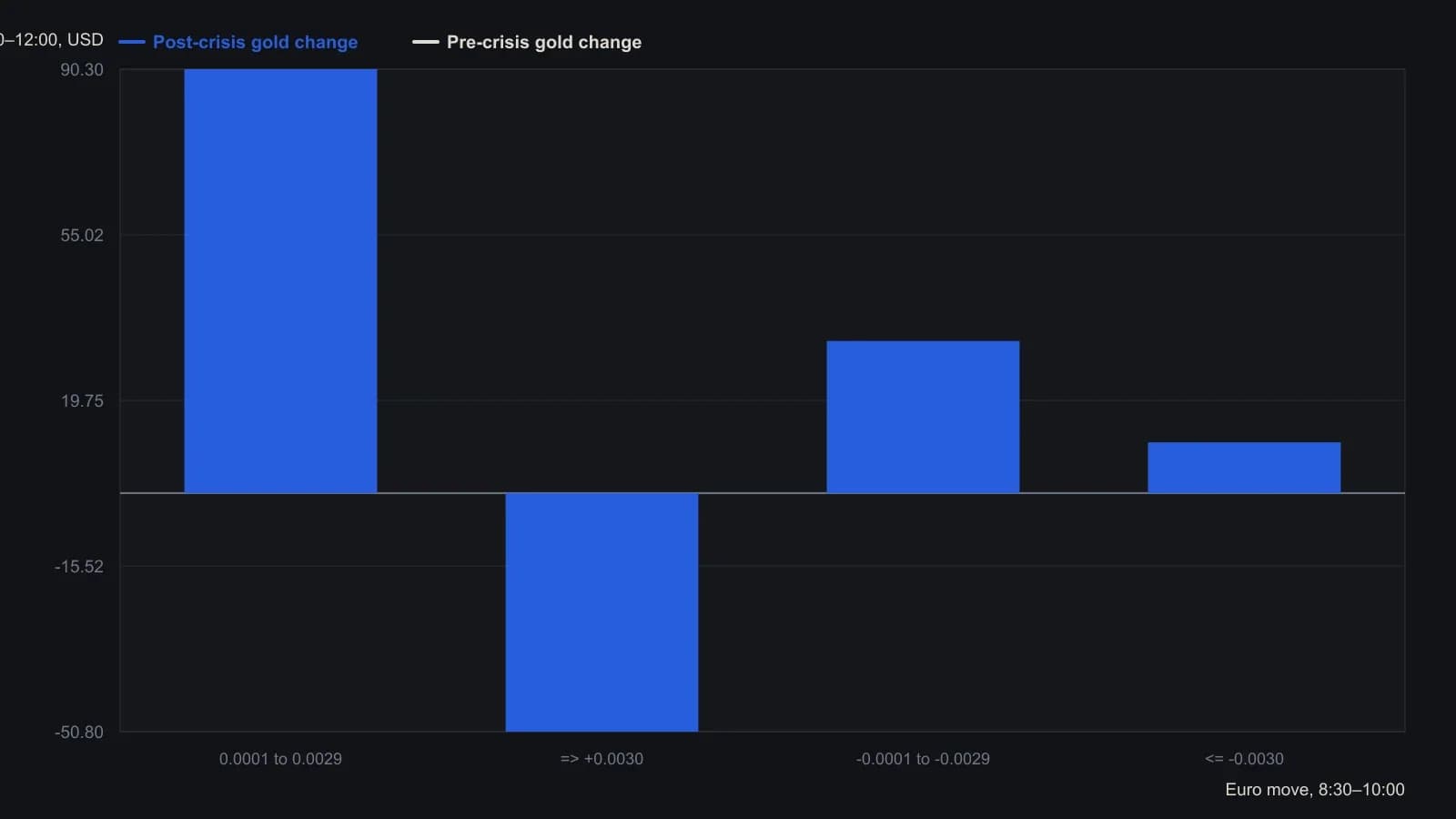
Euro is scored from 8:30 to 10:00; gold is observed from 10:00 to 12:00. The post-crisis sample begins 5 April 2010, when gold overtook the euro, and runs through 31 July 2010 (83 sessions). The author reports post-crisis correlation r = −0.857.
Paper-trade entry, exit, and sit-out together
The procedure withholds capital until the two-variable link is confirmed. An abstention rule is the coded sit-out that withholds a signal until the two-contract link is confirmed, or when the leader move does not map to a defined path.
Paper trading is a no-capital run of the same coded rules against market state and execution constraints. The same entry, exit, and sit-out rules can then be paper-traded as one testable mechanical trading system.
All readings on this track · 24 readings
- 1988Process goals, journals, and pre-trade stress checks
- 1989A written plan before impulse takes command
- 1991Step-through construction of a currency range tactic
- 1999Relocating expiration break-even with a bull debit spread
- 2003Rebuild testable trading rules after a drawdown
- 2005Forex stops, lot count, and reward as one budget
- 2010Predefined rules before discretion in a mechanical trading system
- 2010Evaluating euro-gold intraday lead-lag rules
- 2011How to turn an FDA-calendar sample into a testable bio-runup procedure
- 2012First-hour countertrend entries after broken levels
- 2012Time-box simulation before live decision pressure
- 2013Adding markets without liquidity and emotion rules
- 2013Precommit the exits on leveraged trades
- 2013Check the currency cross, the margin, then the demo fill
- 2014Test entry, exit and abstention as one procedure
- 2015Paper-trade the system you refuse to complicate
- 2015Four-step system vetting before live trading
- 2015Price and volume rules over pattern shortcuts
- 2017Closing a Friday news fade into one entry and exit procedure
- 2019Hype-resistant trading process: paper checks and ruin risk
- 2020Paper trading cannot validate a live decision process
- 2020Tenth-size futures as a small-account ruin filter
- 2020Evaluating systems with paper trading and walk-forward windows
- 2020Sizing protective puts with micro index options