1991issue C011-9
Step-through construction of a currency range tactic
A currency range tactic is finished only when size changes, stop alerts, and abstention can be paper-stepped as one auditable procedure and booked in a declared base currency.
- Encode the range tactic as one mechanical martingale size rule so a tactical sequence of adds, cuts, and stands can be tested instead of a hand-run method.
- Drive coding from two reports: the ordered actions of the current sequence and a ledger of completed sequences kept in base-currency books.
- Use a stop alert at a wider point-spread bound so a loss or exposure limit is flagged before the next step is accepted.
- Paper-test entry, exit, and abstention with a step-through paper run, a commission allowance, and a parameter retune when exchange rates print much smaller than stocks.
Finish the tactic as one mechanical procedure
A range tactic is encoded as one mechanical martingale procedure that adds or reduces size as price moves, because a hand-run method cannot be tested rigorously. The martingale size rule increases or reduces units as price moves while the existing holding remains on the books.
Each bounded run of adds, cuts, and stands under one parameter set is a tactical sequence. The sequence closes on a completed rule outcome, a stop alert, or an operator abort. A point-spread trigger is the chosen up or down increment that authorizes a mechanical size change instead of a new discretionary entry.
Currency exposure was not only a listed future
Before January 1989, United States federal law barred routine foreign-currency deposit accounts, so currency exposure was widely treated as a futures-or-options activity only.
Banks can offer deposit-account transfers, forwards, and interbank options, and some will lend up to eight times the holding. That gives a cash-market path that is not a listed future.
A sideways band blocks an unchanged trend signal
After January 1990 the dollar-mark rate entered a sideways band while official intervention aimed to damp dollar advances, so a prior trend signal could not be reused unchanged.
A volatility plot does not execute the procedure
A moving exchange-rate plot is used to display volatility and to mark statistically high and low zones. That picture locates candidate areas but does not itself execute the procedure.
Code from the sequence report and the ledger
Coding is driven by two required reports: the ordered actions of the current sequence and a ledger of completed sequences that can be compared or summed.
Editorial view: those two reports are the design object. The tactic is not finished when the plot locates a zone. It is finished when the current sequence and the completed ledger can be audited together.
Dollar net of each tactical currency game, May 1989–April 1990
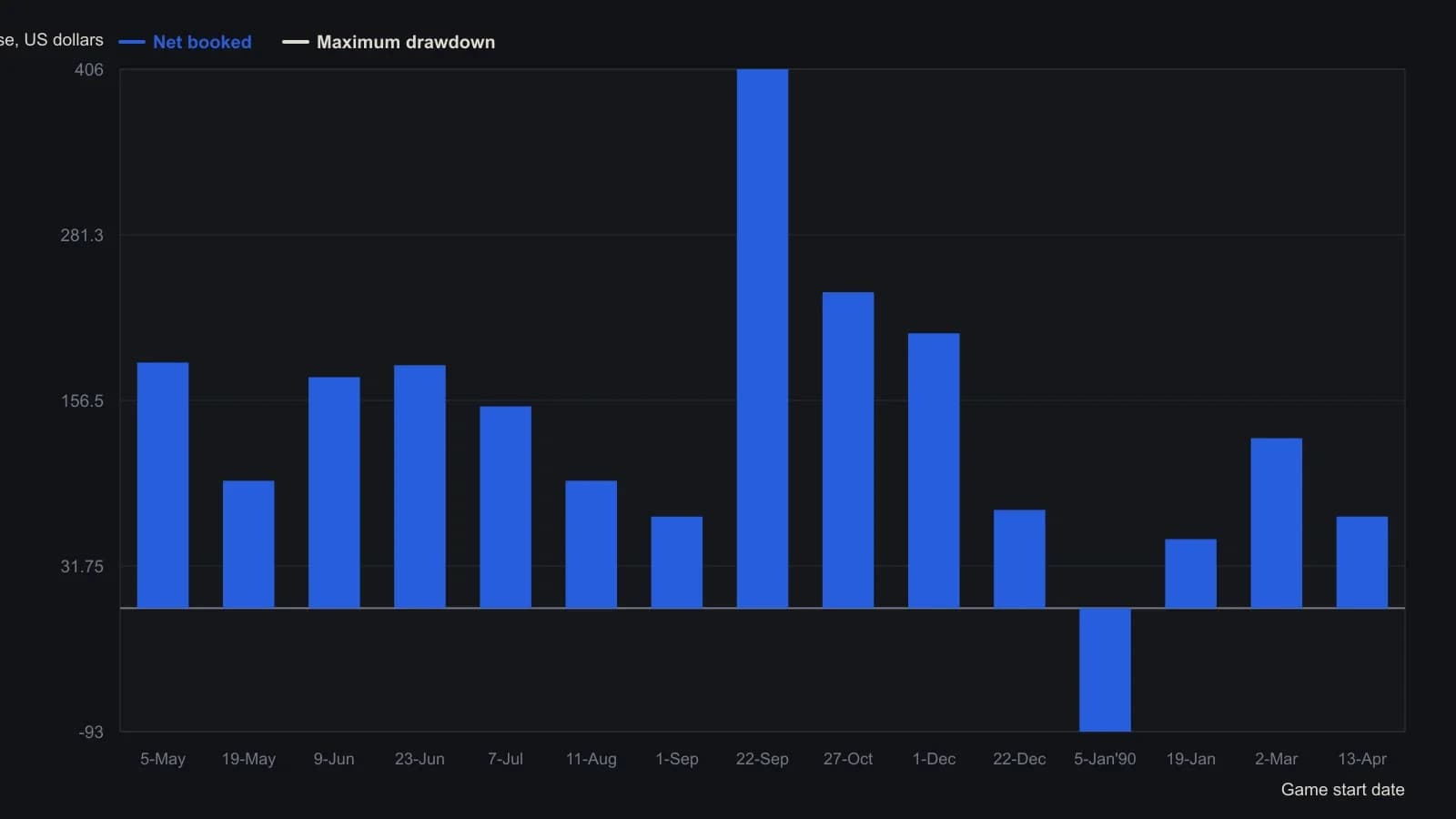
The 35 percent annual net holds only if the mark is shorted and accounting stays in dollars. The run uses one parameter set and a fixed maximum commission rather than a live bank schedule.
Bound the loss before the next step
A stop is a chosen point-spread distance that raises an on-screen stop alert when price travels that far against the position. That wider bound flags a loss or exposure limit so the loss decision is bounded before the next step is accepted.
Retune when exchange rates print small
Exchange rates often print at much smaller numbers than stock prices, so point-spread, unit size, series string, and a fixed commission allowance must be retuned or the design can be handicapped.
A parameter retune resets point spread, unit size, and series string when the instrument prints at a much smaller numerical level than the tactic was first written for. The commission allowance is a conservative fixed cost reserved on each action so a test is not run as if transfers were free.
Paper-test entry, exit, and abstention together
The operator can step one print at a time, continue or abort after seeing the last fill and any stop alert, and chain sequences from the last stored database row.
That step-through paper run advances one printed rate at a time so the operator can accept, stand aside, or abort after seeing the last action and any stop flag. Entry, exit, and abstention become paper-testable as a single procedure.
All readings on this track · 24 readings
- 1988Process goals, journals, and pre-trade stress checks
- 1989A written plan before impulse takes command
- 1991Step-through construction of a currency range tactic
- 1999Relocating expiration break-even with a bull debit spread
- 2003Rebuild testable trading rules after a drawdown
- 2005Forex stops, lot count, and reward as one budget
- 2010Predefined rules before discretion in a mechanical trading system
- 2010Evaluating euro-gold intraday lead-lag rules
- 2011How to turn an FDA-calendar sample into a testable bio-runup procedure
- 2012First-hour countertrend entries after broken levels
- 2012Time-box simulation before live decision pressure
- 2013Adding markets without liquidity and emotion rules
- 2013Precommit the exits on leveraged trades
- 2013Check the currency cross, the margin, then the demo fill
- 2014Test entry, exit and abstention as one procedure
- 2015Paper-trade the system you refuse to complicate
- 2015Four-step system vetting before live trading
- 2015Price and volume rules over pattern shortcuts
- 2017Closing a Friday news fade into one entry and exit procedure
- 2019Hype-resistant trading process: paper checks and ruin risk
- 2020Paper trading cannot validate a live decision process
- 2020Tenth-size futures as a small-account ruin filter
- 2020Evaluating systems with paper trading and walk-forward windows
- 2020Sizing protective puts with micro index options