2013issue C0834-38
Precommit the exits on leveraged trades
Editorial reading: leveraged trading is an exit-first procedure. The historical workflow refuses the fill until the invalidation, the staged peel, and the skip rule are already written, then rehearses that sequence by paper-trading so emotion does not invent a decision after the market moves.
- An early unexplained winning stock trade can create false competence, and the same sequence then gave back most of those gains.
- Risk control is reduced to three pre-entry numbers: dollars at risk, projected reward, and the account fraction that will be exposed.
- If the projected reward does not cover the bounded loss, the setup is skipped.
- Emotion is treated as a missing plan: the if-then sequence is written before any live bar is seen and rehearsed by paper-trading without capital.
An early win can look like skill
An early unexplained winning stock trade can create false competence. The same sequence then gave back most of those gains.
Contract-unit conversions can misstate both open profit and stop risk by a factor of ten. A live-cattle short was read as 100 dollars when the actual result and stop exposure were 1,000 dollars.
Three numbers before the fill
Risk control is reduced to three pre-entry numbers: dollars at risk, projected reward, and the account fraction that will be exposed. Those numbers are then mapped to an entry, a stop if wrong, and a first profit-take if right.
That comparison is risk-versus-reward: the dollars that will be lost if the idea is wrong against the dollars that the planned target could return.
In futures and forex, risk control is order placement and later management of those orders, not spreading capital across many instruments. Attention is kept on a small set of markets.
Margin bounds the market list
Which markets can be traded is bounded by initial, maintenance, and same-session margin versus account size. Day-margin is a reduced margin that applies only when the position is closed before the session ends. Return-on-margin is the share of account capital compared with the exchange margin required to hold a contract.
A common starting cap is committing no more than 20 percent of the account to a market, while 60 percent is treated as aggressive.
Set the loss side first
Leverage speeds both gains and losses, so each setup is screened by a planned risk-versus-reward test, with a stated preference for risking one unit to pursue two.
The loss side is set first from structure or a fixed dollar or percent cap. On a one-two-three-swing bottom, a long after a break of point 2 can be abandoned at the loss of point 3 rather than at point 1, because the higher-low sequence is already broken.
If the projected reward does not cover the bounded loss, the setup is skipped. Accepted trades start with multiple units, one full-size stop, and staged profit-takes along a volatility-and-time projection.
Weekly XLF price, December 2010 to 16 November 2012
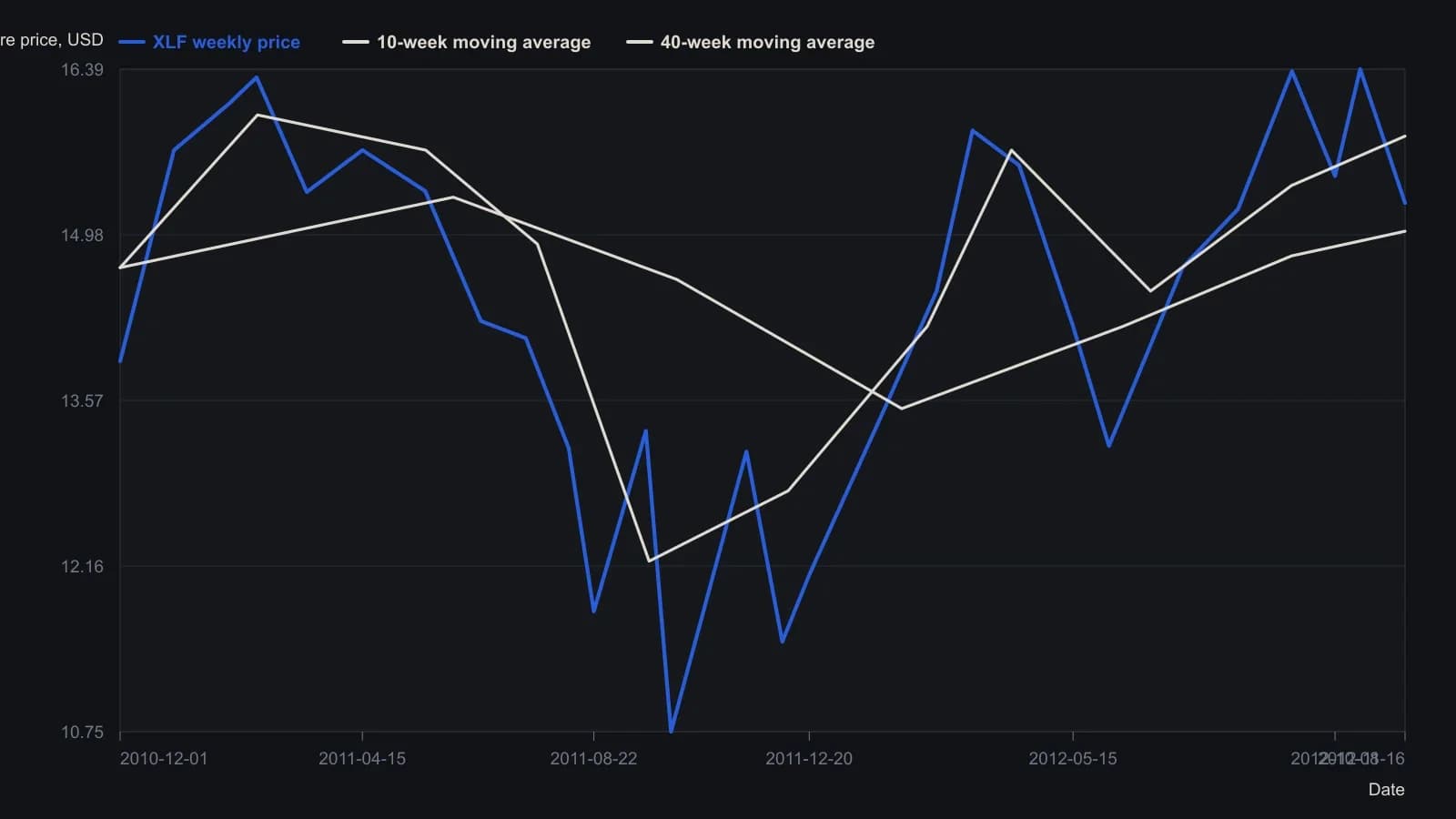
Swing labels keep the three-decimal prices printed on the bars; unlabeled fills are digitized to one decimal from a 0.25 price grid. Dates for those labels are inferred from the monthly axis, not printed. The 10-week and 40-week averages match the MA(10) and MA(40) overlays; only the 16 November 2012 prints (15.82 and 15.01) are exact.
Scale-out leftover exposure
The staged close is a scale-out: pieces of a multi-unit position are closed at successive planned targets instead of exiting all at once.
Leftover risk is kept bounded by advancing and splitting stops behind support or resistance, or along a calculated trailing-stop or parabolic stop-and-reverse path, so one fill need not close the entire remaining position.
Precommitment, then paper-trading
Emotion is treated as a missing plan. Precommitment is writing the if-then responses for profit, loss, and abstention before any live bar is seen.
That sequence is then rehearsed by paper-trading: stepping historical bars forward and placing simulated orders so the full entry-exit-skip sequence can be practiced without capital. Later live decisions already have a practiced response.
All readings on this track · 24 readings
- 1988Process goals, journals, and pre-trade stress checks
- 1989A written plan before impulse takes command
- 1991Step-through construction of a currency range tactic
- 1999Relocating expiration break-even with a bull debit spread
- 2003Rebuild testable trading rules after a drawdown
- 2005Forex stops, lot count, and reward as one budget
- 2010Predefined rules before discretion in a mechanical trading system
- 2010Evaluating euro-gold intraday lead-lag rules
- 2011How to turn an FDA-calendar sample into a testable bio-runup procedure
- 2012First-hour countertrend entries after broken levels
- 2012Time-box simulation before live decision pressure
- 2013Adding markets without liquidity and emotion rules
- 2013Precommit the exits on leveraged trades
- 2013Check the currency cross, the margin, then the demo fill
- 2014Test entry, exit and abstention as one procedure
- 2015Paper-trade the system you refuse to complicate
- 2015Four-step system vetting before live trading
- 2015Price and volume rules over pattern shortcuts
- 2017Closing a Friday news fade into one entry and exit procedure
- 2019Hype-resistant trading process: paper checks and ruin risk
- 2020Paper trading cannot validate a live decision process
- 2020Tenth-size futures as a small-account ruin filter
- 2020Evaluating systems with paper trading and walk-forward windows
- 2020Sizing protective puts with micro index options