2013issue C026-7
Posted tickets hide margin and fill gates
A published equity ticket is only the first implementation-cost filter. Financing on a realistic debit-balance, plus fill-eligibility on any execution-guarantee, decide whether that ticket is even available.
- A late-October 2012 four-venue commission-schedule listed 7.95, 8.95, a 7.99 to 9.99 band, and 9.99, and footnotes said the website schedule was not a complete tariff.
- Only one venue listed a one-second execution-guarantee with an automatic commission rebate, and fill-eligibility limited that rebate to certain market orders, sizes, listings, and regular-session hours.
- Advertised margin-rate quotes on a 500000 debit-balance ranged from 3.75 percent to 7.00 percent across the same venues, and a separate base-margin-rate of 6.575 percent was disclosed as of 12 January 2009.
- Editorial view: treat the broker cost table as a pre-trade rejection tool. If the margin-rate line or the fill-eligibility window fails, the order is not cheap, regardless of the commission-schedule row.
The posted ticket is an incomplete tariff
A four-venue comparison of published online U.S. equity tickets, dated late October 2012, listed 7.95, 8.95, a 7.99 to 9.99 band, and 9.99. Those figures belong to the commission-schedule, the published per-ticket tariff for online equity orders.
Comparison footnotes stated that other pricing could apply from asset level or from combined trading and asset levels, so the published website schedule was not a complete tariff. Implementation-cost is the full bill for getting an order live: posted tickets, financing on borrowed funds, and the conditions that decide whether a rebate or guarantee applies.
Only one of those four venues was marked as offering thirty exchange-traded funds with no commissions and no short-term-trading-fee.
Posted U.S. equity tickets and $500k debit margin rates
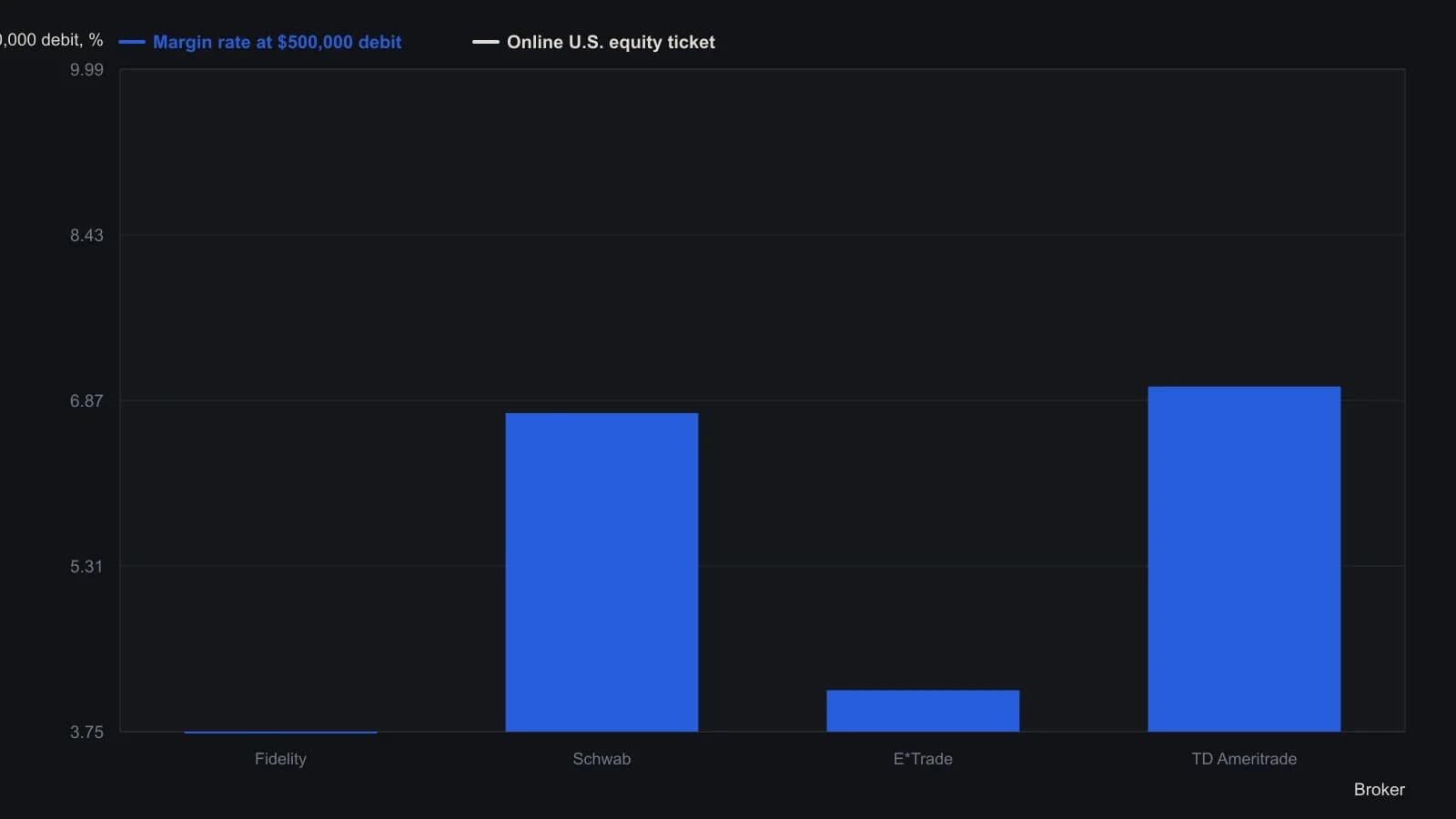
Commissions are published website schedules as of 31 October 2012; E*Trade’s $7.99–$9.99 band is for clients making fewer than 150 trades per quarter. Margin rates are for a $500,000 debit as of 31 October 2012. Fidelity’s one-second rebate applies only to 1–1,000-share S&P 500 market orders entered 9:45 a.m.–3:59 p.m. ET.
Fill-eligibility is narrower than the advertisement
A one-second execution-guarantee tied to an automatic commission rebate was listed for only one of the four venues. An execution-guarantee is a promise to complete an eligible order inside a stated time or rebate the ticket.
That rebate applied only to market orders of 1 to 1000 shares in a specified large-cap index universe, entered between 9:45 a.m. and 3:59 p.m. Eastern time on an open regular session. It excluded short sales, extended-hours orders, directed orders, and certain other types. Fill-eligibility is the order type, size, listing, session window, and routing conditions that decide whether an advertised execution term applies.
Margin-rate quotes do not match one debit
Advertised margin-rate quotes on a 500000 debit-balance as of 31 October 2012 were 3.75 percent, 6.75 percent, 4.14 percent, and 7.00 percent across the same four venues. The margin-rate is the interest charged on a debit-balance when a position is financed with borrowed funds.
The same disclosure set a base-margin-rate of 6.575 percent as of 12 January 2009, separate from the 500000-debit comparison rates. Margin was described as increasing loss risk and creating interest-debt exposure, as not suitable for all investors, and as something to size against financial circumstances and risk tolerance before use.
Keep a risk measure in view
An adjacent editorial argued that staying inside habitual price and indicator routines can crowd out separate risk measures, and urged keeping at least one risk measure in view for the life of a system.
Editorial reading: taken together, that demand to keep risk in view and the cost table's spread of debit-balance financing rates treat exposure as both a pre-trade bound and a priced line item that changes with venue and debit-balance size. The commission-schedule row does not close the filter.
All readings on this track · 25 readings
- 1988When action-seeking replaces the decision process
- 1997Convert a market story into a testable decision process
- 2004Posted margin as the scarce input of an option-income write
- 2004Capping futures leverage to intended share exposure
- 2005Currency execution costs hide in spreads and margin
- 2006Daily margin as a leverage filter
- 2006A commodity sleeve is a contract-design choice
- 2007Bounding futures risk with stops, trails, and margin
- 2010Currency futures versus forex on spread, margin, and micros
- 2010Enforced margin as the real futures trade guarantee
- 2010Choose mini or standard futures before the first fill
- 2012Segregated margin is an incomplete exposure filter
- 2013Posted tickets hide margin and fill gates
- 2013Portfolio margin calls versus pair-hedge leverage locks
- 2015Forex execution checks for fills, margin, and leverage
- 2015Cheaper margin is not a currency leverage edge
- 2015Cheap daytrading margin is not a risk discount
- 2016Futures liquidity filter with equal-dollar size and effective margin
- 2016Cap futures leverage before margin turns into debt
- 2016Gold option income as a margin-sizing problem
- 2017Electronic matching changed what a futures account could carry
- 2018Broker margin-upcharges can force an option-income exit
- 2019Inspect execution cost and margin bounds before cycle timing
- 2020Treat automatic futures gearing as a pre-entry filter
- 2020Equal-dollar futures liquidity and an effective margin screen