2015issue C1141
Cheap daytrading margin is not a risk discount
Daytrading margin is broker-set collateral for a same-session futures trade, not a cheaper version of overnight risk. Lower access can raise contract count, leave a thinner cushion, and bring forced liquidation closer when volatility jumps.
- Daytrading margin is set by the brokerage, not by the exchange overnight minimum, and it can be revised at any time.
- Raising the requirement when volatility jumps is leverage-control and margin-management: more capital per contract so a loss cannot scale as freely.
- Very low daytrading margin can encourage higher trade volume, while a nearby liquidation line can force an exit after only a small equity drop.
- A cheap requirement can deplete an account when the E-mini S&P makes a fast, multi-handle move against the position.
Daytrading margin is a broker setting
Daytrading margin is the collateral a brokerage requires to open a futures position that is expected to be closed before the same session ends. Overnight margin is the exchange-declared minimum for a position held past the session close. For futures, daytrading margin is set by the brokerage. It is not set by the exchange overnight minimum.
At the time of writing, exchange overnight margin for one E-mini S&P 500 contract was $5,060. Some brokers offered daytrading access at 50% ($2,530), 25% ($1,265), or a flat $500.
E-mini S&P 500 margin: overnight versus daytrading access
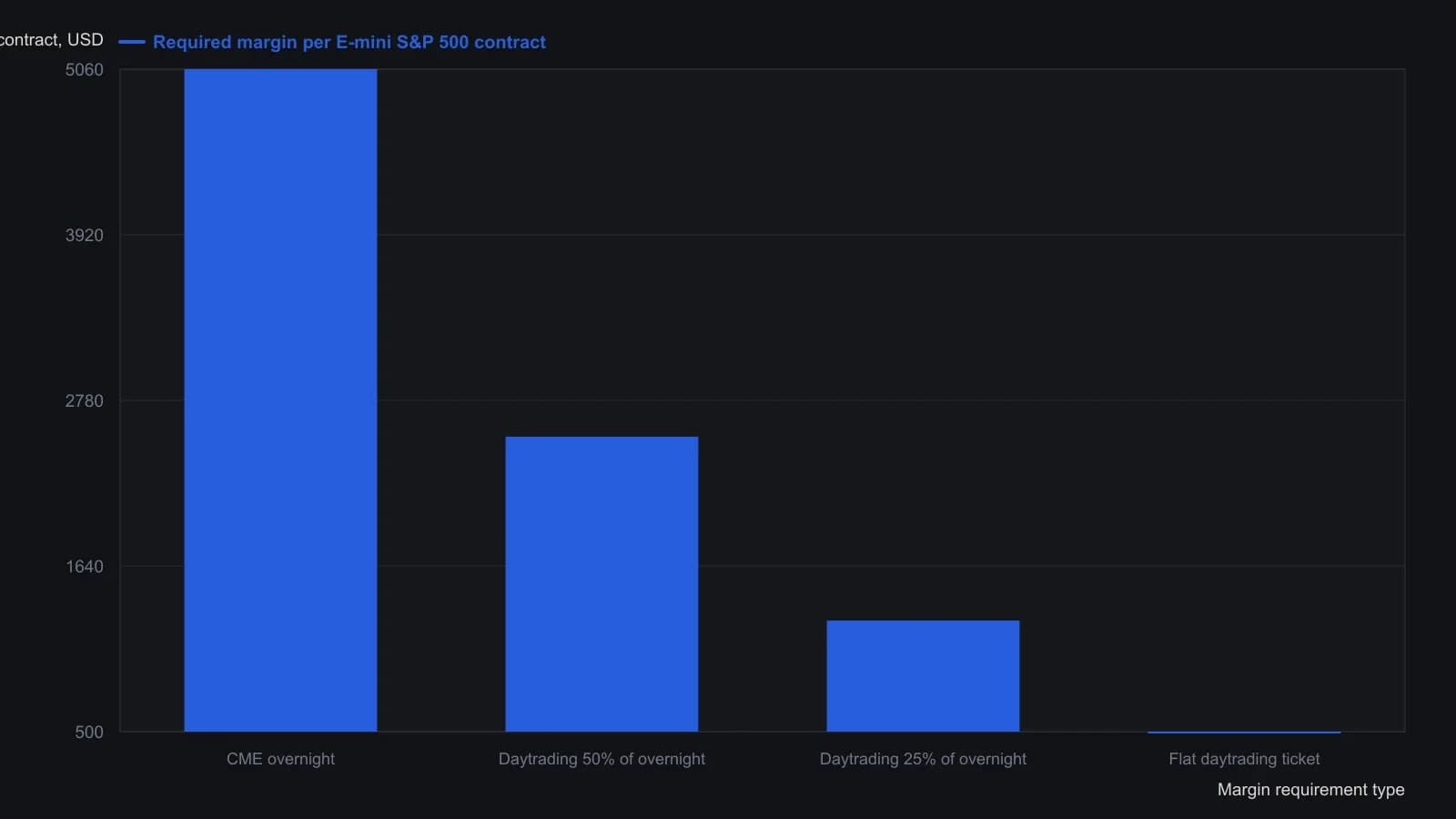
Figures are as of the November 2015 column. The $500 rate is a common flat daytrading ticket the author cites, not a CME overnight minimum. Forced-liquidation example ($400 per open contract) is a separate broker rule and is not plotted.
Volume, stress, and a moving requirement
Very low daytrading margin can encourage higher trade volume, which increases brokerage commission income. Futures traders can lose more than the cash on deposit, so the brokerage also carries risk on each client trade.
An account that has been exhausted no longer produces commission. That gives a firm a reason to restrain client leverage during stress.
During the August 2015 flash crash, some firms raised daytrading margin to match higher volatility. Daytrading margin can be revised at any time, so a firm that has not yet raised it may still do so.
A cheap ticket can meet a fast exit
Some low-margin firms may force-exit quickly. One described policy allowed $500 to enter but liquidated if the balance fell below $400 per open contract. Forced liquidation is a broker-initiated market exit when account equity falls through an internal threshold.
A $500 daytrading requirement in an E-mini S&P market moving 10 to 20 handles in a short interval can deplete an account if the position is on the wrong side of the move. Handle is used here as an informal futures increment for a large, fast price swing.
All readings on this track · 25 readings
- 1988When action-seeking replaces the decision process
- 1997Convert a market story into a testable decision process
- 2004Posted margin as the scarce input of an option-income write
- 2004Capping futures leverage to intended share exposure
- 2005Currency execution costs hide in spreads and margin
- 2006Daily margin as a leverage filter
- 2006A commodity sleeve is a contract-design choice
- 2007Bounding futures risk with stops, trails, and margin
- 2010Currency futures versus forex on spread, margin, and micros
- 2010Enforced margin as the real futures trade guarantee
- 2010Choose mini or standard futures before the first fill
- 2012Segregated margin is an incomplete exposure filter
- 2013Posted tickets hide margin and fill gates
- 2013Portfolio margin calls versus pair-hedge leverage locks
- 2015Forex execution checks for fills, margin, and leverage
- 2015Cheaper margin is not a currency leverage edge
- 2015Cheap daytrading margin is not a risk discount
- 2016Futures liquidity filter with equal-dollar size and effective margin
- 2016Cap futures leverage before margin turns into debt
- 2016Gold option income as a margin-sizing problem
- 2017Electronic matching changed what a futures account could carry
- 2018Broker margin-upcharges can force an option-income exit
- 2019Inspect execution cost and margin bounds before cycle timing
- 2020Treat automatic futures gearing as a pre-entry filter
- 2020Equal-dollar futures liquidity and an effective margin screen