2020issue C0356
Treat automatic futures gearing as a pre-entry filter
A posted futures deposit can control a much larger notional-exposure, so ordinary session moves show up as large percentage swings in the account. The editorial reading is to convert trading-margin into the share of equity a routine move can consume, and to keep that bound in force while the position is open.
- Percentage results on a futures position are calculated on the posted deposit, not on the full contract value that actually moves.
- A routine single-session move against a small trading-margin can consume a large share of equity, including when the decline is measured from a recent peak.
- Automatic-futures-gearing is granted without a loan or interest charge, which is why unused notional capacity is easy to mistake for free buying power.
- TradersWeek editorial reading: convert posted margin into an equity-share bound before entry, and keep that bound in force for as long as the position is open.
Percentage results sit on the deposit
Financial leverage means a small posted sum can control a much larger exposure, so percentage outcomes are measured against the deposit rather than full contract value. Trading-margin is a good-faith deposit required to open and hold a futures position rather than a purchase of the full notional-exposure.
In a purchase made with 10 percent down, a 10 percent rise or fall in the asset can produce a 100 percent gain or 100 percent loss of the posted principal.
A crude-oil posting against contract value
A crude-oil futures illustration posted $4,125 against about $60,000 of contract value, described as a 6.875 percent good-faith deposit. In that illustration, a move from $60 to $65 per barrel produced about $5,000, equal to a 120 percent change in the posted deposit.
The same illustration showed a close near $59 producing about a $1,000 loss, or 24 percent of starting capital, and about 65 percent if measured from an earlier session high. That second reading is a high-watermark-drawdown: the decline in account value measured from a recent peak rather than from the original posted deposit.
Deposit-relative results in the January 2020 crude example
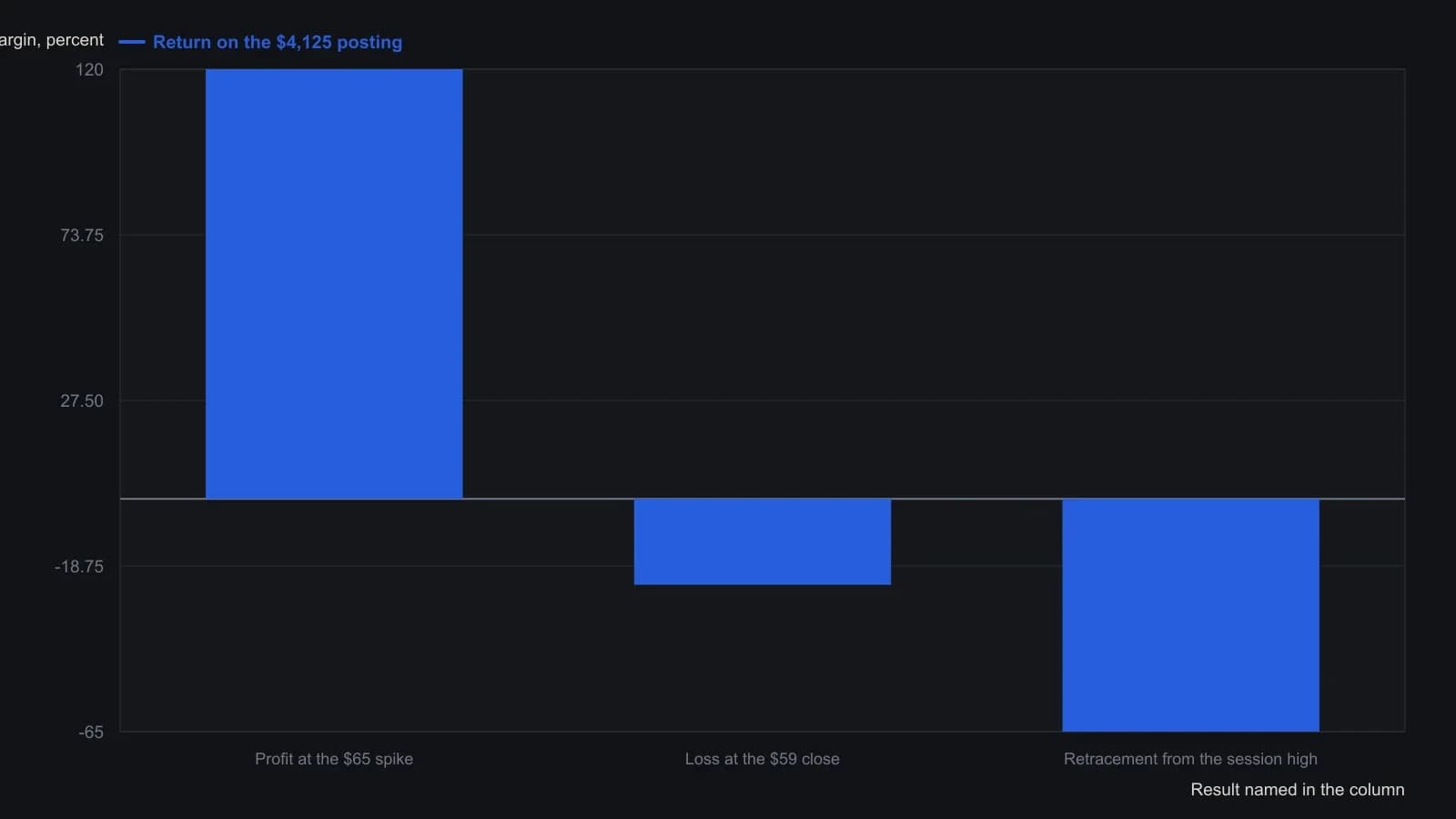
The $60, $65 and $59 levels are the column’s near/toward figures, not exchange settlement prints. The 65 percent loss is measured from the account high watermark set at the $65 spike, not from the $60 entry.
Gearing arrives without a loan
Futures gearing is typically granted automatically by the exchange without an interest charge, while equity leverage usually requires a stock-margin-loan, interest, and is often limited to larger accounts. Automatic-futures-gearing is the exchange-granted ability to control full contract value without borrowing cash or paying interest.
Large position-value swings on relatively small posted capital can produce outsized account-balance volatility and can impair subsequent decision quality.
A filter before entry and while open
Leverage-control is a pre-entry and in-trade filter that keeps loss or exposure bounded relative to account equity. Margin-management is the practice of sizing and maintaining the posted deposit so that ordinary price movement cannot consume a disproportionate share of equity.
TradersWeek editorial reading: those two filters belong on the order before it is sent, and they stay in force for as long as the position is open. The archive illustration shows the historical deposit-and-move arithmetic. It does not prescribe a present-day size.
All readings on this track · 25 readings
- 1988When action-seeking replaces the decision process
- 1997Convert a market story into a testable decision process
- 2004Posted margin as the scarce input of an option-income write
- 2004Capping futures leverage to intended share exposure
- 2005Currency execution costs hide in spreads and margin
- 2006Daily margin as a leverage filter
- 2006A commodity sleeve is a contract-design choice
- 2007Bounding futures risk with stops, trails, and margin
- 2010Currency futures versus forex on spread, margin, and micros
- 2010Enforced margin as the real futures trade guarantee
- 2010Choose mini or standard futures before the first fill
- 2012Segregated margin is an incomplete exposure filter
- 2013Posted tickets hide margin and fill gates
- 2013Portfolio margin calls versus pair-hedge leverage locks
- 2015Forex execution checks for fills, margin, and leverage
- 2015Cheaper margin is not a currency leverage edge
- 2015Cheap daytrading margin is not a risk discount
- 2016Futures liquidity filter with equal-dollar size and effective margin
- 2016Cap futures leverage before margin turns into debt
- 2016Gold option income as a margin-sizing problem
- 2017Electronic matching changed what a futures account could carry
- 2018Broker margin-upcharges can force an option-income exit
- 2019Inspect execution cost and margin bounds before cycle timing
- 2020Treat automatic futures gearing as a pre-entry filter
- 2020Equal-dollar futures liquidity and an effective margin screen