2004issue C031-3
Posted margin as the scarce input of an option-income write
A 2003 snapshot held December expiration and out-of-the-money distance fixed, then compared a cash-index write and a futures-option write by how much initial margin each posted per dollar of credit. This article uses that ratio as a margin-management filter on an option-income strategy.
- Posted margin, not the credit alone, is the scarce input that decides how many bounded option-income writes fit in the account.
- On 25 September 2003, a 10% out-of-the-money cash-index December 550 short call posted $5.95 of exchange-minimum margin per dollar of credit; a matching-distance futures-option December 1100 short call posted $4.64 under SPAN margin.
- A cash-index December 550/560 call credit spread moved that ratio only to $5.00 while collecting 52% less premium; a matching-distance futures-option credit spread moved it to $2.48.
- Editorial: keep the short-call rule fixed and accept a defined-risk overlay or a different listing venue only when that venue's margin engine changes credit per unit of capital enough to change how many bounded trades the account can hold.
What the snapshot held fixed
The 2003 snapshot compared two option-income procedures at the same December expiration and the same percentage distance from the money: a naked out-of-the-money call and a call credit spread. Inputs were settlement prices from 25 September 2003 with 84 days remaining. Volatility was not treated as a separate adjustment because the two equity-index underlyings were taken to share similar volatility patterns.
The option-income strategy is the testable short-premium procedure that specifies strike distance, expiration, entry, exit, and stand-aside conditions for collecting a credit over one holding period. Margin management is the pre-trade and in-trade filter that bounds exposure from account equity, volatility, remaining life, and stop or strike-width distance before a write is sized.
Naked out-of-the-money calls
Margin per dollar of premium is initial posted margin divided by cash credit received. Premium as a share of margin is the inverse score: collected credit divided by initial margin. Those two ratios are how this snapshot compares how much capital a write ties up per unit of income.
For a 10% out-of-the-money cash-index short December 550 call, exchange-minimum cash-index margin after the out-of-the-money offset was $2,500 against $420 of premium, or $5.95 of posted margin per dollar of credit (16.8% premium as a share of margin). Exchange-minimum cash-index margin is a percentage-of-underlying formula reduced by the out-of-the-money amount.
Futures-option premium was restated to a fair-value futures level so a matching 10% out-of-the-money December 1100 short call could be compared. SPAN initial cash requirement was $7,425 against $1,600 of adjusted premium, or $4.64 of posted margin per dollar of credit (21.5% premium as a share of margin).
Scaling those uncovered-call premium-to-margin ratios to $100,000 of notional margin produced $16,800 of credit in the cash-index case and $21,500 in the futures-option case.
Margin engines, not exercise style
Both listings were American-style, so early-exercise rights were not the stated cause of the margin gap. The futures-option requirement used a SPAN margin engine that takes volatility, remaining life, and moneyness as inputs rather than a single percentage of notional. The cash-index uncovered write used the exchange-minimum cash-index formula.
The same distance as a call credit spread
A call credit spread is a net-short call that buys a farther out-of-the-money call so maximum loss equals strike width minus net credit. The cash-index December 550/560 call credit spread collected $200 net against $1,000 of strike-width margin, or $5.00 of margin per dollar of credit (20.0%). That is only a small change from the $5.95 uncovered-call figure, while collecting 52% less premium.
A matching-distance futures-option credit spread collected $600 net against $1,491 of SPAN initial margin, or $2.48 of margin per dollar of credit (40.2%). Scaling those credit-spread premium-to-margin ratios to $100,000 of notional margin produced $20,000 of credit in the cash-index case and $40,240 in the futures-option case.
How the filter reads the two overlays
Editorial: the cash-index overlay left margin per dollar of premium almost unchanged and collected much less credit, so it does not, on this snapshot, change how many bounded writes fit once capital is the scarce input. The futures-option listing already posted less margin per dollar of credit on the naked write, and the matching credit spread moved that ratio again.
Editorial: the short-call rule stays the object under test. A change of listing venue or a defined-risk overlay is accepted only when that venue's margin engine changes credit collected per unit of capital enough to alter how many bounded trades the account can hold. The snapshot ranks those capital-use differences. It does not rank later profitability.
Margin posted per dollar of credit, matched December 2003 writes
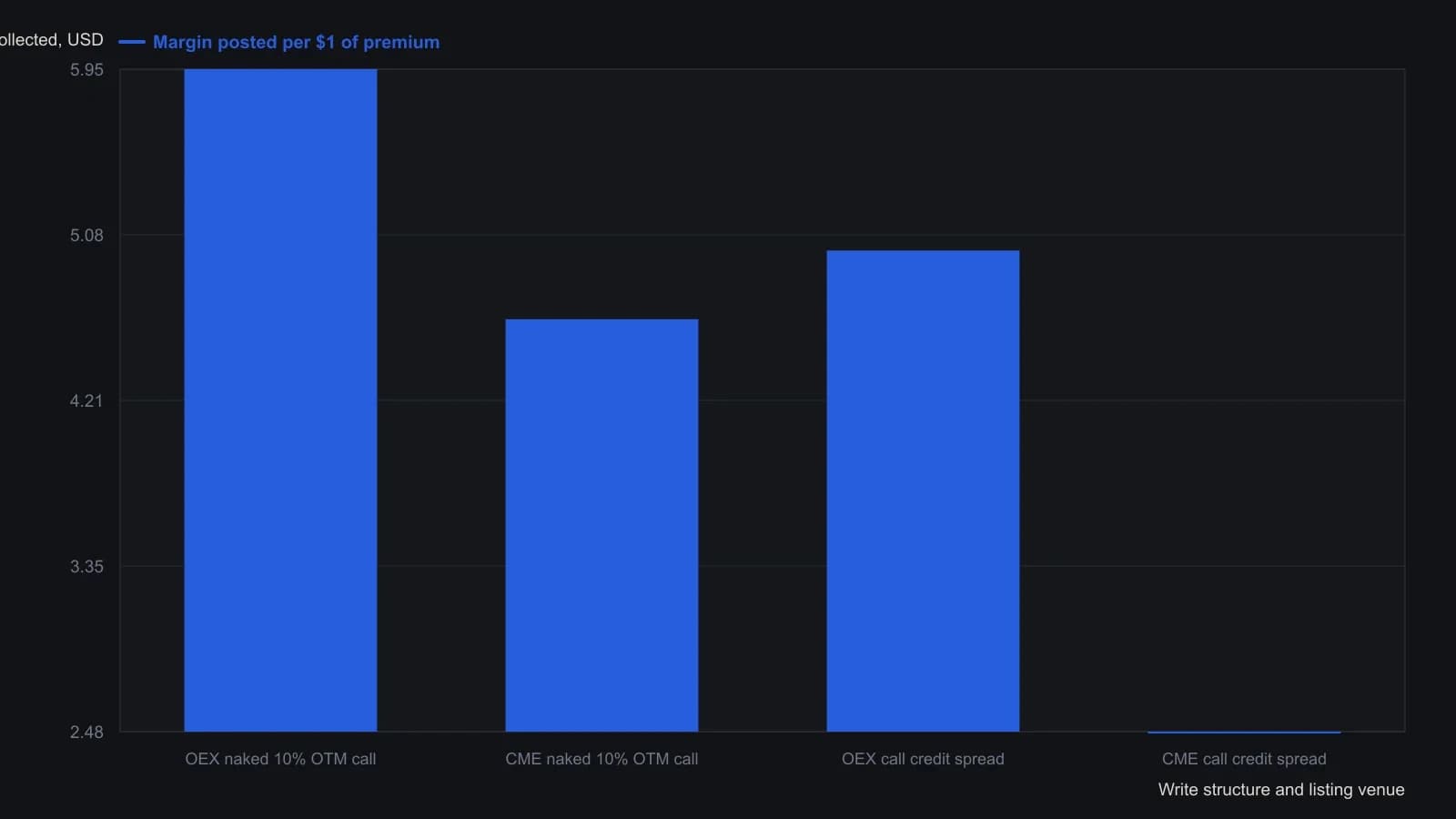
Expiration month and 10% out-of-the-money distance were held fixed. CME premiums were restated to an S&P 500 futures fair value of 1001.46 because the futures closed below cash. SPAN initial margin was generated in OptionVue 5. OEX posted margin is the $2,500 exchange minimum after the out-of-the-money subtraction, excluding the premium credit.
All readings on this track · 25 readings
- 1988When action-seeking replaces the decision process
- 1997Convert a market story into a testable decision process
- 2004Posted margin as the scarce input of an option-income write
- 2004Capping futures leverage to intended share exposure
- 2005Currency execution costs hide in spreads and margin
- 2006Daily margin as a leverage filter
- 2006A commodity sleeve is a contract-design choice
- 2007Bounding futures risk with stops, trails, and margin
- 2010Currency futures versus forex on spread, margin, and micros
- 2010Enforced margin as the real futures trade guarantee
- 2010Choose mini or standard futures before the first fill
- 2012Segregated margin is an incomplete exposure filter
- 2013Posted tickets hide margin and fill gates
- 2013Portfolio margin calls versus pair-hedge leverage locks
- 2015Forex execution checks for fills, margin, and leverage
- 2015Cheaper margin is not a currency leverage edge
- 2015Cheap daytrading margin is not a risk discount
- 2016Futures liquidity filter with equal-dollar size and effective margin
- 2016Cap futures leverage before margin turns into debt
- 2016Gold option income as a margin-sizing problem
- 2017Electronic matching changed what a futures account could carry
- 2018Broker margin-upcharges can force an option-income exit
- 2019Inspect execution cost and margin bounds before cycle timing
- 2020Treat automatic futures gearing as a pre-entry filter
- 2020Equal-dollar futures liquidity and an effective margin screen