2020issue C1158
Equal-dollar futures liquidity and an effective margin screen
A 2020 listed-futures workflow scales each contract to the same three-year dollar range, ranks residual liquidity from that count, open interest, and a volume factor, then places listed percent margin beside effective percent margin.
- An equal-dollar contract count scales each listed market to the same three-year dollar range, so a one-lot position is not a common economic size across markets.
- Relative contract liquidity multiplies that count by total open interest and a volume factor. Contracts with one activity mark or none are treated as thinly traded and less executable for speculative use.
- Effective percent margin divides dollar margin by the same three-year dollar range. Listed percent margin and effective percent margin need not move together.
- Each constructed column is a proportional measure and is comparable only to other values in the same column.
What the 2020 workflow constructs
The archive workflow builds three proportional columns for listed futures instead of treating a one-lot order as a shared economic size.
Equal-dollar contract counts, relative contract liquidity, and effective percent margin are constructed from the same three-year dollar range. Futures contract selection then compares equal-dollar lot counts and relative liquidity rather than one-lot convenience.
Equal-dollar contract counts
An equal-dollar contract count is constructed as tick dollar value times the three-year maximum price excursion, so each listed market is scaled to the same historical dollar range.
That count is the number of contracts of one futures market needed to match another market’s three-year maximum dollar excursion. In the 2020 snapshot the counts run from 1 for the December Ultra T-Bond to 50 for December corn, so a one-lot position is not a common economic size across markets.
Relative contract liquidity
A futures liquidity rank can be constructed by multiplying contract point value, a three-year maximum price motion, open interest, and a volume adjustment usually between 1 and 4.
Relative contract liquidity is the equal-dollar contract count times total open interest times a volume factor. The volume factor is the greater of 1 or the exponential of the natural log of volume divided by the natural log of 5000, minus 2.
The liquidity filter is a pre-trade screen that ranks or rejects a listed futures contract by how easily its book can be entered and exited, using activity marks, open interest, and a volume adjustment. Contracts showing one activity mark or none are treated as thinly traded and therefore less executable for speculative use.
Effective percent margin beside listed percent margin
Effective percent margin is constructed by dividing dollar margin by the three-year dollar price range of the contract and multiplying by 100.
Percent margin is exchange margin as a share of contract value, kept beside effective percent margin so deposit size is not read in isolation. Margin management bounds capital before entry by reading those two figures together, with effective percent margin scaled to the contract’s own multi-year dollar range.
Listed percent margin and effective percent margin need not move together. The December 2020 S&P 500 E-Mini shows 8 versus 23.3, while November 2020 WTI crude shows 15.2 versus 7.6.
Compare only inside a column
Each constructed column is a proportional measure and is only comparable to other values in the same column.
Listed versus effective percent margin, November 2020 futures
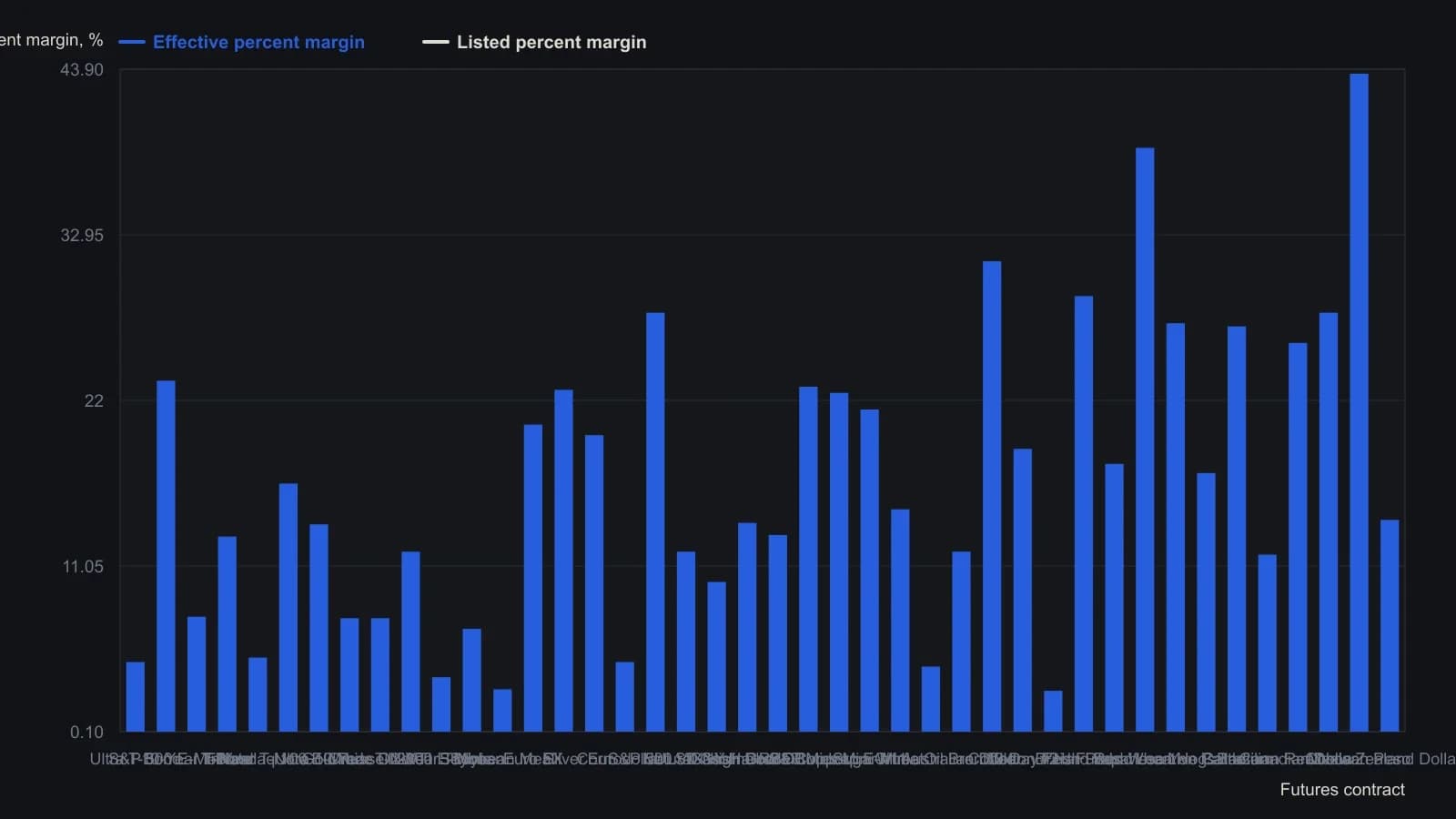
Effective percent margin is margin dollars divided by the three-year dollar range of the contract, times 100. The source ranks rows by residual liquidity and states that each column is meaningful only against other rows in that column. Contract counts and the dot liquidity rank are omitted here because they are different units.
All readings on this track · 25 readings
- 1988When action-seeking replaces the decision process
- 1997Convert a market story into a testable decision process
- 2004Posted margin as the scarce input of an option-income write
- 2004Capping futures leverage to intended share exposure
- 2005Currency execution costs hide in spreads and margin
- 2006Daily margin as a leverage filter
- 2006A commodity sleeve is a contract-design choice
- 2007Bounding futures risk with stops, trails, and margin
- 2010Currency futures versus forex on spread, margin, and micros
- 2010Enforced margin as the real futures trade guarantee
- 2010Choose mini or standard futures before the first fill
- 2012Segregated margin is an incomplete exposure filter
- 2013Posted tickets hide margin and fill gates
- 2013Portfolio margin calls versus pair-hedge leverage locks
- 2015Forex execution checks for fills, margin, and leverage
- 2015Cheaper margin is not a currency leverage edge
- 2015Cheap daytrading margin is not a risk discount
- 2016Futures liquidity filter with equal-dollar size and effective margin
- 2016Cap futures leverage before margin turns into debt
- 2016Gold option income as a margin-sizing problem
- 2017Electronic matching changed what a futures account could carry
- 2018Broker margin-upcharges can force an option-income exit
- 2019Inspect execution cost and margin bounds before cycle timing
- 2020Treat automatic futures gearing as a pre-entry filter
- 2020Equal-dollar futures liquidity and an effective margin screen