1991issue C091-6
Parameter windows for averages, option overlays and time stops
A simple moving-average length was treated as the lookback that marks which past prices remain relevant and which have dropped out of the decision set. The same windows governed a short-option overlay and a stop-and-reverse when a low still inside the window failed.
- A simple moving-average length was treated as the lookback that keeps some prices in the decision set and drops older highs and lows once they leave the window.
- A short-option overlay sold a call and a put at different strikes only inside the same parameter horizon, with the directional system assigned to cover the short call if price ran.
- A buy at a 20-day Eurodollar low used a stop-and-reverse so failure of that low became a bounded loss rather than an open hold.
- A roll-off check inspected the oldest value about to leave a simple average, especially after a range lasted longer than the 20-day parameter.
Editorial reading of the parameter window
Editorial interpretation: treat every entry and exit parameter as a memory license. The moving-average length decides which prices may still count. An option-income overlay may sell only what that same horizon can cover. A failed level inside the window must force a time-bounded reverse instead of an open-ended hold.
The archive facts below describe only the historical workflow. They do not themselves use the memory-license wording.
The average length as a lookback
A simple moving-average length was treated as the lookback that marks which past prices remain relevant and which have dropped out of the decision set.
In the terminology used here, a moving-average is a rolling mean of ordered prices whose length is both a trend filter and the lookback that drops older highs and lows from the decision set. The lookback window is the span of observations still inside the chosen average. Prices older than this span are treated as no longer operative references.
Thirteen-week and forty-week equity references
A 13-week average and a 40-week average on a cash equity index were used as trending references. The 40-week span, not multi-year levels, was treated as the bound that kept a 360 resistance and a later 320 support operative.
A 13-week window was applied the same way. A breakout reference near day 259 was the 280 high still inside that quarter, not nearby older highs that had already left the window.
A short-option overlay inside the same horizon
An option-income strategy, in this usage, is a short-option overlay such as a strangle with different call and put strikes. It is placed only when the same parameter horizon implies the short strike can be covered if price breaks.
A short-option income overlay sold a call and a put at different strikes inside a 35-day average horizon. The next 17-day half-window was expected to reach recent highs. The directional system was assigned to cover the short call if price ran.
In-sample lows were not treated as strength
In late May, March bond lows outside the 35-day window were treated as non-reference prices. May lows still inside the window were not assumed to be strong merely because they remained in sample.
S&P 500 cash with 13-week and 40-week averages
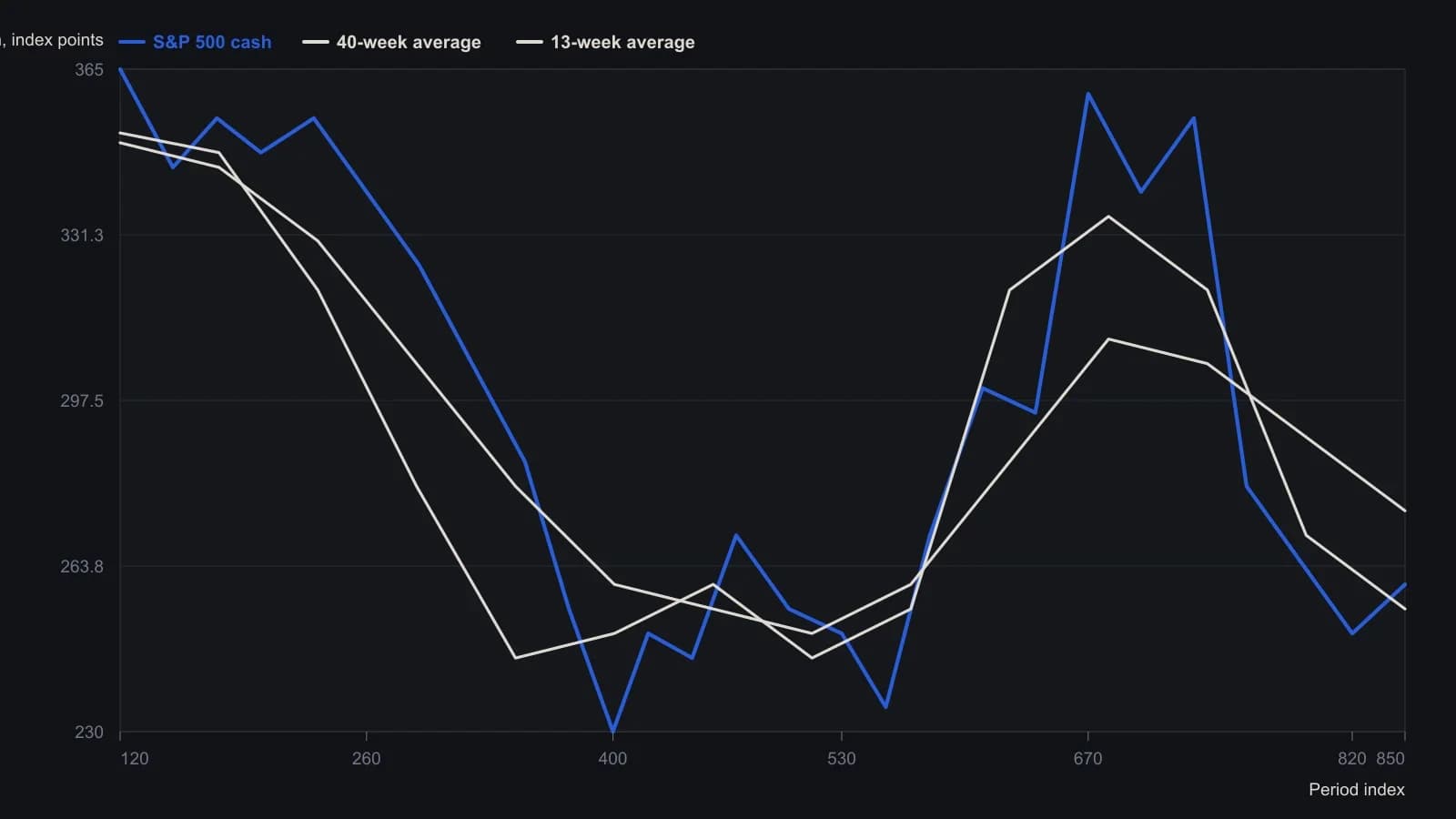
Raster is a 180-degree scan of a weekly close plot; points are approximate weekly closes and moving-average levels, not official index prints. Horizontal axis uses the figure's own period index (~116 to ~851).
A time-stop when a window low fails
A time-stop is a precommitted exit or reverse when a high or low still inside the current parameter window fails, so the loss is bounded before the trade is held further.
Eurodollar parameters of 12 days and 20 days defined the range-trading horizon. A buy at the 20-day low used a stop-and-reverse so failure of that low became a bounded loss rather than an open hold.
A roll-off check before the window advances
A roll-off check inspects the oldest value about to leave a simple average to judge whether an imminent signal will be cancelled as the window advances.
Inspecting values about to roll out of a simple average was used to judge whether an imminent signal would be cancelled as the window advanced, especially once a range lasted longer than the 20-day parameter.
Windows as market-specific memory lengths
The same windows were treated as market-specific memory lengths rather than fixed constants. One bond episode showed a January low older than 35 days still being tested.
All readings on this track · 15 readings
- 1989Preflight checklist, time-stops, and stand-aside rules
- 1991Parameter windows for averages, option overlays and time stops
- 1995Three setup gates and a session-count clock complete a long bottom
- 1995Evaluating index futures OHLC reversals with RSI and time stops
- 1995A weekly two-close breakout and an eight-week time stop
- 2000Constructing breakout entry rules and time stops
- 2004Constructing action-reaction swing targets and time stops
- 2005Constructing breakout entries with trailing and time stops
- 2006Evaluating a restrictive range entry with a timed exit
- 2008Evaluating point-and-figure column breaks with time stops
- 2011Intraday gold swing with a daily entry limit, a time-stop, and a fixed stop-loss
- 2012Last-hour entries with a book-level loss bound and a next-open time stop
- 2015Precommit stop-loss, trailing-stop, and time-stop rules before entry
- 2018Auditing rank-rotation tests for time-stop and slot rules
- 2019Confirmation-first pyramiding with price and time stops