2006issue C101-3
Evaluating a restrictive range entry with a timed exit
A historical workflow treated a quiet regular session in e-mini NASDAQ 100 futures as one mechanical procedure. A long was allowed only after eight consecutive restricted bars and was closed by a 60-minute time stop, including leftover minutes after the 4:15 p.m. close. Evaluation kept that same one-hour hold and grouped the trades by slope split, session window, and a longer dormant screen.
- A restricted bar was a 15-minute interval whose open-to-close change stayed inside 2.00 index points, a band equated with a monetary change under $40, with wick extremes ignored.
- The rule-based entry bought only at the close of eight consecutive restricted bars, a 120-minute compression sequence, with no discretionary delay after the count was filled.
- The time stop closed the long after 60 minutes of subsequent trading, and a session-boundary hold finished leftover minutes after the next 8:30 a.m. open.
- The same 60-minute longs were scored by slope split, by four session entry windows, and against a twelve-bar quiet screen, not as an all-session hold.
The procedure under review
The mechanical trading system applied a restricted-bar count, a long-only entry, and a timed exit together so entry, exit, and abstention could be scored as one procedure. The study window was the regular 8:30 a.m. to 4:15 p.m. session in e-mini NASDAQ 100 futures, read as 15-minute bars.
What counted as a restricted bar
A bar counted as restricted when its open-to-close difference stayed inside 2.00 index points. That band was equated with a monetary change under $40. Wick extremes were excluded from that test.
The compression sequence was eight consecutive restricted bars, equal to 120 minutes of regular-session trading. That sequence was required before any entry.
When a long was allowed
The rule-based entry permitted a long only at the close of a completed eight-bar compression sequence. There was no discretionary delay after the count was filled. The mechanical entry bought at the close of the eighth bar.
How the time stop closed the trade
The exit was a time stop. The long was closed after 60 minutes of subsequent trading, equal to four 15-minute bars. That mandatory close bounded how long the long could remain open, including across the session boundary.
A long still open at the 4:15 p.m. close was carried so leftover minutes plus the next 8:30 a.m. open completed the same 60-minute hold.
How the same hold was scored
Evaluation grouped the same long-after-compression trades by the net slope of the eight-bar run: up, down, or no movement. Runs whose net change exceeded 4.00 index points were isolated separately.
A longer quiet-bar screen of twelve consecutive 15-minute bars, or 180 minutes, was compared with the eight-bar rule to test whether a longer dormant stretch changed the subsequent one-hour result.
Outcomes were also scored by the clock time of the long entry in four session blocks: 08:30 to 10:00, 10:00 to 12:00, 12:00 to 14:00, and 14:00 to 16:00.
Across 156 examined sessions, the eight-bar restriction condition produced 96 candidate entries. Those entries were scored as a 60-minute long rather than as an all-session hold.
Average 60-minute NQ profit by entry window
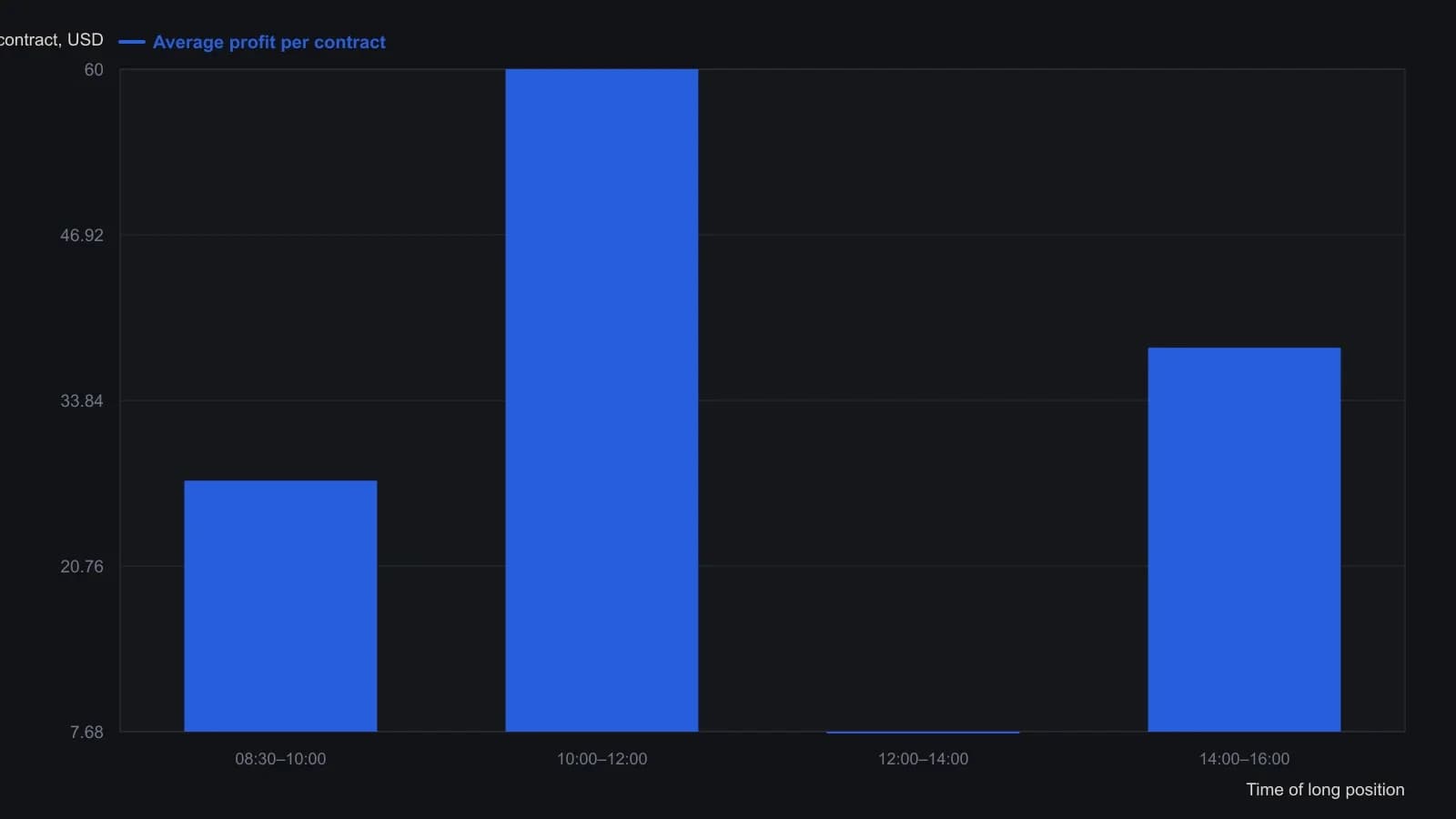
Ninety-six 120-60 longs over 156 regular sessions (8:30 a.m.–4:15 p.m. ET), 18 October 2005–26 May 2006. Each long is closed after 60 minutes, including leftover minutes after the 4:15 p.m. close.
All readings on this track · 15 readings
- 1989Preflight checklist, time-stops, and stand-aside rules
- 1991Parameter windows for averages, option overlays and time stops
- 1995Three setup gates and a session-count clock complete a long bottom
- 1995Evaluating index futures OHLC reversals with RSI and time stops
- 1995A weekly two-close breakout and an eight-week time stop
- 2000Constructing breakout entry rules and time stops
- 2004Constructing action-reaction swing targets and time stops
- 2005Constructing breakout entries with trailing and time stops
- 2006Evaluating a restrictive range entry with a timed exit
- 2008Evaluating point-and-figure column breaks with time stops
- 2011Intraday gold swing with a daily entry limit, a time-stop, and a fixed stop-loss
- 2012Last-hour entries with a book-level loss bound and a next-open time stop
- 2015Precommit stop-loss, trailing-stop, and time-stop rules before entry
- 2018Auditing rank-rotation tests for time-stop and slot rules
- 2019Confirmation-first pyramiding with price and time stops