2008issue C131-4
Limit versus market orders for a commodity option-spread
The historical workflow treats commodity futures as leveraged speculation inside a long-term range and stays flat through a report-window. When a directional view must remain on, the position is an option-spread, and the last execution choice is a market-order fill or a limit-order that splits the quote.
- Commodity futures are treated as leveraged speculation inside a long-term price range, not as a buy-and-hold investment vehicle.
- Public-lag, including late call-buying after a long advance, is a psychology barometer that a move may be ending, not a reason to chase a newly seen headline.
- The default through a report-window is to be flat. If a directional view must be held, the executable position is an option-spread rather than outright futures.
- A market-order pays the net of each leg's bid and ask, while a limit-order can split that quote. A naked-leg still leaves theoretically unlimited risk beyond its strike.
The position before the ticket
Commodity futures are treated as leveraged speculation inside a long-term price range, not as a buy-and-hold investment vehicle.
Editorial interpretation: the book is a sequence of entries, exits, and periods of staying flat. The first execution question is which position is allowed to remain on, not which ticket type looks convenient.
What already sits in the rules
Late public demand, including call-buying after a long advance, is used as a psychology barometer that a move may be ending rather than as a reason to chase. That pattern is public-lag: late retail demand arrives after a move is already priced and often clusters near extremes rather than at the start of the trend.
Trades are not initiated from a newly seen headline because available information is already in the price, especially when markets trade nearly around the clock.
The default rule around major employment or GDP-style releases is to be flat and to avoid placing orders immediately before or after the print. That interval is the report-window, when prices can jump without a durable direction.
How the quote is netted and how the ticket is chosen
A spread quote is the net of each leg's own bid and ask, so a buyer pays the ask on longs and collects the bid on shorts. A market-order accepts the currently quoted bid or ask on each leg, producing an immediate but often worse net fill than a working limit. A limit-order names a price inside the quoted spread, such as splitting the bid, so the ticket is only filled if the market pays that price.
In the illustrated three-leg package, a market buy is shown at a 325 net debit while a limit that splits the bid is placed at 160.
Limit versus market fill on the June Dow option spread
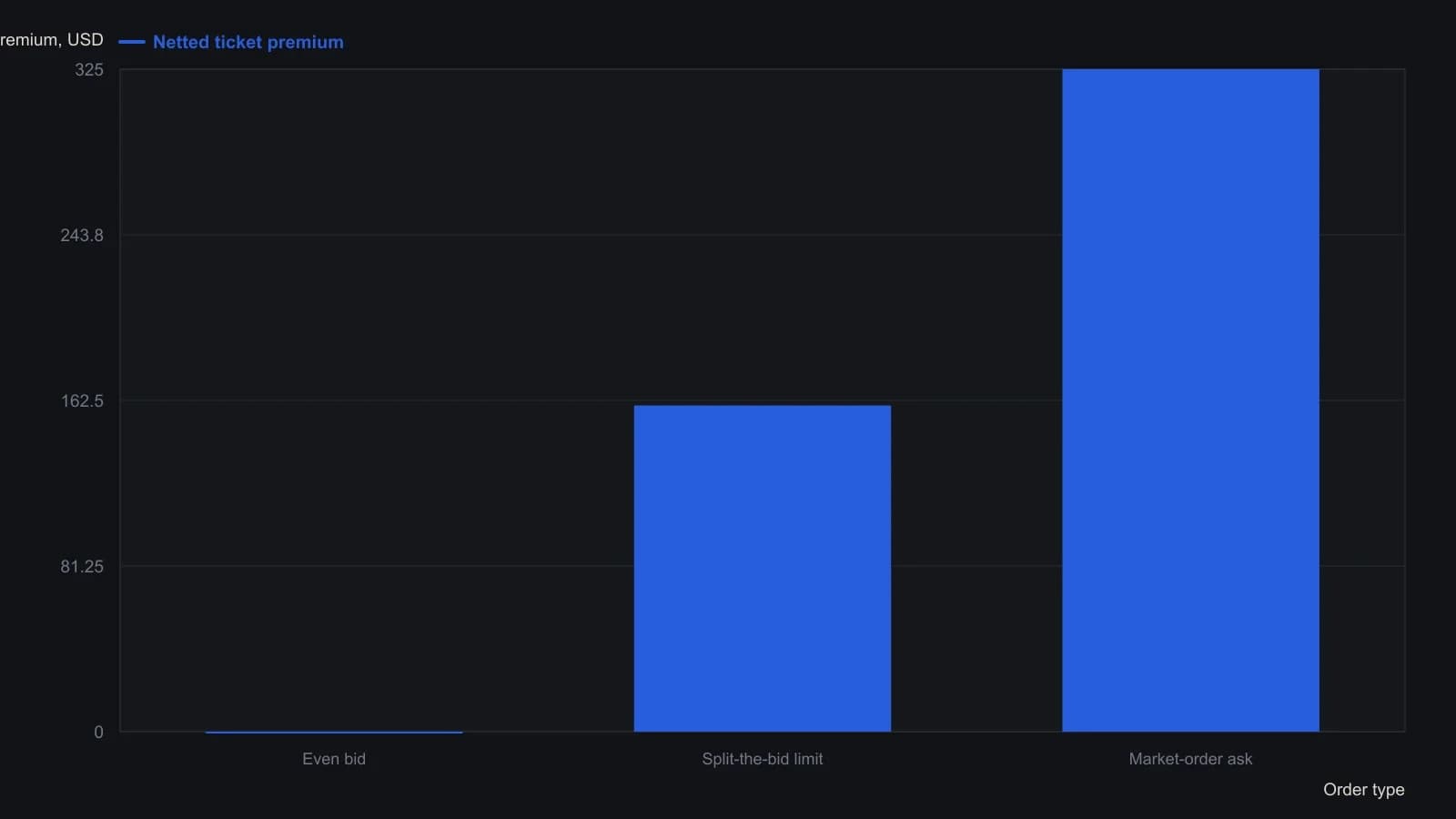
The buy-side net uses the 2,525 ask on the long 12,900 call minus the 750 and 1,450 bids on the short 13,300 call and 12,700 put. Quotes are one-lot; the article states a five-lot at the ask costs 1,625 dollars before commissions and fees.
Editorial reading of the procedure
Editorial interpretation: news risk, auction risk in the report-window, and bid-ask netting already belong in the rules. Once those constraints are written down, the remaining execution choice is whether the option-spread is sent as a market-order or as a limit-order that splits the quote.
Entry, exit, and abstention stay one procedure. The ticket type is the last filter on an already defined option-spread, not a separate override when a headline appears.
All readings on this track · 26 readings
- 1995Canceled prints versus executable fills
- 1999How order routing changes market and limit fills
- 2000Direct access, intelligent order routing, and visible book depth
- 2001Retail routing and market versus limit fills
- 2001Stop triggers and opening-only short market orders
- 2002Market-order routing across linked venues
- 2002Market-order routing, internalization, and displayed size
- 2004Direct access order routing after the display rules
- 2004Listed-stock limit envelopes versus market-order routing
- 2005Closing option spreads with limit or market orders
- 2005Contingent routing as a pre-trade futures contract
- 2007Constructing executable futures orders with market, limit, and fill or kill
- 2008Bid-ask spreads, routing paths, and order choice
- 2008Retail market buys hit the ask
- 2008Limit versus market orders for a commodity option-spread
- 2011A pre-trade checklist before market or limit orders
- 2013Retail market orders and the displayed queue they never join
- 2013Option stop orders, wide spreads and forced market exits
- 2014Opening range breakout with weekday ratings, abstention and exits
- 2014Constructing forex orders from session liquidity
- 2015Order-type and routing scripts for faster execution
- 2015Market, limit, and routing choices inside the order life cycle
- 2015Handheld futures tickets as a second execution venue
- 2017Screen execution starts from the live bid and ask
- 2017Electronic stop-loss orders and protected price bands
- 2020Market-order slippage on split-adjusted stock prices