1989issue C011-4
Finishing a market order in a first index-pit session
A first session in the S&P 500 futures pit is a laboratory for implementation only after badge identity, card fields, fill allocation, and the live tape confirm the same trade. A shouted price is not the end of a market order.
- A market order is an immediately executable bid or offer stated by open outcry as price then size, and it is incomplete until quantity, contract month, opposite house, opposite badge, price, and time bracket are written.
- Order routing on the floor is decided by badge visibility, first-come step location, and a filling broker's pointed fill allocation.
- Tape reading of the wall board and successive prints tests whether a just-done fill is still consistent with the auction.
- An out-trade leaves residual risk after cards leave the pit, and that risk stays open until morning cards clear the keypunch operator.
A first session as an implementation laboratory
Index-and-options membership conferred the right to trade S&P 500 futures from the exchange floor. Large participants used the contract both to hedge equity portfolios and to arbitrage short-lived cash-versus-futures gaps, sometimes in clips of 2,000 to 3,000 contracts.
Editorial reading: that mix of hedge and arb flow, plus the density of the open, makes a first session a laboratory for implementation. A market order is not finished when a price is shouted. It is finished only when badge identity, card fields, fill allocation, and the live tape all confirm the same trade.
Badge, step, and who can be selected
Each floor participant wore a badge of at most three letters, and completed trades were processed against that badge identifier. Pit standing room was first-come, first-served, and after the 8:30 CST open the crowd was dense enough that leaving a step was treated as impractical.
Turning a badge face-down was used at the open to avoid being selected as a counterparty during the first burst of bids and offers. Order routing is how a fill finds a counterparty on the floor: badge visibility, step location, and a filling broker's pointed allocation decide who is allowed to trade and in what size.
Stating the market order and completing the card
Open outcry is a voice-and-hand auction in which price is announced before quantity and buy-side palms face the bidder. A buy was stated as price then quantity with palms toward the bidder.
A market order is an immediately executable bid or offer stated that way, accepted when a counterparty hits it, and incomplete until the card shows quantity, month, opposite house, opposite badge, price, and time bracket. The time bracket is the session interval stamped on the card so a fill can be sequenced and later reconciled.
Prints after the first lift
After a one-lot bid at 212.15 was lifted, a top-step broker offered 500 contracts at the same price and the prints moved through 212.10, 212.05, 212.00, and 211.95. Tape reading means reading the wall board and successive prints during the order's life to judge whether a just-done fill is still consistent with the auction.
A requested two-lot exit at 212.20 was filled only after a filling broker allocated one order across several counterparties by pointing. Fill allocation is that pointed split, so a requested exit size depends on being selected.
S&P 500 futures tape after the first lift
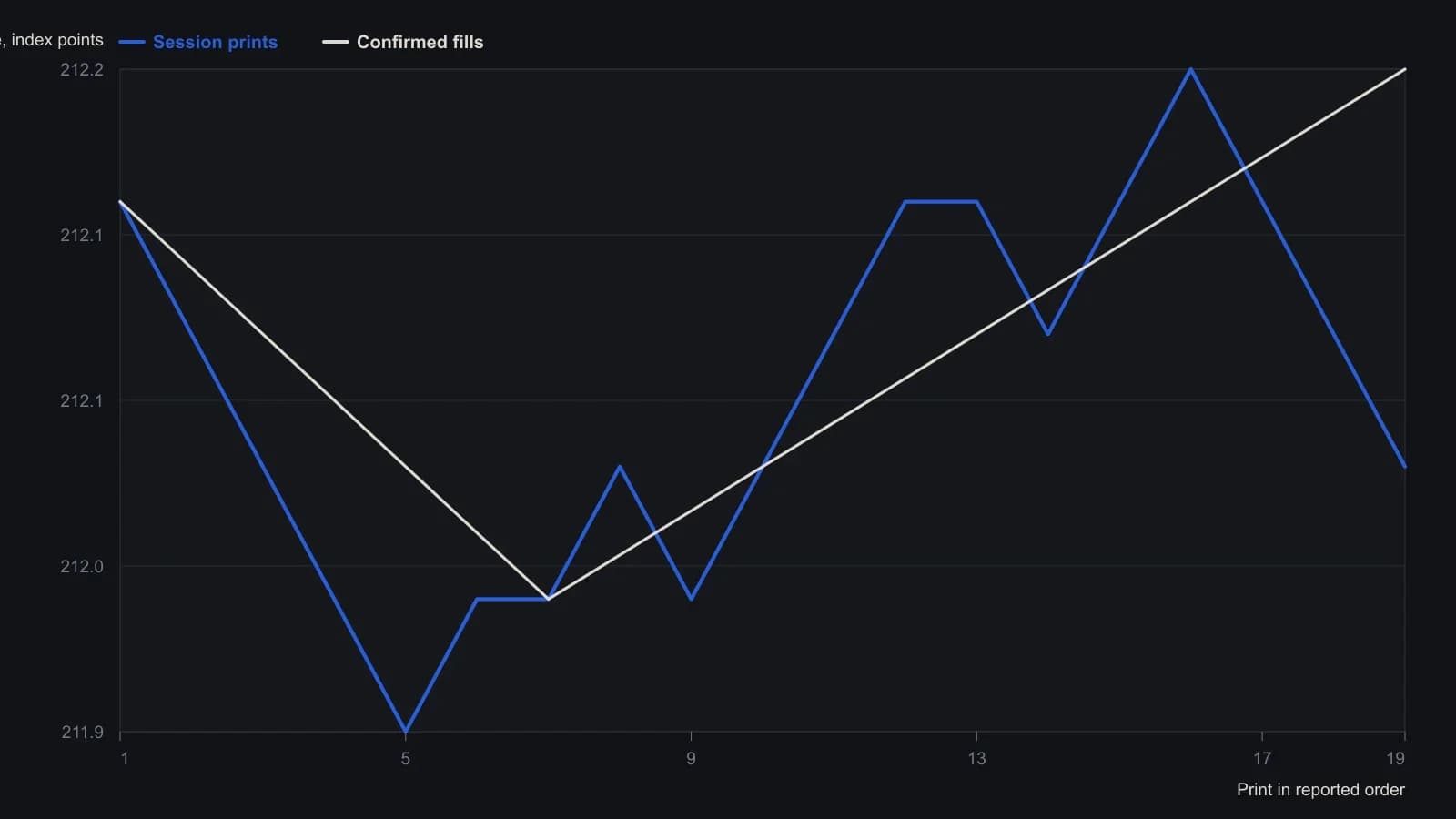
No exchange timestamps are given. Points follow narrative order of stated prints and the three confirmed fills. Consecutive repeats are separate reports at the same price, not interpolated ticks.
When unmatched-trade risk is still open
An unmatched trade occurred when one party recorded a fill the other did not match at the same price. That break is an out-trade: one or both parties record a fill the other does not match at the same price, leaving residual risk after cards leave the pit. A single such break was treated as existentially costly for a floor trader.
Trading cards were submitted to a keypunch operator after the morning session, and unmatched-trade risk was still open until those records cleared.
All readings on this track · 20 readings
- 1986Open outcry hand signals as order routing
- 1989Finishing a market order in a first index-pit session
- 2001Ticket charges, internalization, and hidden size on the tape
- 2003Opening auction indications, premium and print size
- 2003Listed open order routing and the short-sale tape
- 2003Opening indication, one-sided envelope, and the sector tape check
- 2003Opening auction fills and the post-print tape
- 2004Specialist prints, opening exits and live tape filters
- 2005A tape-reading case study of support, resistance, and breakout confirmation
- 2005Tape flips versus idle capital: a process critique
- 2005Read the tape, name the liquidity job, then route for price
- 2006Fill entitlement, hybrid routing, and pairs sequencing
- 2006Alerts over resting stops, with tape-reading at the exit
- 2006When crowd levels diverge from Fibonacci support
- 2008Perfect prints before the chart
- 2008Hidden size, tape delay, and pairs shorts belong in the trade rule
- 2010Inside the spread: why OHLC bars hide the buy-sell shift
- 2010Specialist pair books sized for dividends and tape
- 2016Tape reading as judgment under distraction
- 2018Tape-reading breakouts with increment stops