2015issue C048-9
Reverse diversification when one winner enters a quiet book
A ten-sleeve illustration mixed nine 2% outcomes with one 30% outcome and reported a compound-style average of 4.504%. The archive exchange then separated sequential-compounding from a concurrent-book-average and recast the loud sleeve as reverse-diversification rather than a risk-reducing-spread.
- Audit a diversification story by asking whether the new sleeve is meant to dampen one loud position or to lift the average of a quiet book.
- Sequential-compounding grows a later percentage on an already larger stake and is not the same figure as a concurrent-book-average.
- Reverse-diversification can raise the book average while volatility also rises; a risk-reducing-spread works in the opposite direction.
- An ex-post-winner is already known, so recycling that sleeve into many new books is a fragile habit rather than a risk plan.
A ten-sleeve compound average
A ten-sleeve illustration presented nine outcomes of 2% plus one outcome of 30% as a compound-style average of 4.504%. The 30% outcome was the single large result beside nine quiet 2% sleeves.
That presentation treated the ten printed rates as if they already belonged in one book average. The later exchange asked what kind of average that figure was, and what kind of diversification story the extra sleeve was being asked to tell.
Why the attributed lift did not match
A challenge to that illustration said a 1.15% lift attributed to the single 30% outcome does not match the move from 2% to 4.504%. The claimed increment and the printed change in the average were not the same arithmetic.
The 1.15% increment was later withdrawn as leftover arithmetic from an earlier version of the example. After that withdrawal, the remaining dispute was about how the ten outcomes should be averaged, not about keeping the withdrawn lift.
Sequential compounding is not a concurrent average
Under sequential-compounding, later gains apply to an already-grown stake. Nine 2% outcomes produce 19.5 cents of gain on a unit stake, while inserting the 30% outcome produces 55.4 cents, a multiple of 2.84.
If the same ten outcomes are treated as concurrent equal weights, the concurrent-book-average, the simple mean of sleeves held at the same time, is 4.8% rather than the 4.504% compound figure.
Nine 2% sleeves, one 30% sleeve, and both book averages
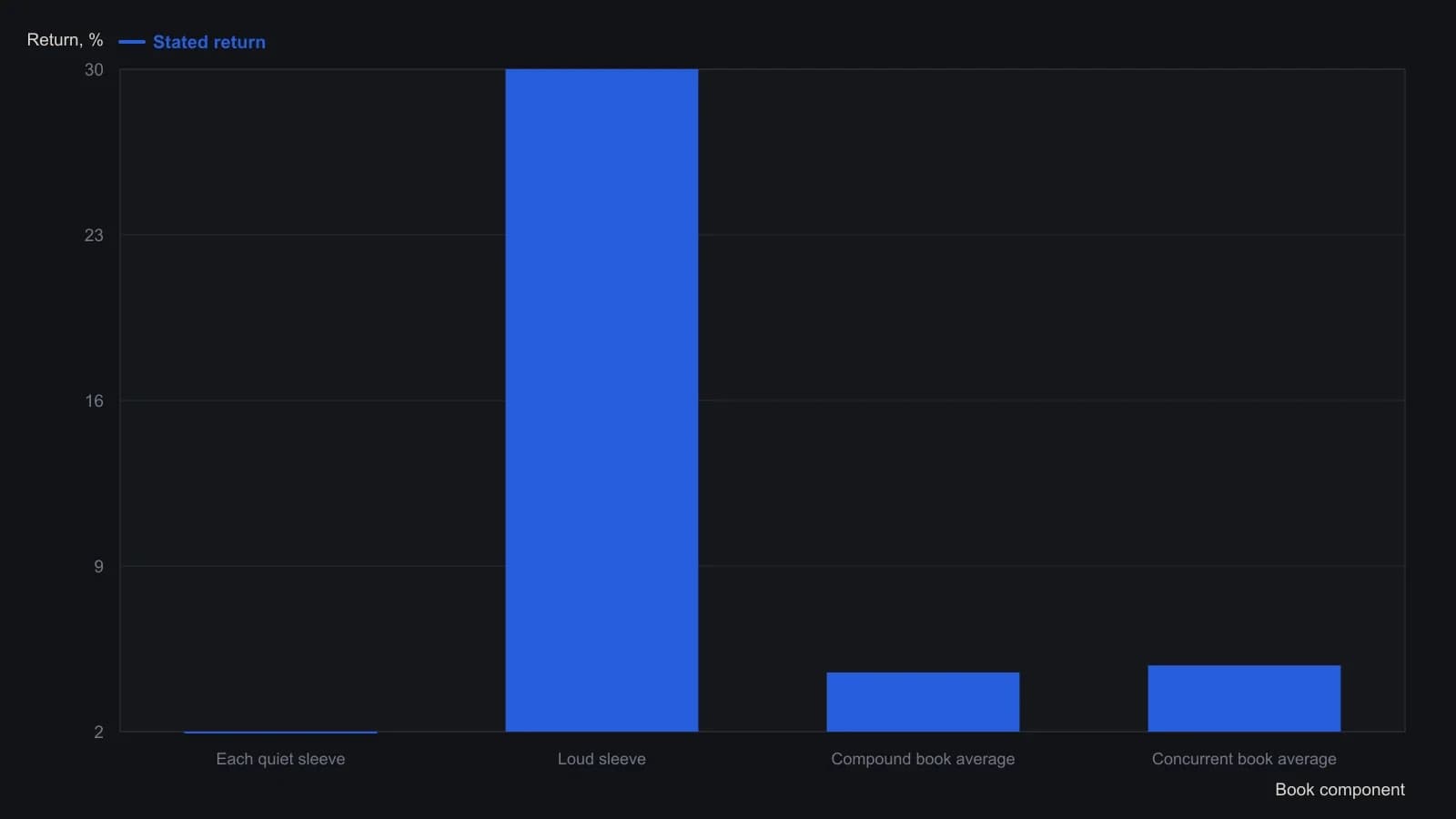
The 4.504% figure treats the ten returns as sequential and compounding. The 4.8% figure is (9×2% + 1×30%)/10. Vandycke withdrew the 1.15% attributed lift as a leftover from earlier calculations.
Reverse diversification and the opposite spread
Adding a 30% sleeve to nine 2% sleeves was recast as reverse-diversification because average return can rise while volatility also rises. The quiet book is not being protected. Its average is being lifted by a louder sleeve.
Risk-reducing diversification was defined in the opposite direction as a risk-reducing-spread: pair lower-return, lower-risk sleeves with a high-return sleeve to dampen that sleeve’s implied risk.
Spreading one 30% position into 2% sleeves was said to cut the standalone 30% average to about 4.8% if positions are concurrent, or about 4.5% if returns are compounded. That gap was treated as secondary to the risk point.
An already-known winner is not a risk plan
The attached caution is that winners are identified only after they have already won. An ex-post-winner is a sleeve whose large gain is already known and therefore cannot be treated as if future winners were equally visible.
Recycling a known winner into many new sleeves was described as a fragile habit rather than a risk plan. The archive caution sits on that timing problem, not on a claim that the next quiet book will contain another visible 30% sleeve.
All readings on this track · 13 readings
- 1989Evaluate mechanical systems by peak-to-trough drawdown
- 1991Pairwise return covariance as a construction gate
- 1999Managed-futures construction from trend, leverage, and diversification
- 2000Treat a single name as a node on a correlation tree
- 2002Rising correlation undercuts foreign-listing diversification
- 2003A directional call is not the skill that keeps an account alive
- 2006Risk-adjusted return for cross-market trend systems
- 2010Iron condor range, volatility and diversification
- 2015Reverse diversification when one winner enters a quiet book
- 2016Rebuild the book when correlations and commentary flip
- 2017Idle screens and unused choice across markets
- 2018Professional trader skill as a staged operating system
- 2019Mechanical systems as a critique of discretion