2019issue C0144-45
Mechanical systems as a critique of discretion
Discretionary trading can treat the same conditions as a buy on one day and a sell on another. A mechanical trading system keeps formulated rules unchanged so entry, exit, and abstention can be tested as one procedure and retired or replaced inside a diversified book.
- Discretionary trading mixes charts, order flow, indicators, context, news, and intuition, so the same conditions can produce a buy on one day and a sell on another.
- Systematic, mechanical, rule-based, and algorithmic trading are presented as one mechanical trading system whose formulated, tested rules do not later change.
- The three stated reasons for that process are historical testing of the full rule set, diversification across strategies and markets, and automation of order placement while strategies are still monitored.
- Rule-based entry, exit, and abstention become educational only when they form one testable system that can be turned off or replaced so one failed setup does not dominate the book.
Same conditions, opposite actions
Discretionary trading can treat the same conditions as a buy on one day and a sell on another. Charts, order flow, indicators, context, news, and intuition remain in the decision mix, so identical conditions can produce opposite actions on different days.
Rules that do not later change
Systematic, mechanical, rule-based, and algorithmic trading are presented as one mechanical trading system in which formulated, tested rules do not later change.
A mechanical trading system is a complete procedure that turns rule inputs, market state, and execution constraints into entry, exit, or abstention signals over the system's holding period.
Entry that still requires a buy
Rule-based entry means a specified pattern that once required a buy still requires a buy years later, with no exception once a pure rule process is in force. The entry action fires only when pre-specified conditions are met and later repeats the same action under the same conditions.
Testing, diversification, and automation
Historical testing of the full rule set is the first stated reason to use a mechanical process. The archive illustrates this by preferring a ten-year historically profitable procedure over a ten-year historically losing one, without treating the record as a forecast. Historical testing evaluates a finished rule set against past market data as a check on the procedure, not as a forecast of later results.
Diversification is the second stated reason. Many independently specified strategies across many markets can be turned off or replaced if one underperforms, whereas a single-market discretionary book is exposed when its setups stop working. Diversification means running many independently specified strategies across markets so one failed setup or market change does not dominate the book.
Automation is the third stated reason. A platform can place orders across more markets than a discretionary chart watcher can cover, while the trader still monitors and develops strategies rather than leaving the book unattended. Automation hands order placement to a platform so more markets can be covered, while strategies still require monitoring and replacement.
One strategy versus ten diversified strategies
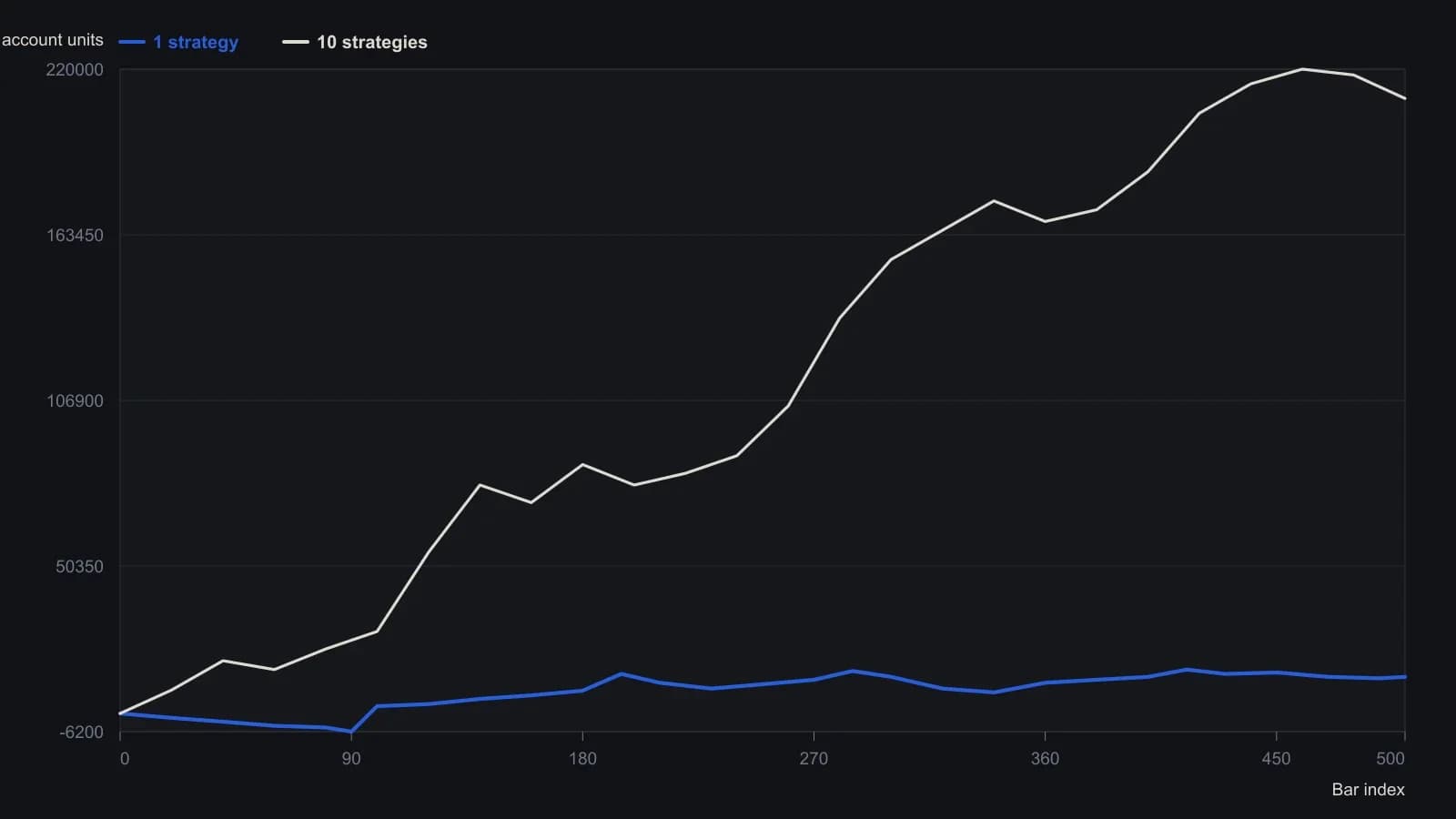
Curves were digitized from the printed Figure 1 raster; y-values are approximate. The source does not label the x-axis unit or the currency of equity.
All readings on this track · 13 readings
- 1989Evaluate mechanical systems by peak-to-trough drawdown
- 1991Pairwise return covariance as a construction gate
- 1999Managed-futures construction from trend, leverage, and diversification
- 2000Treat a single name as a node on a correlation tree
- 2002Rising correlation undercuts foreign-listing diversification
- 2003A directional call is not the skill that keeps an account alive
- 2006Risk-adjusted return for cross-market trend systems
- 2010Iron condor range, volatility and diversification
- 2015Reverse diversification when one winner enters a quiet book
- 2016Rebuild the book when correlations and commentary flip
- 2017Idle screens and unused choice across markets
- 2018Professional trader skill as a staged operating system
- 2019Mechanical systems as a critique of discretion