2002issue C011-2
Rising correlation undercuts foreign-listing diversification
Conventional pitches sell foreign listings as a diversification hedge and a direct way to own global growth. The archive treats that story as intuitively appealing but weakly evidenced once domestic and international equities share the same regime. Editorial stance: test co-movement first, then read multinational revenue mix as a listing-versus-demand spread.
- Editorial: audit an overseas sleeve as an intermarket position. First test whether foreign listings still co-move with the home book, then split the demand story from the listing choice.
- Tighter correlation between domestic and international equities is treated as canceling the diversification hedge against US holdings, because the books more often occupy the same up and down regime.
- Overseas demand can be held through home-listed firms that already sell a large share of output abroad, rather than by defaulting to a locally listed competitor.
- Currency fluctuation, regulation, and government intervention are framed as persistent policy and currency risk in foreign listings, not only as crisis-period shocks.
The conventional overseas pitch
Conventional overseas-allocation pitches present foreign listings as a diversification hedge against home-market downturns and as a direct way to own global growth. A foreign listing is an equity whose primary listing and corporate domicile sit outside the investor's home market.
Those pitches are critiqued as intuitively appealing but weakly evidenced, including a multi-decade lookback used to question whether capital needed to leave the home market.
S&P 500 returns versus the MSCI EAFE
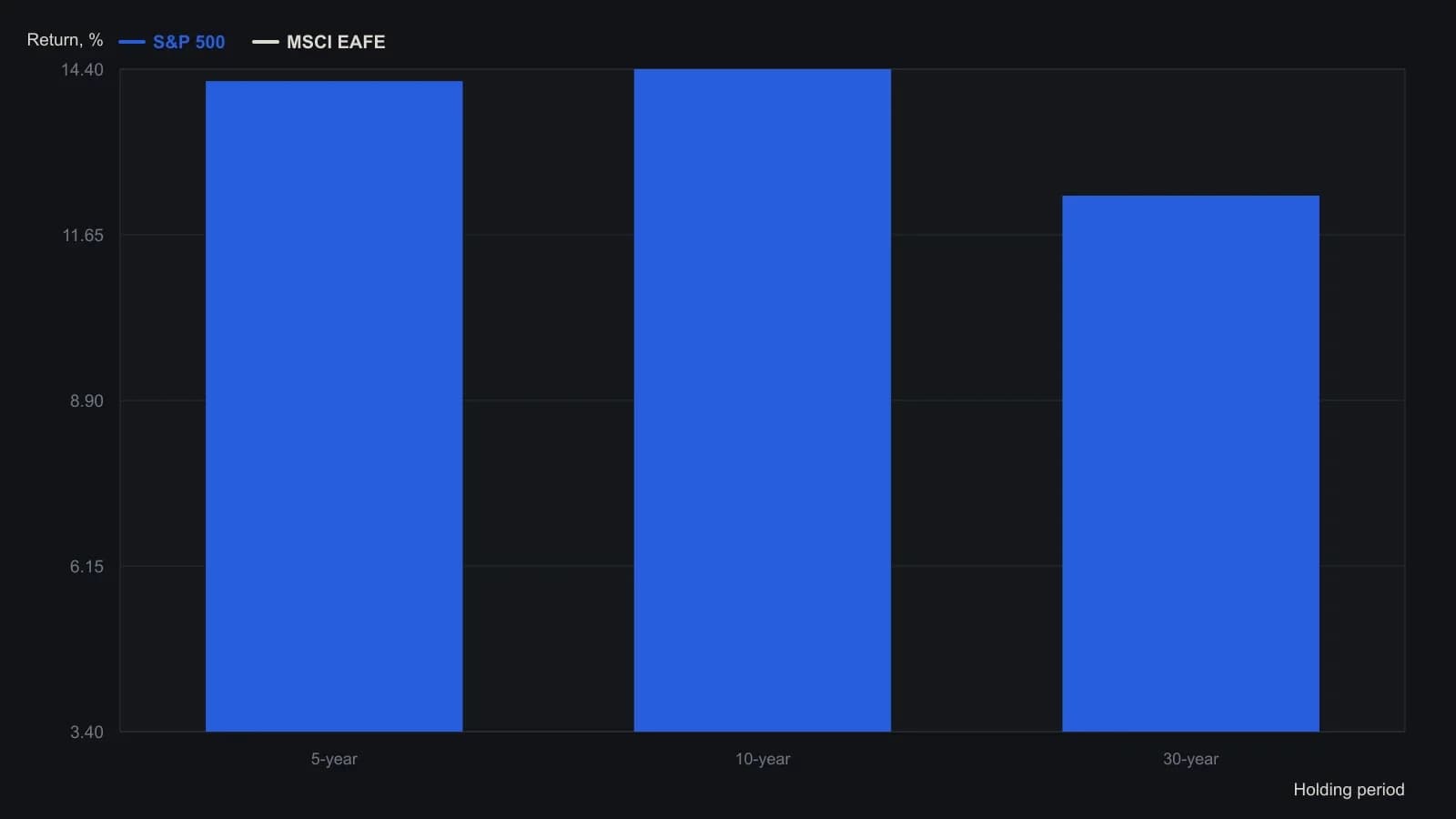
Morningstar’s foreign-stock-fund composite is omitted because the source left its 30-year return blank, so that series cannot be drawn with three complete bars.
When the books share a regime
Tighter correlation between domestic and international equities is treated as canceling the hedge value of foreign listings against US holdings, because the books more often occupy the same up and down regime.
That cross-market correlation is the tendency of domestic and international equity indexes to rise and fall together rather than offset each other. Regime co-movement is the related condition in which the home and foreign equity books occupy the same risk regime instead of independent cycles.
Why correlation rose, and what risk remains
Easier cross-border trade and mature home-country firms expanding abroad are the two mechanisms given for that rising cross-market correlation.
Currency fluctuation, regulation, and government intervention are framed as persistent risks in foreign listings, not only as crisis-period shocks. Those frictions are the policy and currency risk attached to the overseas listing.
Split listing domicile from customer geography
Overseas demand can be held through home-listed firms that already sell a large share of output abroad, rather than by defaulting to a locally listed competitor.
One illustrated screen required US-based companies to earn at least 40 percent of revenue abroad, treating listing domicile and customer geography as separate legs of the same intermarket position.
Worked examples include a restaurant operator with more than 63 percent of sales outside the US, a microprocessor producer with about 60 percent of revenue abroad and little foreign processor competition, and an insurer with 80 percent of revenue from Japan.
A boom is not proof of a hedge
Isolated foreign-market booms are acknowledged as possible, but they are not accepted as proof that a standing foreign-listing allocation supplied independent diversification.
All readings on this track · 13 readings
- 1989Evaluate mechanical systems by peak-to-trough drawdown
- 1991Pairwise return covariance as a construction gate
- 1999Managed-futures construction from trend, leverage, and diversification
- 2000Treat a single name as a node on a correlation tree
- 2002Rising correlation undercuts foreign-listing diversification
- 2003A directional call is not the skill that keeps an account alive
- 2006Risk-adjusted return for cross-market trend systems
- 2010Iron condor range, volatility and diversification
- 2015Reverse diversification when one winner enters a quiet book
- 2016Rebuild the book when correlations and commentary flip
- 2017Idle screens and unused choice across markets
- 2018Professional trader skill as a staged operating system
- 2019Mechanical systems as a critique of discretion