2013issue C138-13
Kelly fraction versus risk of ruin
Editorial view: treat the Kelly criterion as a pre-trade exposure filter. First confirm that expectancy is greater than zero, then choose a fraction that keeps risk of ruin inside a personal bound instead of taking the theoretically maximum growth bet.
- A positive edge exists only when expectancy is greater than zero. A non-positive expectancy implies no trading edge and is treated as a reason not to trade at all.
- The Kelly optimum fraction simplifies to FO = E / R, linking bet size directly to expectancy and the win-to-loss ratio.
- Raising the bet fraction produces an exponential rise in risk of ruin, described as increasing at a square rate with betting level.
- A half-Kelly fraction lowers risk of ruin relative to a full-Kelly fraction, at the cost of a lower profit level and lower ending equity.
Confirm a positive edge first
Expectancy is defined as E = B * (1 + R) - 1, so a positive edge exists only when expectancy is greater than zero. A non-positive expectancy implies no trading edge and is treated as a reason not to trade at all.
Set the Kelly fraction from expectancy and the ratio
The Kelly optimum fraction simplifies to FO = E / R, linking bet size directly to expectancy and the win-to-loss ratio. At the same expectancy, a low win-to-loss ratio allows a higher win rate and a larger Kelly fraction than a high win-to-loss ratio.
Fixed-dollar betting and fixed-fraction betting
Fixed-dollar betting produces linear, noncompounded equity change, while fixed-fraction betting compounds equity at a nonlinear rate.
Risk of ruin and a half-Kelly fraction
Raising the bet fraction produces an exponential rise in risk of ruin, described as increasing at a square rate with betting level. When profit per trade is matched across setups, a high win-to-loss-ratio case can show substantially worse risk of ruin than a low-ratio case.
A half-Kelly fraction lowers risk of ruin relative to a full-Kelly fraction, at the cost of a lower profit level and lower ending equity.
Ruin risk at full Kelly versus half Kelly
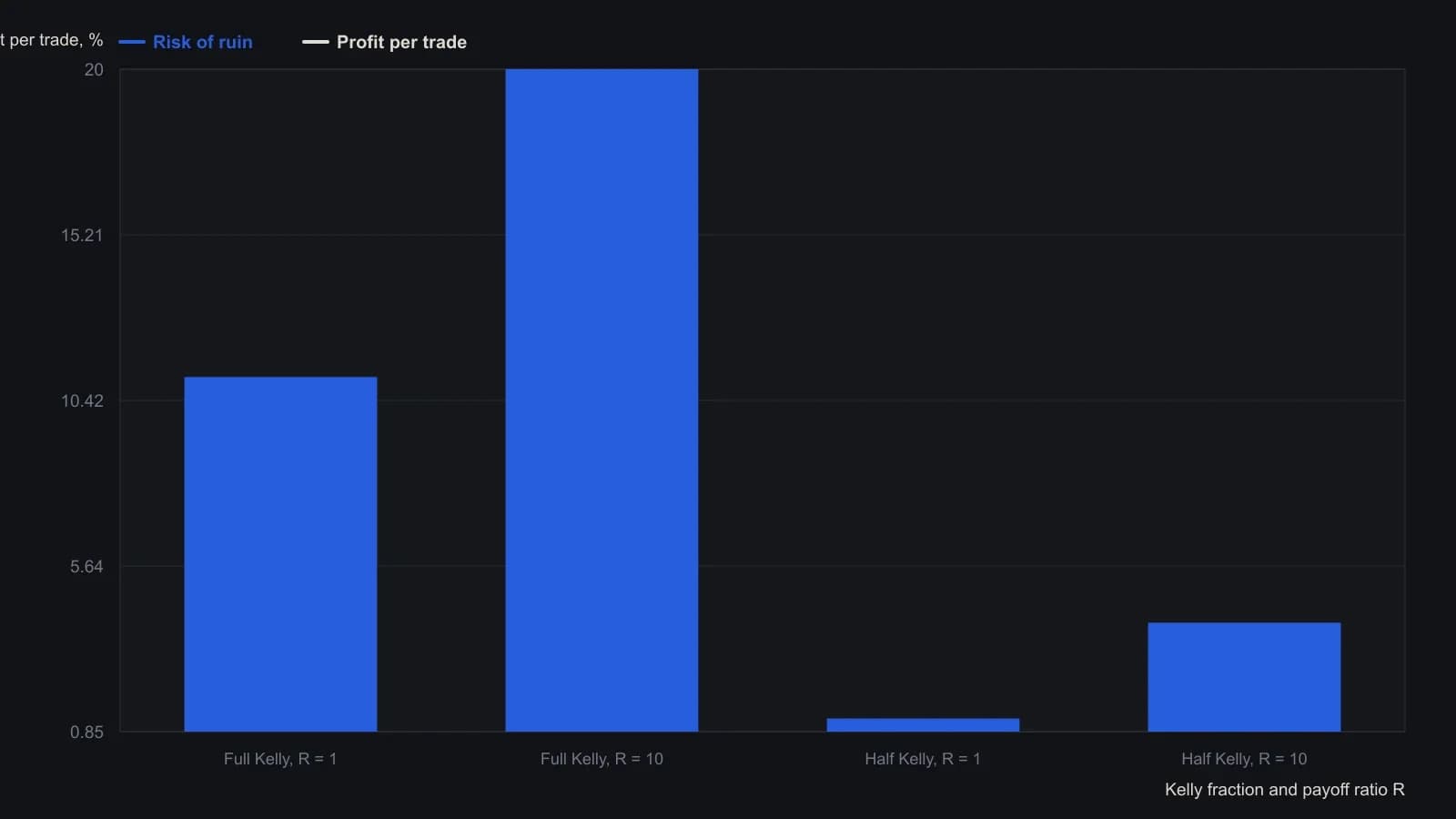
Expectancy is fixed at 0.50. The R = 1 rows use win bias B = 0.75; the R = 10 rows use B = 0.136.
All readings on this track · 9 readings
- 1982Three gates for a futures book: equity risk, expected value, and shrinking pyramids
- 1995A Kelly-style leverage grid and reshuffled paths
- 2004Bound the loss before leverage changes size
- 2010Treat risk of ruin, drawdown limits, and Kelly sizing as consistent pre-trade filters
- 2010Fixed-fractional forex position sizing
- 2013Kelly fraction versus risk of ruin
- 2016Expected value versus leverage, drawdown, and Kelly sizing
- 2017Fixed-fraction sizing versus a theoretical pattern edge
- 2018Evaluating double-bottom breakouts as a testable system