2010issue C1030-37
Fixed-fractional forex position sizing
This archive article treats forex lot size as a pre-entry control on loss and exposure. A constant lot count lets leverage drift with the account, while a fixed-fraction rule keeps dollar risk proportional to current equity and changes the drawdown path even when the trade list does not.
- Position size is framed as a pre-entry control on loss and exposure rather than an after-the-fact adjustment.
- A constant lot count produces arithmetic equity growth and lets effective leverage drift as the account balance changes.
- Fixed-fractional sizing sets lot count from current equity, the fraction of equity at risk, stop distance in pips, and pip value so dollar risk stays proportional to the account.
- Risking too large a fraction raises the chance a trader does not survive long enough to use a positive expectancy, while risking too little can leave that expectancy unrealized.
A decision made before the order
Position size is framed as a pre-entry control on loss and exposure rather than an after-the-fact adjustment.
Risked-equity-per-trade is the planned maximum loss on a trade, expressed as a fraction or dollar amount of current equity.
Constant lots and leverage-drift
A constant lot count produces arithmetic equity growth and lets effective leverage drift as the account balance changes.
Fixed-contract-sizing is a constant lot or contract count that does not change when account equity rises or falls. Leverage-drift is the unintended change in effective leverage that occurs when lot size stays fixed while equity moves.
How a fixed fraction sets lot count
Fixed-fractional sizing is a position-sizing rule that risks a constant fraction of current equity on each trade, usually via stop distance.
The rule sets lot count from current equity, the fraction of equity at risk, stop distance in pips, and pip value so dollar risk stays proportional to the account.
Because size shrinks after losses, a true fixed-fraction rule is described as theoretically unable to reach total ruin, though the methodology should be abandoned long before an account is depleted.
Per-trade dollar result under fixed-fractional sizing
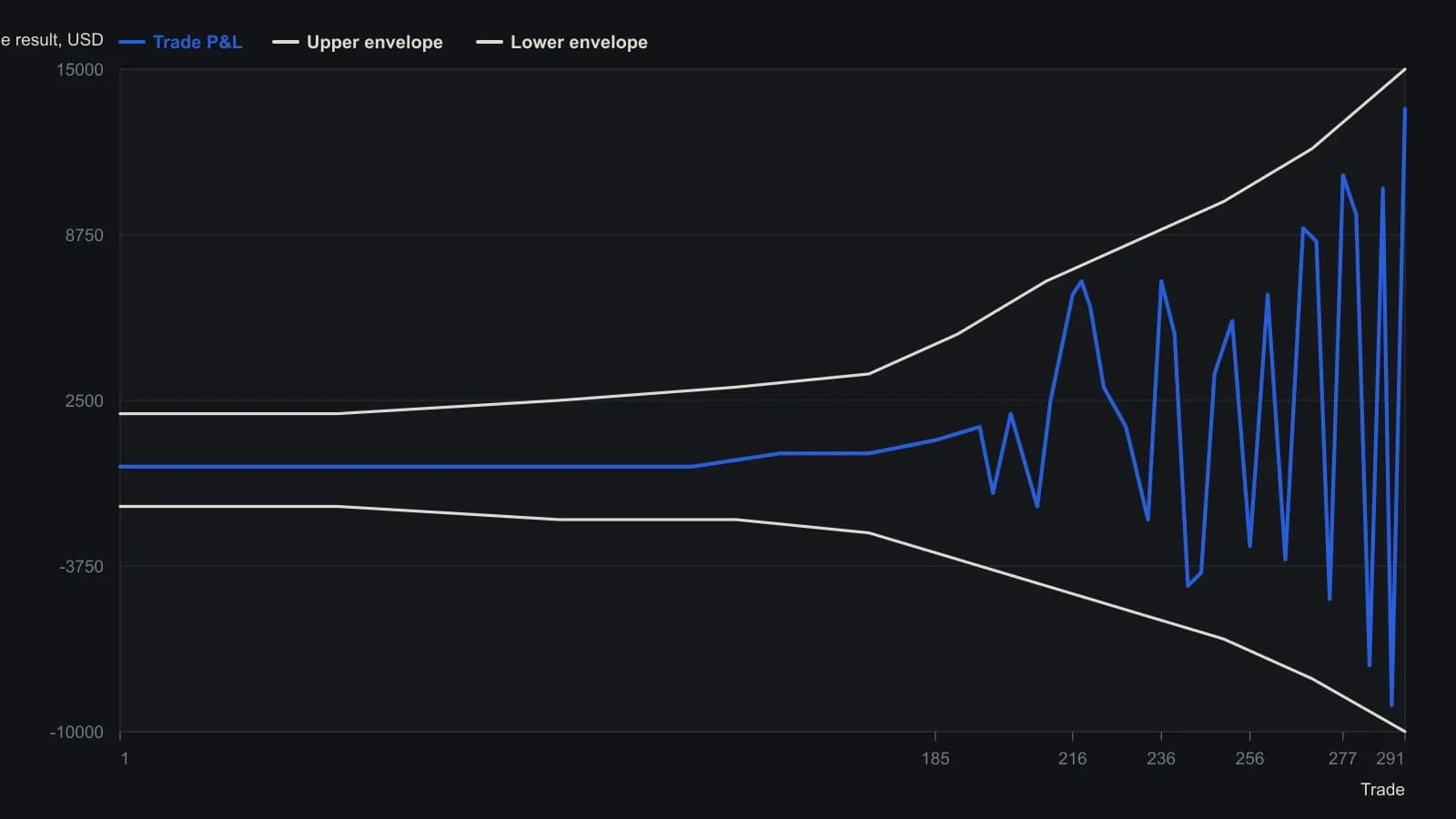
291-trade GBP/USD intraday backtest, 2005–2009, starting at $2,000 and one mini lot. Dollar heights are read from the raster against that printed scale and rounded to $500; the first 150 or so trades sit on the axis at this scale and cannot be resolved more finely.
Same trades, different path risk
On the same 291-trade sterling-dollar sample, a constant-size run showed a 24.9% maximum drawdown while a fractional variant showed a 12% maximum drawdown.
The comparison is used to illustrate how size rules change path risk even when trade count and win rate stay the same.
Fractions that are too large or too small
Risking too large a fraction raises the chance a trader does not survive long enough to use a positive expectancy, while risking too little can leave that expectancy unrealized.
All readings on this track · 9 readings
- 1982Three gates for a futures book: equity risk, expected value, and shrinking pyramids
- 1995A Kelly-style leverage grid and reshuffled paths
- 2004Bound the loss before leverage changes size
- 2010Treat risk of ruin, drawdown limits, and Kelly sizing as consistent pre-trade filters
- 2010Fixed-fractional forex position sizing
- 2013Kelly fraction versus risk of ruin
- 2016Expected value versus leverage, drawdown, and Kelly sizing
- 2017Fixed-fraction sizing versus a theoretical pattern edge
- 2018Evaluating double-bottom breakouts as a testable system