2008issue C051-4
Hedging a short KOSPI 200 options mix for delta and vega
A short same-underlying call and put can collect time value while the market is quiet, but delta hedging alone still leaves implied-volatility exposure. On a studied KOSPI 200 sample, a futures-implied-volatility link and a changed call-put mix were used to offset both shocks together.
- A short same-underlying call and put can collect time value in a quiet market, but a sharp move can still produce a large loss.
- Delta hedging that only offsets call and put deltas still leaves the short book exposed to implied-volatility changes, because both options have positive vega.
- On the studied KOSPI 200 sample, futures-based kappa clustered near -0.5 and was the more consistent hedge input, while spot-based kappa scattered near zero.
- The construction rule set the portfolio delta-to-vega ratio equal to minus kappa by changing relative call and put size, so underlying and implied-volatility shocks could be offset together.
A short straddle still needs a hedge
A short straddle that sells the same-underlying call and put can collect time value while the underlying is quiet. That options straddle remains exposed to a large loss if the underlying moves sharply.
Why offsetting delta is not enough
Offsetting only the call and put deltas leaves the short combination still exposed to implied-volatility changes. Both options have positive vega, so delta hedging that stops at a flat delta does not remove the implied-volatility exposure.
The futures link to implied volatility
Implied volatility analysis on the studied KOSPI 200 sample found that futures-based kappa clustered near -0.5, while spot-based kappa scattered near zero. The futures-implied-volatility link was the more consistent hedge input.
A futures-based kappa of -0.5 means implied volatility rose about 0.5 percent for each one-point futures decline. An unhedged short combination was then exposed to volatility when futures fell.
In a delta-neutral profit curve, kappa of zero produced a flat slope at the 180 at-the-money level. Kappa of -1 left a positive slope and more downside when futures declined.
Sizing the call and put mix
Implied-volatility change with remaining time T was treated as inverse to the square root of T. That horizon dependence was used to convert the futures-implied-volatility relation into a hedge ratio.
Setting the portfolio delta-to-vega ratio equal to minus kappa, by changing the relative call and put size, was the construction rule used to offset underlying and implied-volatility shocks together.
What the compared cases reported
On a November 7, 2005 short-strangle illustration with futures down three points, the call-to-put count was changed from -80/-100 to -100/-80. That change moved the delta-vega ratio from 0.0005 to 0.0100 and flipped reported actual profit from -11.30 to 11.90.
Across the compared short-strangle cases, average gains of a zero-delta book and a delta-vega-hedged book were similar. The largest reported loss was -31.30 points with delta only, versus -17.20 with the combined hedge.
Short-strangle P&L by call-put mix after a three-point drop
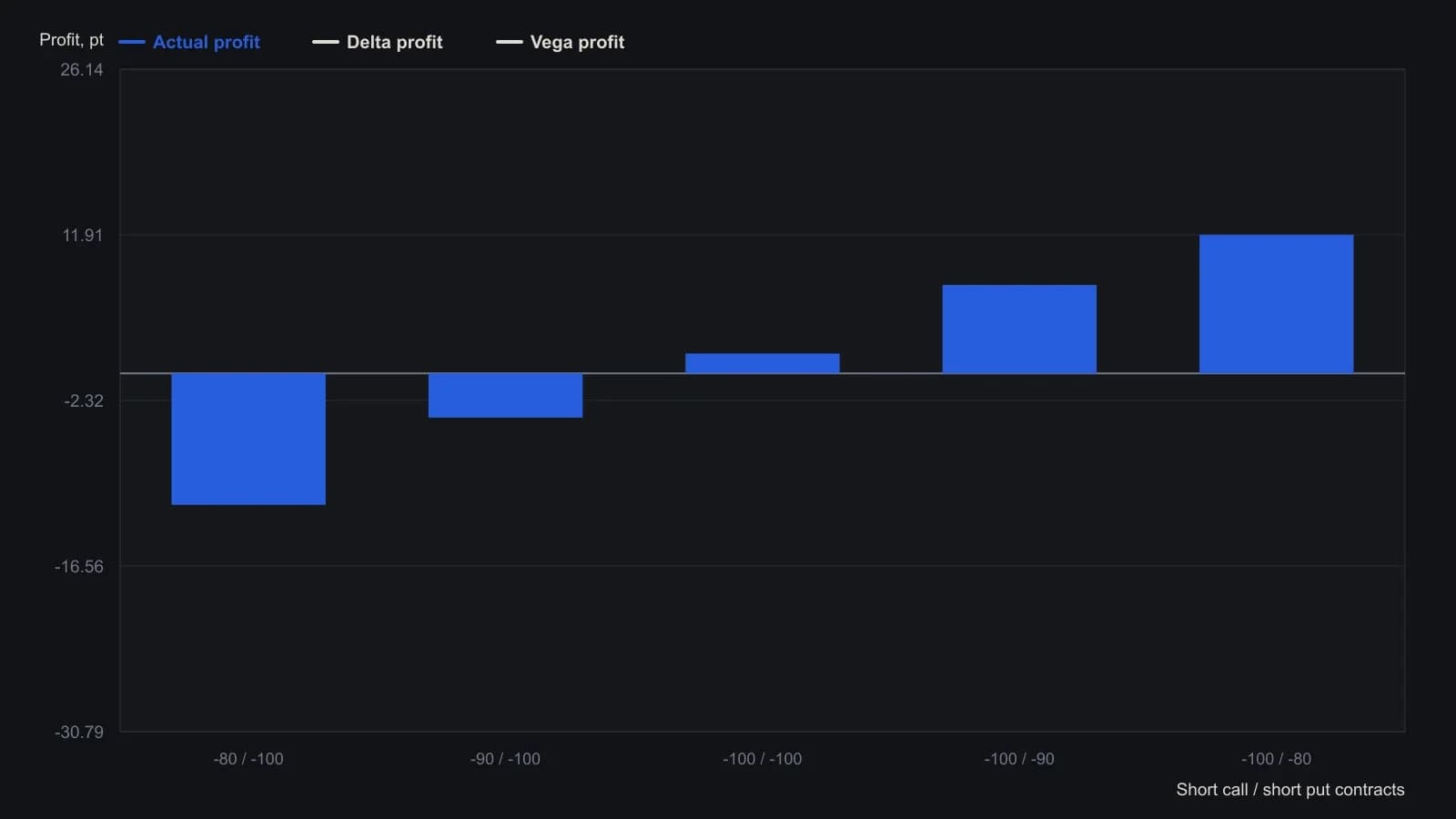
Sample date November 7, 2005; futures declined three points. Call Greeks: delta 0.3287, vega 7.228 pt per 100 percent, theta -46.76 pt/year. Put Greeks: delta -0.2567, vega 6.442, theta -49.45. Actual profit is not the sum of the Greek columns.
All readings on this track · 21 readings
- 1988Constructing regime-aware option income from implied volatility
- 1989Constructing a delta-hedged implied versus historical volatility book
- 1990How a 1989 Eurodollar break turned cheap volatility into a regime-aware book
- 1991Constructing a perishable delta hedge from option moves
- 1991Option deductibles that bound position risk
- 2002Option premium, delta, and volatility-regime spreads
- 2004Option loss pacing with spreads and protective puts
- 2004Delta-neutral options as regime-aware portfolio insurance
- 2004Late-cycle expiration loss and skew as regime context
- 2007Short-term call construction under volatility regimes
- 2008Constructing a limited-risk option spread from volatility and delta
- 2008Option greeks as pre-strategy construction checks
- 2008Hedging a short KOSPI 200 options mix for delta and vega
- 2010Delta hedging as context, not cover
- 2010A margin call as a net-delta budgeting problem
- 2012Strike-level open interest as a hedge and pin map
- 2013Constructing regime-aware overlays from commodity option greeks
- 2013Currency option venues as a straddle and hedge case study
- 2014Long-dated versus near-term calls as a volatility regime
- 2018Constructing regime-aware option books from net greeks
- 2020Custom-delta option spreads for a limit-locked futures book