2008issue C011-6
Constructing a limited-risk option spread from volatility and delta
Assemble one defined-risk options position from a single checklist: implied-volatility regime, remaining time, delta, skew, and the chart view. Those items are construction rules, not separate opinions about direction.
- A structured options method can be a checklist of criteria and freely chosen parameters rather than a fixed trading system.
- Compare current implied volatility with its own history to see whether time premiums are relatively high or low before buying or selling premium.
- Use delta as both a probability that an option finishes in the money and a sensitivity that can rise as the underlying approaches the strike.
- Pair a relatively cheap option against a relatively expensive option in a defined-risk spread, then apply each checklist item as one entry, exit, or abstention rule.
A checklist, not a locked system
A structured options method can be a checklist of criteria and freely chosen parameters rather than a fixed trading system.
The construction checklist has five criteria: probability via delta, implied-volatility regime, time to expiration, skew between cheap and expensive options, and market timing.
One chart, several limited-risk expressions
The same underlying chart can support a downtrend view, a breakout view, or a range view. Each view can be expressed as a limited-risk options construction.
Editorial note: treat the chart view as the market-timing item on the same checklist, not as a separate directional call that stands apart from volatility, time, and delta.
Intrinsic value and time premium
An option price splits into intrinsic value, equal to how far it is in the money, and extrinsic value, which is the remaining time premium. Out-of-the-money options have no intrinsic value and are priced entirely as time premium.
All time premium disappears by expiration. That decay typically speeds up in the last month, helping sellers and hurting buyers. Time decay is the erosion of extrinsic value as expiration approaches, which favors option sellers and works against option buyers, especially in the final month.
High or low time-premium regime
Historical volatility is computed from past underlying moves. It is a backward-looking measure of how much the underlying already moved over a chosen window, and it is distinct from the market’s current implied-volatility regime.
Implied volatility is the volatility a pricing model must use to match the live option price. It is the volatility the market prices into current option premiums.
Comparing current implied volatility with its own history indicates whether time premiums are relatively high or low before choosing to buy or sell premium. Use that comparison as a high-or-low time-premium regime rather than as a forecast of realized moves.
IBM 90-day ATM implied volatility, 2002–2007
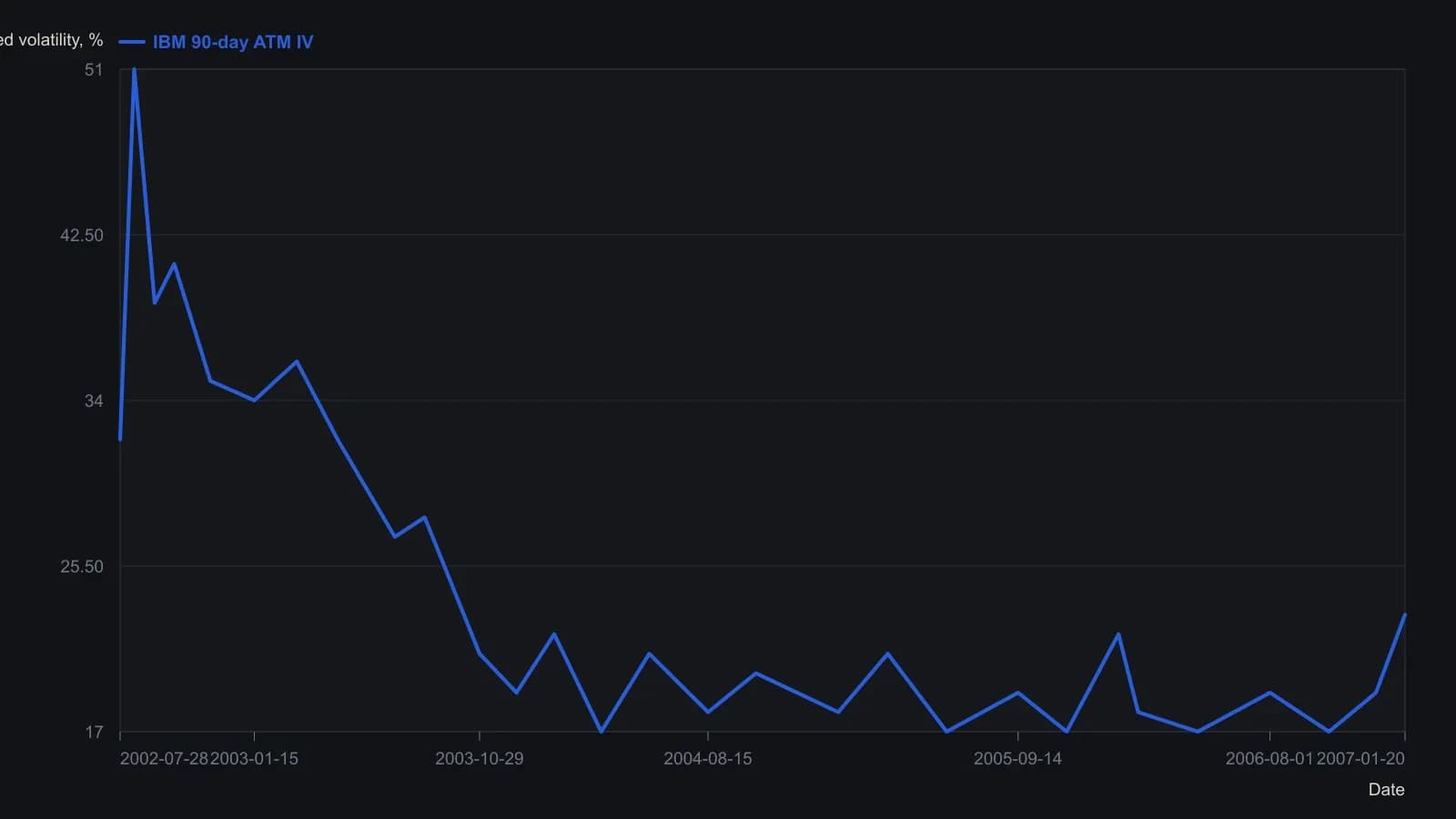
Digitized from the Optionetics Platinum raster of 90-plus-day ATM implied volatility. Dates between the labeled ticks are interpolated. Vertical accuracy is about one volatility point. The article’s single-option example (IBM September 120 call at 45.97 on 25 July 2007) is a different calculation, not a point on this 90-day ATM series.
Skew inside the spread
Skew construction looks for an edge by pairing a relatively cheap option against a relatively expensive option in a spread.
The option spread in this workflow is a defined-risk combination of long and short options chosen so each checklist criterion can be applied as one entry, exit, or abstention rule.
Delta as probability and sensitivity
Delta is used both as a probability that an option finishes in the money and as a sensitivity that can rise sharply as the underlying approaches the strike. The same reading is a probability proxy for finishing in the money and a sensitivity measure that changes as the underlying approaches a strike.
Assemble one position
Editorial note: walk the checklist on a single limited-risk construction. Read implied volatility against its own history, choose remaining time with time decay in mind, and place the strike with delta. Then pair cheap and expensive options and match the structure to the chart view.
All readings on this track · 21 readings
- 1988Constructing regime-aware option income from implied volatility
- 1989Constructing a delta-hedged implied versus historical volatility book
- 1990How a 1989 Eurodollar break turned cheap volatility into a regime-aware book
- 1991Constructing a perishable delta hedge from option moves
- 1991Option deductibles that bound position risk
- 2002Option premium, delta, and volatility-regime spreads
- 2004Option loss pacing with spreads and protective puts
- 2004Delta-neutral options as regime-aware portfolio insurance
- 2004Late-cycle expiration loss and skew as regime context
- 2007Short-term call construction under volatility regimes
- 2008Constructing a limited-risk option spread from volatility and delta
- 2008Option greeks as pre-strategy construction checks
- 2008Hedging a short KOSPI 200 options mix for delta and vega
- 2010Delta hedging as context, not cover
- 2010A margin call as a net-delta budgeting problem
- 2012Strike-level open interest as a hedge and pin map
- 2013Constructing regime-aware overlays from commodity option greeks
- 2013Currency option venues as a straddle and hedge case study
- 2014Long-dated versus near-term calls as a volatility regime
- 2018Constructing regime-aware option books from net greeks
- 2020Custom-delta option spreads for a limit-locked futures book