2014issue C1221
Long-dated versus near-term calls as a volatility regime
A same-strike, same-risk pair of listed equity calls shows how expiry reshapes delta, gamma, theta, and vega, and how implied volatility can revalue a long call even when the underlying is unchanged.
- TradersWeek editorial interpretation: treat expiration as a regime dial, not a calendar convenience. The same funded bullish call can be a high-gamma, high-decay share substitute or a slower, vega-heavy long-dated holding that is more a cheap-volatility stance than a near-term price bet.
- A January 2015 100 call and a January 2017 100 call were compared at the same strike with maximum risk set at $1,700 for both positions.
- Under that risk budget the nearer-dated 100 call translated to about 158 shares of delta exposure and the 2017 100 call to about 54 shares, with the extra near-term gamma paired with greater theta decay.
- On a contract-by-contract basis the longer-dated call had higher vega. Implied volatility stood at 25, was rising with broader-market volatility, and remained low relative to other leading technology names, so a rise in implied volatility with no change in the underlying would increase the long-call value.
Expiration as the main difference
Listed long-dated equity options can keep a position open for as long as three years.
Option expiration analysis here is a same-strike, same-risk comparison of otherwise similar calls that differ mainly by expiry. The comparison is used to show how horizon reshapes delta, gamma, theta, and vega.
A January 2015 100 call and a January 2017 100 call were held at the same 100 strike. Maximum risk was set at $1,700 for both positions.
Near-term versus LEAPS 100-strike call profit versus Apple price
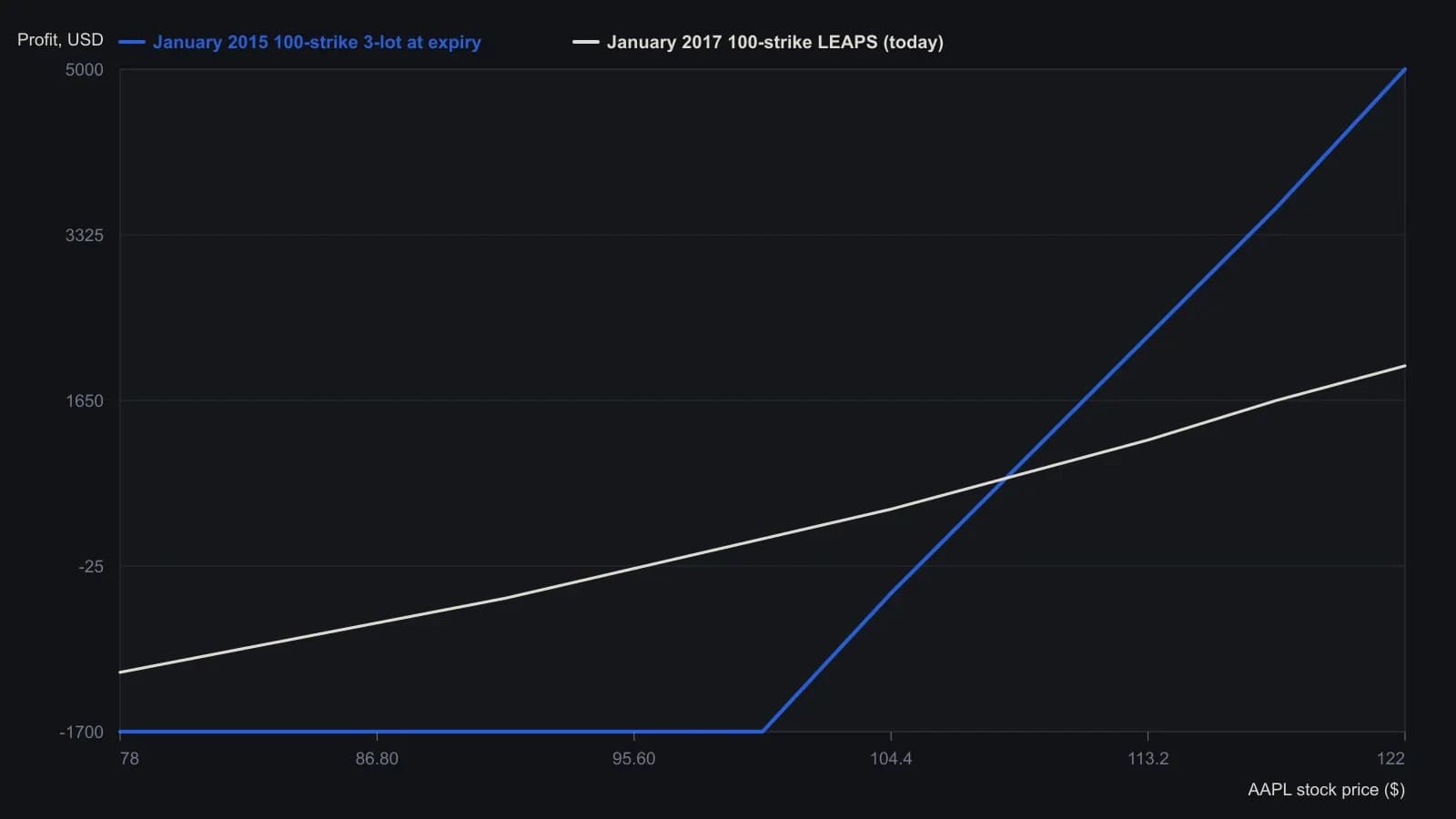
Trade 1 is long three January 2015 100 calls at 5.5; trade 2 is long one January 2017 100 call at 17. The overlay also shows extra days-to-expiration and volatility traces; only the January 2015 expiration payoff and the January 2017 current line were digitized.
Delta as equivalent share exposure
Delta hedging in this workflow means reading an option's delta as an equivalent share holding. The two expirations can then be compared as stock-like exposure rather than as a raw contract count.
Under that risk budget, the nearer-dated 100 call translated to about 158 shares of delta exposure, while the 2017 100 call translated to about 54 shares.
Gamma, theta, and vega
The nearer-dated call showed higher gamma than the longer-dated call, consistent with front-month options carrying more gamma than back-month options. Gamma is how quickly delta changes as the underlying moves, and nearer expirations typically carry more of it than long-dated contracts.
The extra gamma in the nearer expiration was paired with greater theta decay. Theta is the daily time-decay cost of holding an option, and it is the usual tradeoff paid for higher front-month gamma.
On a contract-by-contract basis, the longer-dated call had higher vega and was more sensitive to a change in implied volatility. Vega is the sensitivity of option value to a change in implied volatility, and longer-dated contracts typically show more of it on a per-contract basis.
Implied volatility and an unchanged underlying
Implied volatility is the expected-move level priced into options. It is used to judge whether a long call is relatively cheap and how a volatility rise would revalue the position even if the underlying is unchanged.
Implied volatility in the example stock was rising with broader-market volatility, yet stood at 25 and remained low relative to other leading technology names.
A rise in implied volatility with no change in the underlying price would increase the value of the long-call position.
All readings on this track · 21 readings
- 1988Constructing regime-aware option income from implied volatility
- 1989Constructing a delta-hedged implied versus historical volatility book
- 1990How a 1989 Eurodollar break turned cheap volatility into a regime-aware book
- 1991Constructing a perishable delta hedge from option moves
- 1991Option deductibles that bound position risk
- 2002Option premium, delta, and volatility-regime spreads
- 2004Option loss pacing with spreads and protective puts
- 2004Delta-neutral options as regime-aware portfolio insurance
- 2004Late-cycle expiration loss and skew as regime context
- 2007Short-term call construction under volatility regimes
- 2008Constructing a limited-risk option spread from volatility and delta
- 2008Option greeks as pre-strategy construction checks
- 2008Hedging a short KOSPI 200 options mix for delta and vega
- 2010Delta hedging as context, not cover
- 2010A margin call as a net-delta budgeting problem
- 2012Strike-level open interest as a hedge and pin map
- 2013Constructing regime-aware overlays from commodity option greeks
- 2013Currency option venues as a straddle and hedge case study
- 2014Long-dated versus near-term calls as a volatility regime
- 2018Constructing regime-aware option books from net greeks
- 2020Custom-delta option spreads for a limit-locked futures book