2004issue C121-4
Late-cycle expiration loss and skew as regime context
A late-cycle options book can be read as regime context by pairing the expiration-loss trough with the put-call skew point, then classifying a short-dated strike as a symmetric pin, a mirrored expiration range, or a hedge the book cannot hold.
- Money already wagered across strikes is treated as usable information about expiry location, even though a precise real-odds number is described as impossible to set.
- Identical expiration-loss and skew markers are treated as the most symmetric and most informative case. When the troughs diverge, the gap is reflected into a mirrored expiration range, and a wider gap is described as less predictive.
- After dealers neutralize residual delta, the late-cycle delta hedge window is when the underlying is said to track toward the expiration-loss trough. Sharper loss curves and larger notional at stake are presented as making that strike more likely to be defended, while heavy equity short interest is described as overpowering the signal.
- Editorial reading: use that pair of markers as a regime overlay for one short-dated strike, not as a standalone forecast.
A late-cycle book as regime context
Money already wagered across strikes is treated as usable information about expiry location. A precise real-odds number is described as impossible to set. The archive still reads that wagered money as information about where expiry may land.
Editorial reading: treat one late-cycle options book as a regime overlay, not a standalone forecast. Pair the expiration-loss trough with put-call dollar imbalance, then classify whether a single short-dated strike sits in a symmetric pin, a mirrored expiration range, or a hedge the book cannot hold.
The expiration-loss trough and the put-call skew point
Maximum loss is defined as combined put and call dollar value by strike. That level is the expiration-loss trough: the strike where combined put and call dollar value at expiry would be smallest for the option book, used as a candidate pinning level.
The put-call skew point is their difference, the strike where the dollar gap between puts and calls is most extreme, used to flag one-sided wagering. Mismatched troughs are read as a one-sided implied-volatility tilt rather than a random bell curve.
When those troughs diverge, the gap is reflected to the opposite side of the distribution to form a mirrored expiration range. A wider gap is described as less predictive. Identical troughs are treated as the most symmetric and most informative case.
QQQ expiration-loss and put-call skew by strike, 13 June 2004
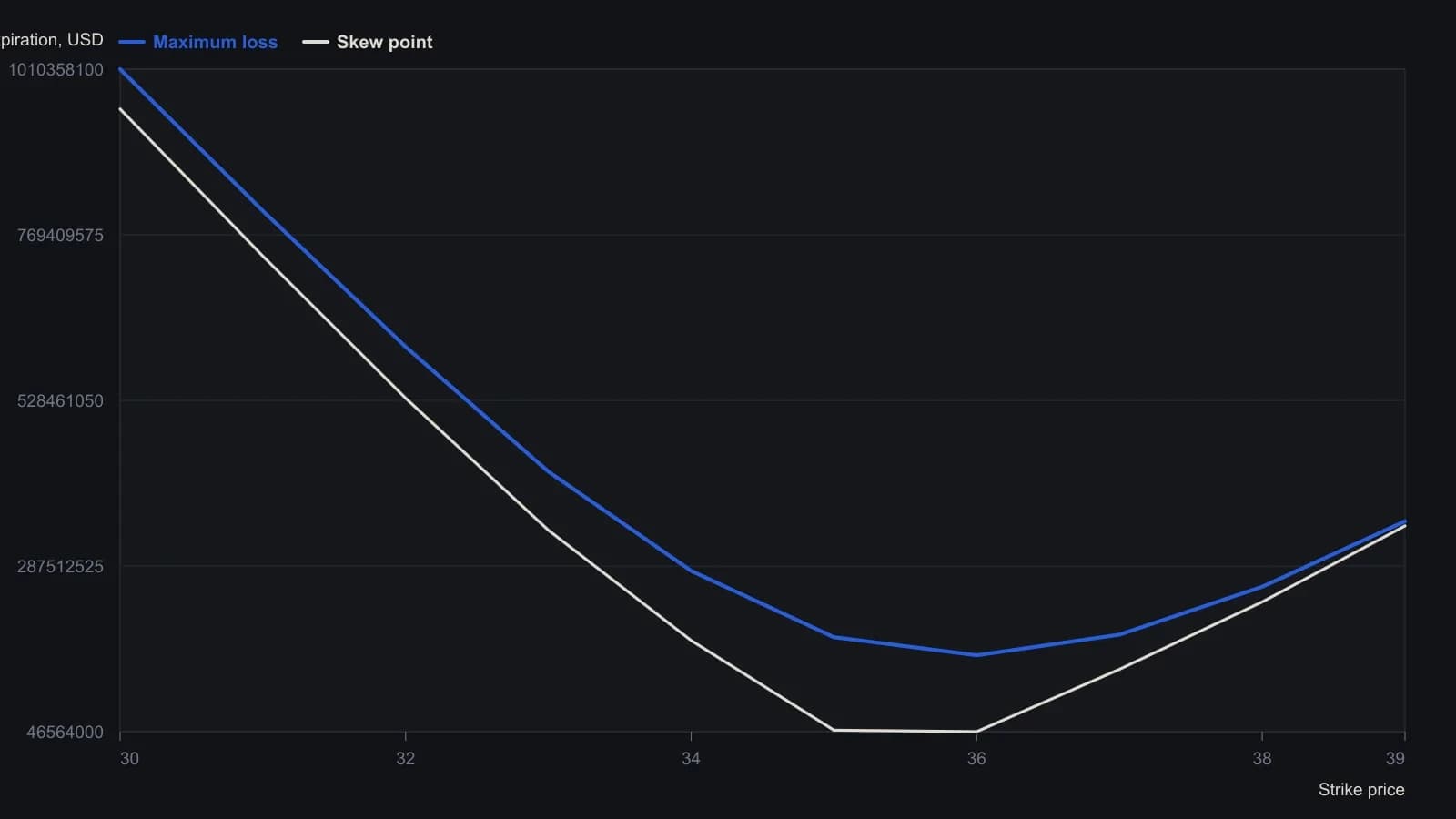
Maximum loss is call dollar value plus put dollar value; skew point is their difference. The source read the book in the last seven sessions before expiration and warned that heavy short interest overwhelms the pin.
Dated snapshots
An SPX expiration-loss snapshot dated 13 June 2004 placed the expiration-loss trough at 1100, the put-call skew point at 1060, and a suggested band from 1100 to 1140. Settlement was 1129.60 and the close was 1135.02.
The same-session OEX snapshot placed the expiration-loss trough at 550 and the put-call skew point at 545, suggesting 550 to 555, with a close of 554.81. QQQ had both markers at 36 and expired at 36.44.
NDX on 13 June 2004 showed an expiration-loss trough at 1425 and a put-call skew point at 1400, suggesting 1425 to 1450. Settlement at 1457.35 and a close at 1464.65 sat outside that band.
IBM on 11 June 2004 had both markers at 90 and closed at 90.06.
Late-cycle delta hedge and notional defense
Dealer delta-neutral hedging is described as clustering around the Wednesday ten sessions before expiry. After that clustering, the final seven sessions are used to draw the curves, and the underlying is said to track toward the expiration-loss trough.
That later window is the late-cycle delta hedge: after dealers neutralize residual delta, the underlying may gravitate toward a heavily defended strike. Sharper loss curves and larger notional at stake are presented as making an indicated strike more likely to be defended. That is notional defense.
Heavy equity short interest is described as overpowering that expiration-loss signal.
All readings on this track · 21 readings
- 1988Constructing regime-aware option income from implied volatility
- 1989Constructing a delta-hedged implied versus historical volatility book
- 1990How a 1989 Eurodollar break turned cheap volatility into a regime-aware book
- 1991Constructing a perishable delta hedge from option moves
- 1991Option deductibles that bound position risk
- 2002Option premium, delta, and volatility-regime spreads
- 2004Option loss pacing with spreads and protective puts
- 2004Delta-neutral options as regime-aware portfolio insurance
- 2004Late-cycle expiration loss and skew as regime context
- 2007Short-term call construction under volatility regimes
- 2008Constructing a limited-risk option spread from volatility and delta
- 2008Option greeks as pre-strategy construction checks
- 2008Hedging a short KOSPI 200 options mix for delta and vega
- 2010Delta hedging as context, not cover
- 2010A margin call as a net-delta budgeting problem
- 2012Strike-level open interest as a hedge and pin map
- 2013Constructing regime-aware overlays from commodity option greeks
- 2013Currency option venues as a straddle and hedge case study
- 2014Long-dated versus near-term calls as a volatility regime
- 2018Constructing regime-aware option books from net greeks
- 2020Custom-delta option spreads for a limit-locked futures book