2012issue C0963-64
Strike-level open interest as a hedge and pin map
A listed-exchange display made equity-option open interest comparable across calls, puts, expiries, and strikes. This archive article reads that snapshot as a hedge-flow map: locate clusters first, then ask whether delta-hedging or pin defense could reinforce those prices.
- Compare open interest across calls, puts, expiries, and strikes instead of reading one contract in isolation.
- Use the raw open-interest total with the session-to-session open-interest difference to see standing books and fresh clustering together.
- Large concentrations, including far out-of-the-money clusters, were treated as candidate support and resistance that later hedge flow might reinforce.
- A heavy book at one strike was linked to pin risk, because defending or unwinding that book can create temporary, position-driven levels.
A listed-exchange display of equity-option open interest was introduced so positioning could be compared across calls, puts, expiries, and strikes instead of scanning each contract in isolation. Open interest is the number of option contracts still outstanding at a given expiry and strike.
Treat clusters as candidate levels
Large open-interest concentrations at individual strikes were presented as candidate support and resistance for the related equity-index market. In this workflow, support and resistance are price zones inferred from large standing option books, where later hedging or defensive trading may slow or reverse a move.
Out-of-the-money options were described as typically more active, so unusually large open interest in far out-of-the-money strikes was treated as a possible support or resistance cue. An out-of-the-money cluster is a buildup of outstanding contracts away from the current index level, treated as a possible mechanical level rather than as a forecast.
The July 2012 snapshot
The illustrated case used July 2012 S&P 500 option open interest and open-interest difference on 16 July 2012. Spikes in both series were used to mark levels.
Open-interest difference is the change in outstanding contracts between the current session and the prior trading session. It was read alongside raw open-interest spikes so a fresh cluster could be seen next to the standing book.
July 2012 E-mini S&P 500 call open interest by strike
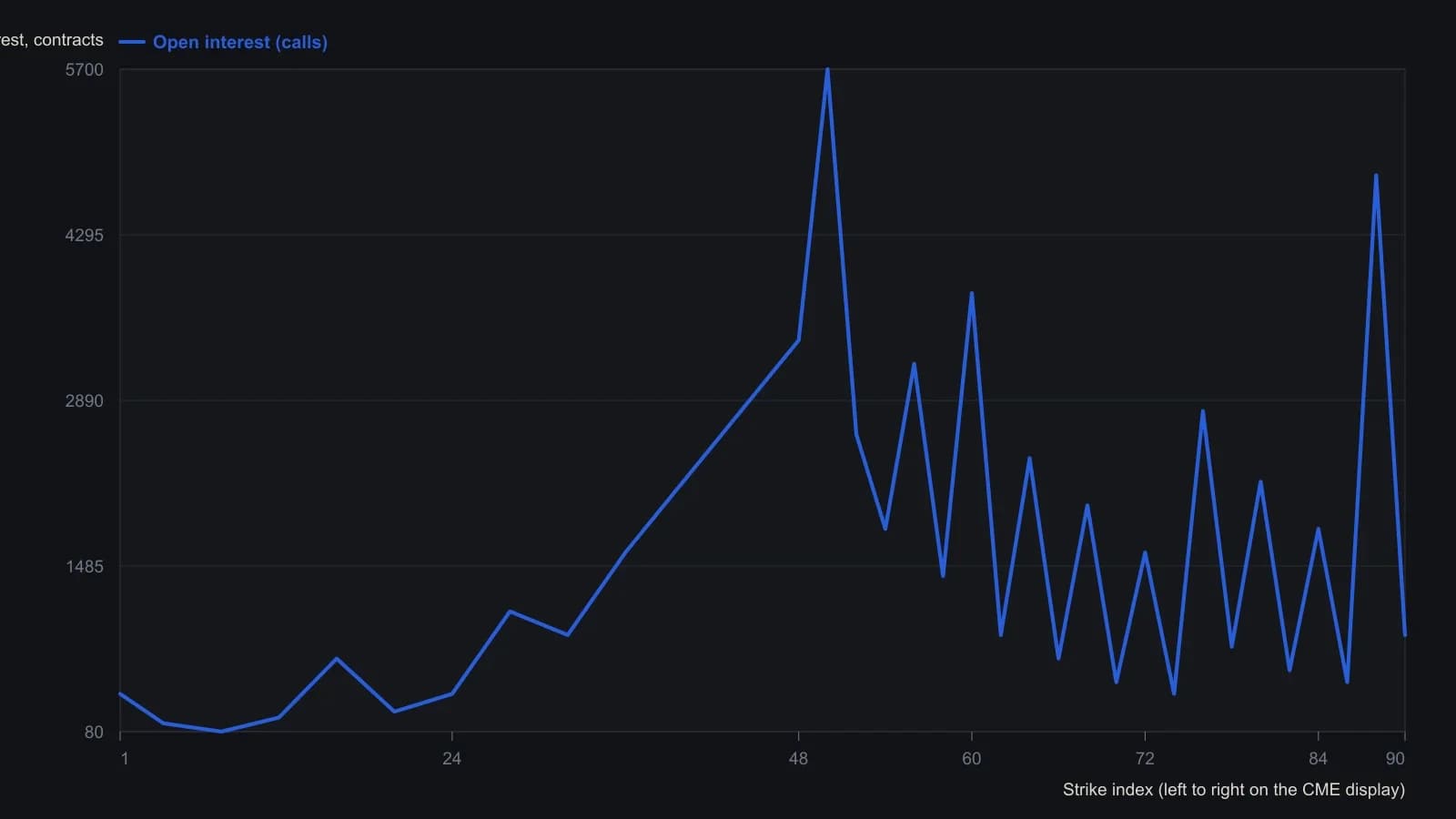
Raster has no printed strike or contract labels on the x-axis and no data table. Series is approximate call open interest versus strike index (left to right as plotted). Put series is present in the legend but not separable on the fill. Cap at digitized peaks; do not treat as exact exchange prints.
Delta-hedging around a large book
A worked hedge sized a short 50-futures overlay against a long 100-call book whose delta was 0.50. Delta-hedging means neutralizing an option book's directional exposure with an offsetting futures position sized to the book's delta.
Delta-hedging activity around strikes that already held large open interest was described as a mechanism that can reinforce support or resistance near those strikes.
Pin risk at a defended strike
Heavy open interest at one strike was linked to pin risk: a participant defending that book might create temporary, position-driven support or resistance. Pin risk is the chance that price is pulled toward a strike that holds a large option book as that book is defended or unwound, especially near expiry.
All readings on this track · 21 readings
- 1988Constructing regime-aware option income from implied volatility
- 1989Constructing a delta-hedged implied versus historical volatility book
- 1990How a 1989 Eurodollar break turned cheap volatility into a regime-aware book
- 1991Constructing a perishable delta hedge from option moves
- 1991Option deductibles that bound position risk
- 2002Option premium, delta, and volatility-regime spreads
- 2004Option loss pacing with spreads and protective puts
- 2004Delta-neutral options as regime-aware portfolio insurance
- 2004Late-cycle expiration loss and skew as regime context
- 2007Short-term call construction under volatility regimes
- 2008Constructing a limited-risk option spread from volatility and delta
- 2008Option greeks as pre-strategy construction checks
- 2008Hedging a short KOSPI 200 options mix for delta and vega
- 2010Delta hedging as context, not cover
- 2010A margin call as a net-delta budgeting problem
- 2012Strike-level open interest as a hedge and pin map
- 2013Constructing regime-aware overlays from commodity option greeks
- 2013Currency option venues as a straddle and hedge case study
- 2014Long-dated versus near-term calls as a volatility regime
- 2018Constructing regime-aware option books from net greeks
- 2020Custom-delta option spreads for a limit-locked futures book