1991issue C081
Constructing a perishable delta hedge from option moves
A short move in an option versus its underlying can be read as a hedge ratio. That weight covers only the next small move and must be rebuilt once price leaves the strike.
- Option delta is the share of a small underlying price change that shows up in the option price, positive for calls and negative for puts.
- Moneyness pulls a call toward a full one-for-one response, a near-zero response, or about a half response, and the same path runs in reverse for puts.
- One archive session showed June 380 calls up 1.30 points and June 380 puts down 1.70 points while June S&P 500 futures rose 3.05 points, a realized call delta of 43% and a realized put delta of -56%.
- Used as a hedge ratio, one at-the-money call offset 43% of near-term exposure, a perishable weight that changes as the underlying leaves the strike.
Delta as a hedge ratio
Option delta is the share of a small underlying price change that shows up in the option price. A call’s delta is positive and a put’s delta is negative. In the archive workflow that same share is the hedge ratio: it sizes how much near-term exposure an option offsets.
How moneyness sets the response
Moneyness is where the underlying sits relative to the strike, which pulls a call toward a full one-for-one response, a near-zero response, or about a half response. A call’s delta is near 1 when the underlying is well above the strike, near 0 when well below, and near 0.50 when the two prices match. A put’s delta approaches -1 as the underlying trades well below the strike and approaches 0 as the underlying trades well above the strike.
A session of realized deltas
From one session to the next, June 380 calls rose 1.30 points and June 380 puts fell 1.70 points while June S&P 500 futures rose 3.05 points, implying a realized call delta of 43% and a realized put delta of -56%. With a $500 multiplier, that 3.05-point futures move equaled $1,525, the call’s 1.30-point gain equaled $650, and the put’s 1.70-point loss equaled $850.
Sizing the near-term offset
Treating delta as a hedge ratio, buying one at-the-money call against a short June S&P 500 futures position offset 43% of near-term exposure in that example. Near-term exposure is the slice of portfolio risk the hedge is meant to cover only for the next small move, not for a lasting regime.
A perishable weight
Delta is an instantaneous measure of the option’s response to a short-term underlying move and changes as the underlying moves away from the strike. The hedge size is a perishable weight: it must be rebuilt after the underlying leaves the strike because the option’s response rate changes.
One-session point moves that produced the June 380 deltas
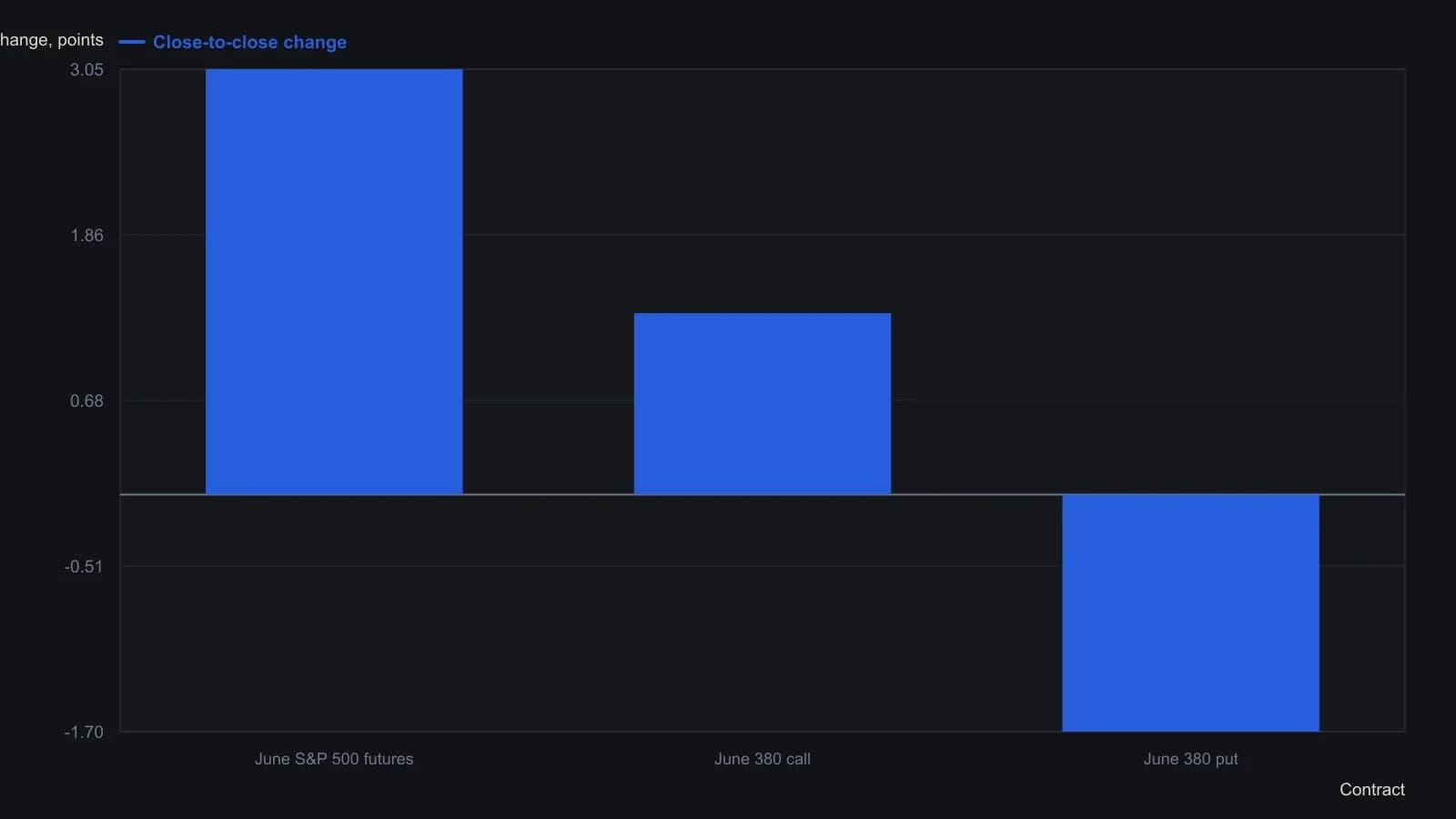
Each option delta is that contract’s point change divided by the 3.05-point futures change. The sidebar treats those weights as valid only while price stays near the 380 strike.
All readings on this track · 21 readings
- 1988Constructing regime-aware option income from implied volatility
- 1989Constructing a delta-hedged implied versus historical volatility book
- 1990How a 1989 Eurodollar break turned cheap volatility into a regime-aware book
- 1991Constructing a perishable delta hedge from option moves
- 1991Option deductibles that bound position risk
- 2002Option premium, delta, and volatility-regime spreads
- 2004Option loss pacing with spreads and protective puts
- 2004Delta-neutral options as regime-aware portfolio insurance
- 2004Late-cycle expiration loss and skew as regime context
- 2007Short-term call construction under volatility regimes
- 2008Constructing a limited-risk option spread from volatility and delta
- 2008Option greeks as pre-strategy construction checks
- 2008Hedging a short KOSPI 200 options mix for delta and vega
- 2010Delta hedging as context, not cover
- 2010A margin call as a net-delta budgeting problem
- 2012Strike-level open interest as a hedge and pin map
- 2013Constructing regime-aware overlays from commodity option greeks
- 2013Currency option venues as a straddle and hedge case study
- 2014Long-dated versus near-term calls as a volatility regime
- 2018Constructing regime-aware option books from net greeks
- 2020Custom-delta option spreads for a limit-locked futures book