2007issue C081-5
Long-call adjustment via a synthetic straddle
A limited-risk long call first expresses a bullish technical objective more cleanly than the underlying, then becomes leftover inventory. Short stock converts that inventory into a long-premium synthetic straddle, and later stock trades reset delta at chart landmarks instead of adding to the original one-way size.
- The case begins with a limited-risk long call chosen to express a bullish technical objective more cleanly than the underlying, then shifts to money-management adjustments of that inventory.
- A synthetic straddle pairs long calls with short stock, or long puts with long stock, to negate directional delta and leave a long-premium options-straddle whose value can rise with larger realized swings and with higher implied volatility.
- Shorting 600 shares against 10 in-the-money May 22.50 calls at a resistance adjustment-zone reduced residual delta to about +35 and left upside convexity that a full 1000-share hedge would have turned into a synthetic long put.
- Later 100-share and 200-share buys at a 50 percent retracement, on earnings, and at a key extension were used to keep the synthetic-option-position nearer neutral after the calls fell far out of the money.
From a bullish call to inventory
The case begins with a limited-risk long call chosen to express a bullish technical objective more cleanly than the underlying. The work then shifts to money-management adjustments of that leftover inventory.
How a synthetic straddle is assembled
A synthetic straddle pairs long calls with short stock, or long puts with long stock, to negate directional delta. A one-contract-to-100-share ratio becomes a synthetic-option-position that replicates a put or a call.
Once assembled, the book is a long-premium options-straddle stance whose value can rise with larger realized swings and with higher implied volatility. Delta-hedging offsets option delta with stock so remaining exposure tracks changing prices, volatility, and time rather than the original one-way thesis.
Resistance as an adjustment-zone
After the underlying reached a predefined resistance zone in nearly three weeks, the unhedged May 22.50 calls were in the money, closer to expiration, and exposed to an approaching earnings date that can lift implied volatility. An adjustment-zone is a predefined technical area, such as resistance or a retracement, used as a cue to rebalance delta instead of adding to the original directional size.
Shorting 600 shares against 10 long calls reduced residual delta to about +35 and converted the payoff so a large enough move in either direction could increase position value.
Partial hedge versus a full synthetic put
Hedging only 600 of a possible 1000 deltas left residual upside convexity. If price returned to the 22.50 strike by expiration with no further hedges, the 10 calls bought for a 1000 debit would expire and covering 600 shares from 23.30 would leave a 520 net loss.
A full 1000-share hedge would create a synthetic long put whose 30 upside path would produce a 200 net loss.
Partial 600-share hedge versus booking the XMSR calls
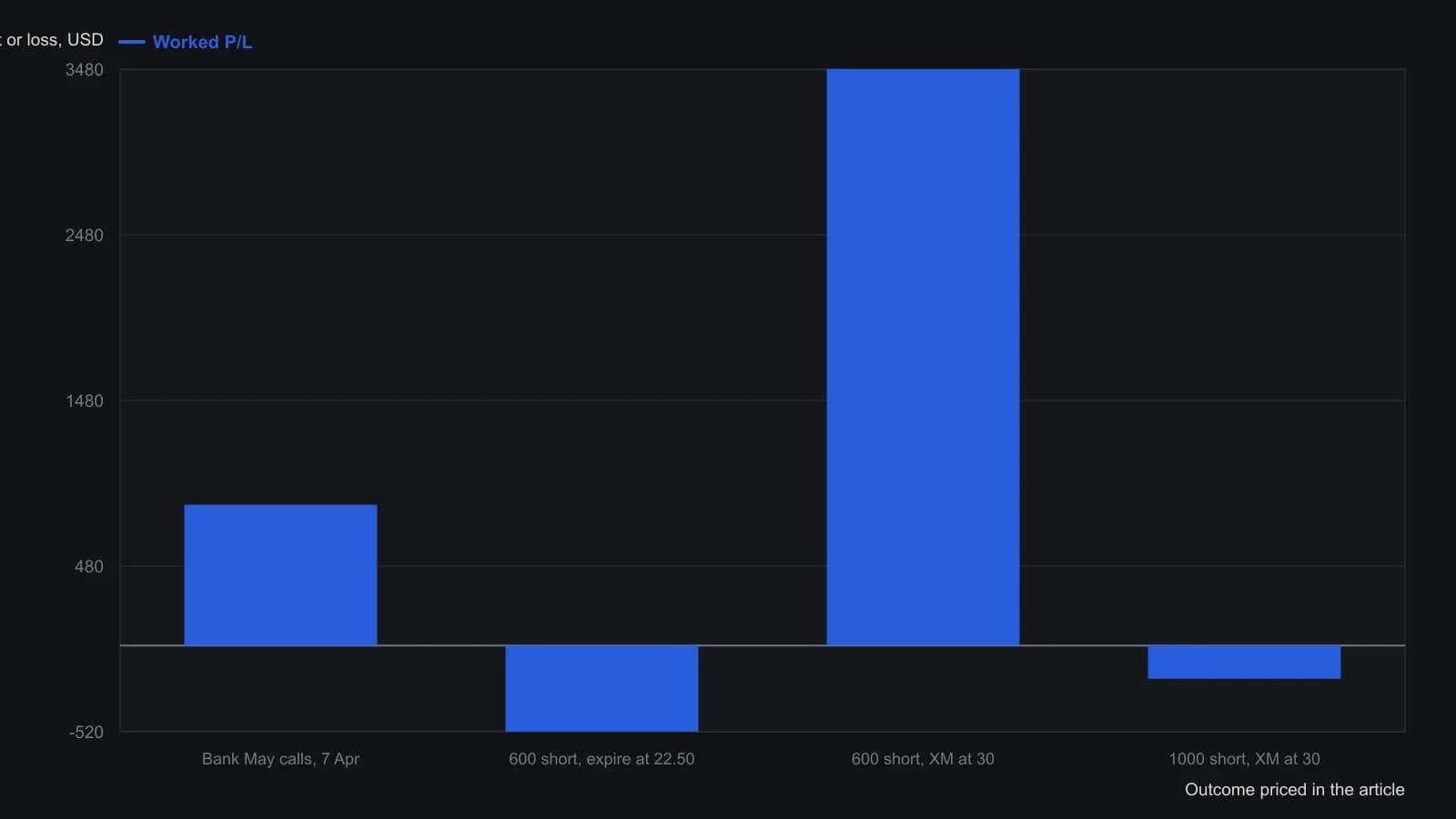
The 3480 uses the article’s 7500 of call value minus a 4020 loss on 600 shares short from 23.30 and does not net out the original 1000 debit the same way the 850 mark does. The 27 April “nearly 600” full exit and the “less than 122” later max-risk line are omitted because they were not given as exact prints.
Later stock resets at chart landmarks
Later delta-hedging used 100-share and 200-share buys at a 50 percent retracement and on earnings to keep the synthetic-option-position nearer neutral, including a slight downward lean under -100 deltas.
After a decline that left the May 22.50 calls far out of the money with about 17 days to expiration, the book sat near -250 delta with 300 short shares still on, so at least 200 shares needed to be bought at a key extension to flatten most directional risk.
All readings on this track · 16 readings
- 1990Synthetic option parity in limit-locked futures
- 1991Constructing synthetic option positions with puts and spreads
- 1991Synthetic stock and protective put payoff construction
- 1993Equivalent option strategies as a capital and execution checklist
- 1993Keep a futures loss bounded when stops fail
- 2001Financed call ratio repair for a gapped long
- 2003Synthetic long construction with delta and margin checks
- 2003Cash-covered split-synthetic after a decline
- 2004Constructing synthetic calls and puts with stock
- 2006In-the-money calls as bounded synthetic leverage
- 2006Credit construction of a synthetic long call via futures and a long put
- 2006Convert a support-and-resistance range into one synthetic option procedure
- 2007Long-call adjustment via a synthetic straddle
- 2008Constructing protective puts and synthetic option packages
- 2018An uneven vertical debit spread as a stock proxy
- 2020Out-of-the-money strikes as a delta budget for synthetic futures