1989issue C121-6
Constructing a delta-hedged implied versus historical volatility book
Options can be assembled into a volatility trade that asks whether implied volatility looks cheap or expensive. A frequently adjusted hedge sized to the option's delta largely removes directional bias, so the book is exposed to implied volatility at entry and to later historical volatility.
- A volatility trade pairs a fixed option position with frequent delta hedging so the book is judged on cheap or expensive implied volatility, not on the direction of the underlying.
- Implied volatility is recovered from the option's current market price and can be compared across strikes and remaining lives. Historical volatility later describes how the underlying actually moved.
- The book can mark a result from a relatively rapid shift in implied volatility, or from later historical volatility differing from the implied volatility at which the options were established.
- Volatility sensitivity is largest for longer-dated at-the-money options, and peaked, fat-tailed, trending, or overnight-gap markets can make hedge rebalancing diverge from a simple implied-versus-historical comparison.
Options can be assembled into volatility trades that bet on whether implied volatility looks cheap or expensive rather than on the direction of the underlying.
A pure volatility construction pairs a fixed option position with a frequently adjusted underlying hedge sized to offset the option's delta, largely removing directional bias. Small price moves then largely cancel at the book level.
Implied volatility as the entry price
Implied volatility is recovered by treating volatility as the unknown in a Black-Scholes-type pricing formula and solving so the formula equals the option's current market price. That input is the market's assessment of remaining-life variability, and it lets cheapness or richness be compared across strikes and remaining lives.
Historical volatility as the later record
Historical volatility is a backward-looking dispersion statistic, often the standard deviation of daily percentage price changes, used to describe how the underlying actually moved. That definition assumes roughly normal increments, but traded instruments typically show more very large and very small moves and fewer intermediate moves than that assumption implies.
Dec 89 Eurodollar implied volatility, Dec 1988–Aug 1989
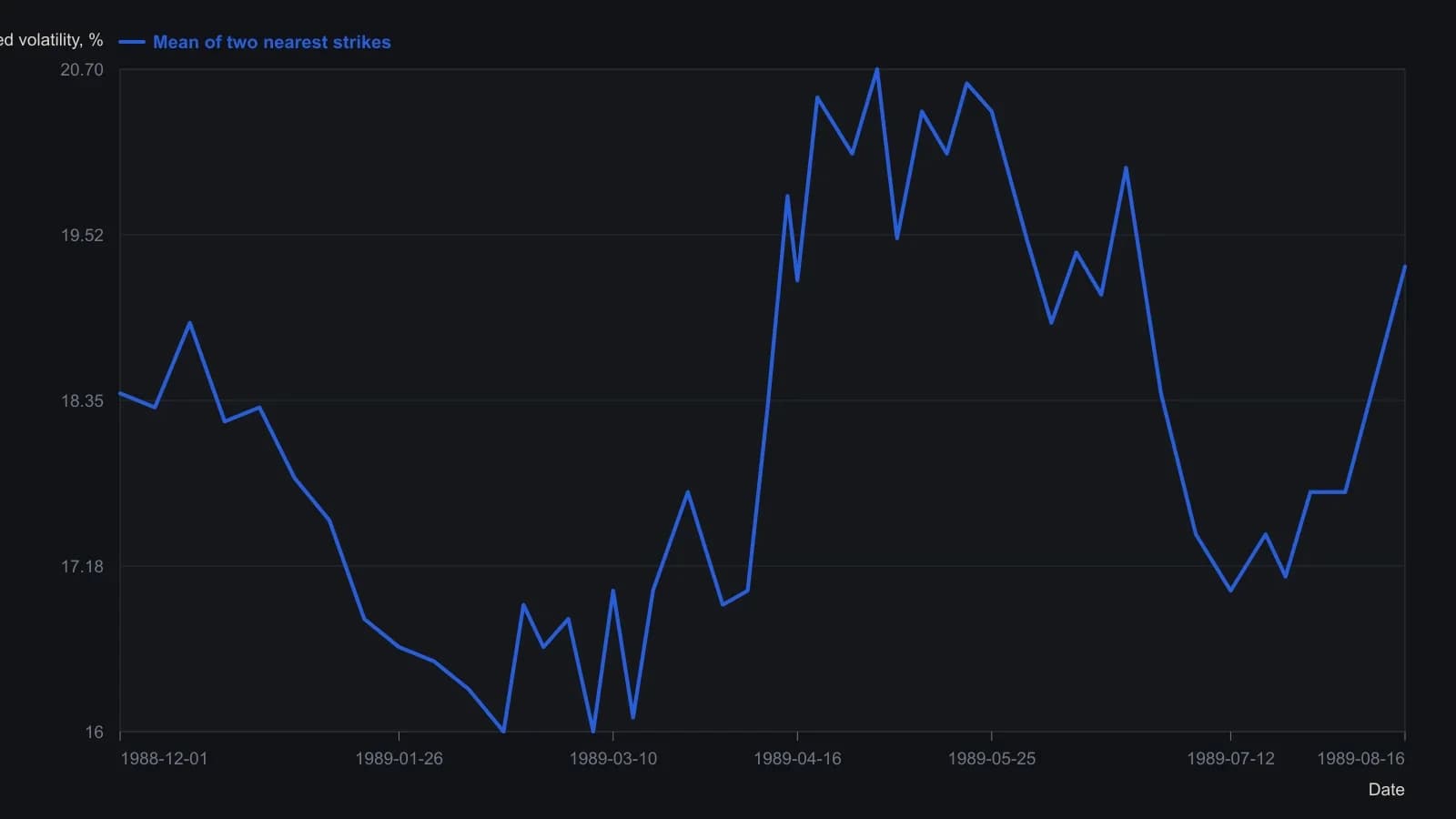
Source plots the mean implied volatility of the two strikes nearest the money. Dates and percent levels are read from the raster against monthly ticks and 1-point horizontal gridlines, so values are approximate to about 0.1–0.2 volatility points. The series ends shortly after the August 1989 tick; the axis continues to October with no further observations.
A net-delta-zero volatility book
Such a book can mark a gain or loss from a relatively rapid shift in implied volatility, or from later historical volatility differing from the implied volatility at which the options were established.
In a worked bond-futures construction, buying 100 of the 96 calls and selling 42 futures produced a net-delta-zero long-volatility book described as long volatility at 10 percent.
Volatility sensitivity and the hedge calendar
Volatility sensitivity is the change in option value for a small change in implied volatility. It is largest for longer-dated at-the-money options, so volatility books built with those contracts are more risky than books built with shorter-dated out-of-the-money options.
Gamma rebalancing resets the hedge as delta changes with the underlying. Long-volatility rebalancing buys the underlying after declines and sells after advances. Short-volatility hedges reverse that schedule, often taking losses in large discrete chunks, and the two sides ask for different execution styles.
All readings on this track · 21 readings
- 1988Constructing regime-aware option income from implied volatility
- 1989Constructing a delta-hedged implied versus historical volatility book
- 1990How a 1989 Eurodollar break turned cheap volatility into a regime-aware book
- 1991Constructing a perishable delta hedge from option moves
- 1991Option deductibles that bound position risk
- 2002Option premium, delta, and volatility-regime spreads
- 2004Option loss pacing with spreads and protective puts
- 2004Delta-neutral options as regime-aware portfolio insurance
- 2004Late-cycle expiration loss and skew as regime context
- 2007Short-term call construction under volatility regimes
- 2008Constructing a limited-risk option spread from volatility and delta
- 2008Option greeks as pre-strategy construction checks
- 2008Hedging a short KOSPI 200 options mix for delta and vega
- 2010Delta hedging as context, not cover
- 2010A margin call as a net-delta budgeting problem
- 2012Strike-level open interest as a hedge and pin map
- 2013Constructing regime-aware overlays from commodity option greeks
- 2013Currency option venues as a straddle and hedge case study
- 2014Long-dated versus near-term calls as a volatility regime
- 2018Constructing regime-aware option books from net greeks
- 2020Custom-delta option spreads for a limit-locked futures book