2013issue C0422-25
Classify the origin low before counting the next advance
After the October 2007 high, the 517-day drop into March 2009 did not match a standard decline band. The next basic advance was counted from the November 20, 2008 secondary low, and middle-section intervals then projected later turning points in 2010 and early 2013.
- Standard time spans group historical advances into four duration bands, so a 900-day advance is treated as an impossible count.
- A 517-day decline from the October 2007 high into March 2009 is outside the standard decline bands, so the next advance is not counted from that ultimate low.
- The principle of continuity starts the next basic advance at the November 20, 2008 secondary low, which arrived on the 13 to 14 month schedule expected after a bull-market high.
- Equal-distance middle-section counts projected a July 5, 2010 low, later checked against July 2, and a combined window from January 16 to February 24, 2013 for the end of the bull market.
Standard time spans accept only some day-counts
Historical advances are grouped into four standard time-span bands, including a subnormal group of 414-615 days and an extended group of 929-968 days. A 900-day advance does not belong to those clusters and is treated as an impossible count.
A basic advance is a classified upward interval counted from a designated origin low to a later high, grouped by standard duration rather than by the size of the price move. A basic decline is a classified downward interval whose length is expected to fall into one of a few standard duration bands after a prior high.
Lindsay standard time spans for basic advances and declines
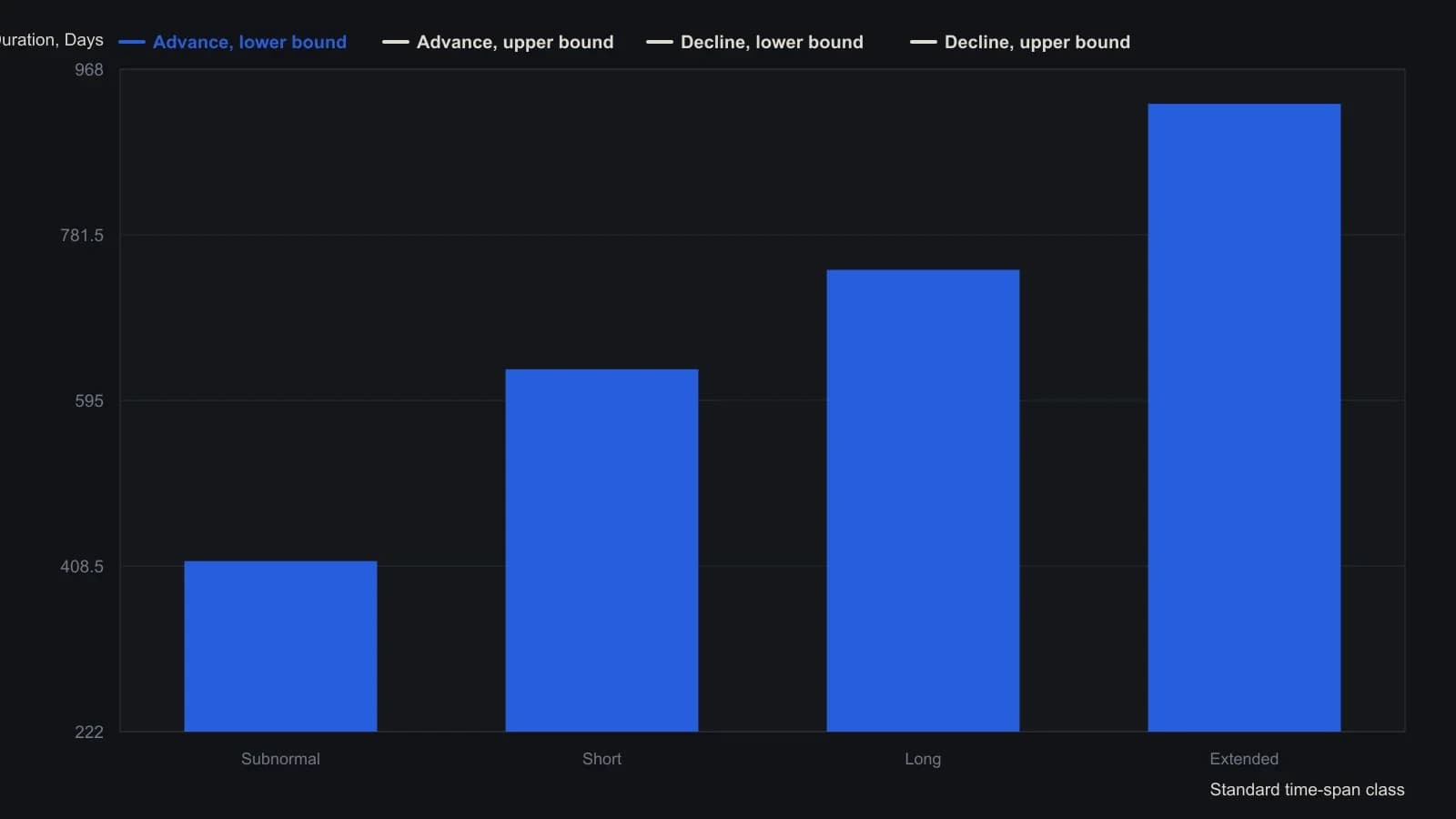
Extended declines are marked not applicable in the source table, so that class has no decline band.
Why the March 2009 trough is not the origin
After the October 2007 high, the decline into March 2009 lasted 517 days. That length does not appear among the standard decline bands, so the next advance is not counted from that ultimate low.
A temporary or secondary low is expected 13 to 14 months after a bull-market high. The 2007-2008 market bounced on that schedule, matching the long basic-decline window. The principle of continuity requires the next advance to be counted from the end of the previous classified decline, which in this case is the secondary low of November 20, 2008, not the later March 2009 trough.
The long-cycle low is not the next origin
Long cycles are described as about 20 years long. Each is split into two multiple cycles, and those multiple cycles themselves contain two to four basic cycles. The March 2009 low is treated as the end of a long cycle.
That larger role does not change the origin rule. The next basic advance is still counted from the November 20, 2008 secondary low rather than from the later long-cycle trough.
Middle-section counts after 2005
A descending middle section is identified by two rallies, E and G, to approximately the same level, then a final low. January 2005 is presented as such a structure even though its rallies were shorter than typical.
Counting 1,000 days from point E on January 12, 2005 to the October 9, 2007 top, then the same distance forward, projected a low on July 5, 2010 against an actual low on July 2, one trading day earlier.
An ascending middle section is a bull-market interval in which the rate of ascent slows relative to the advances that come before and after it. An August 10, 2005 count of 1,304 days to the March 6, 2009 long-cycle low implied a later high 1,309 days after that low, dated October 5, 2012.
A 1,451-day count from an earlier origin to the March 2009 low, repeated forward, targeted the end of the subsequent bull market on February 24, 2013 and was classified as an extended basic advance. Combining the middle-section projections produced an expected end of the bull market between January 16 and February 24, 2013.
All readings on this track · 14 readings
- 1982A three-category Fibonacci filter for wave setups
- 1985Three-check Fibonacci swings in Treasury bonds
- 1990Elliott labels and Fibonacci day counts on a reversal-volatility plot
- 1991Constructing Fibonacci time-cycle clusters from wave ratios
- 1992Constructing clustered static and dynamic cycle forecasts
- 1992Constructing a five-cycle time-ratio workbook
- 1998Constructing support-resistance oscillators and Fibonacci time zones
- 2003Constructing nested fifth waves with Fibonacci ratios
- 2010Seasons, the Wall cycle, and Fibonacci time on a 1949 long wave
- 2011Building Fibonacci and Lucas time-cycle markers
- 2013Contracting Fibonacci time posts as a dominant-cycle classroom case
- 2013Classify the origin low before counting the next advance
- 2014Calling a cycle end with range bars, median lines, and Fibonacci
- 2015Building reaction zones with swings and median lines