2003issue C091-3
Constructing nested fifth waves with Fibonacci ratios
A finished fifth wave can be redrawn at a smaller degree with the same Elliott labels left in place. The replica is then checked against 0.618 and 0.382 price geometry and against alternate-Fibonacci duration fractions.
- An Elliott wave construction treats market price as a robust fractal: nested swings keep a specified form while length and duration still vary.
- Self-affinity is tested by locking identical labels at two wave degrees and checking whether nested price spans sit on 0.618 and 0.382 retracement geometry.
- Nested durations are compared with the matching parent wave using alternate-Fibonacci fractions such as 2/5, 3/8, 5/13, 8/21, and 13/34.
- Counting motive and corrective subdivisions of a completed wave structure produces the Fibonacci integers 1, 1, 2, 3, 5, 8, 13, 21, 34, and 55.
A fifth wave as a drafting template
An Elliott wave construction treats market price as a robust fractal: nested swings keep a specified form while their length and duration still vary.
A fifth wave is the terminal motive leg of a completed five-wave advance, including the same-number component nested inside a larger fifth wave.
An idealized five-wave diagram can be redrawn through three iterations so that a wave in any relative position resembles the same-position wave at every plotted degree.
Lock the same labels at two degrees
Wave degree is the relative scale of a labeled swing, so a fifth wave at one degree can be compared with the fifth wave that contains it.
Elliott wave analysis is a labeled five-wave motive and three-wave corrective construction used to locate the same-position component at a larger or smaller degree.
On a monthly logarithmic industrial-average chart, the 1932 to 2000 advance is labeled as a fifth wave whose internal five-wave sequence itself ends in a boxed fifth-wave segment that began in 1974.
Count subdivisions into the Fibonacci sequence
Counting the motive and corrective subdivisions of a completed wave structure produces the Fibonacci integers 1, 1, 2, 3, 5, 8, 13, 21, 34, and 55.
Adjacent Fibonacci integers approach the limit ratio 0.618. Alternate Fibonacci integers approach 0.382.
The phi ratio is that 0.618 limit between adjacent Fibonacci integers, used as a price-span and retracement constant. The phi-squared ratio is the 0.382 limit between alternate Fibonacci integers, used both as a price-span fraction and as a family of duration ratios.
Test nested price spans on retracement geometry
Fibonacci retracement is a construction that places 0.618 and 0.382 price fractions against a completed swing to test whether component spans share that ratio family.
Price spans of the components of two distinct 1975 and 1977 countertrend swings were observed to align with Fibonacci-ratio expressions, the same ratio family used to construct retracement overlays.
In the idealized construction, each fifth wave and its internal components measure about 38 percent of the matching waves of the full structure, matching the 0.382 alternate-Fibonacci ratio.
Test nested durations on the alternate-Fibonacci time family
A Fibonacci time cycle compares the duration of a nested wave with the matching parent wave using alternate-Fibonacci fractions such as 2/5, 3/8, 5/13, 8/21, and 13/34.
In the historical fifth-of-a-fifth example, every inner-wave duration in years equaled a 0.382-family multiple of the matching parent-wave duration, using those successive alternate-Fibonacci fractions.
The same duration map lists nine time correspondences in which the inner fifth wave matches the parent fifth wave both as a whole and component by component.
Self-affinity is the construction test that two same-number waves at different degrees share form and stand in a Fibonacci proportion of price or time.
Inner fifth-wave years versus the parent fifth on the Dow
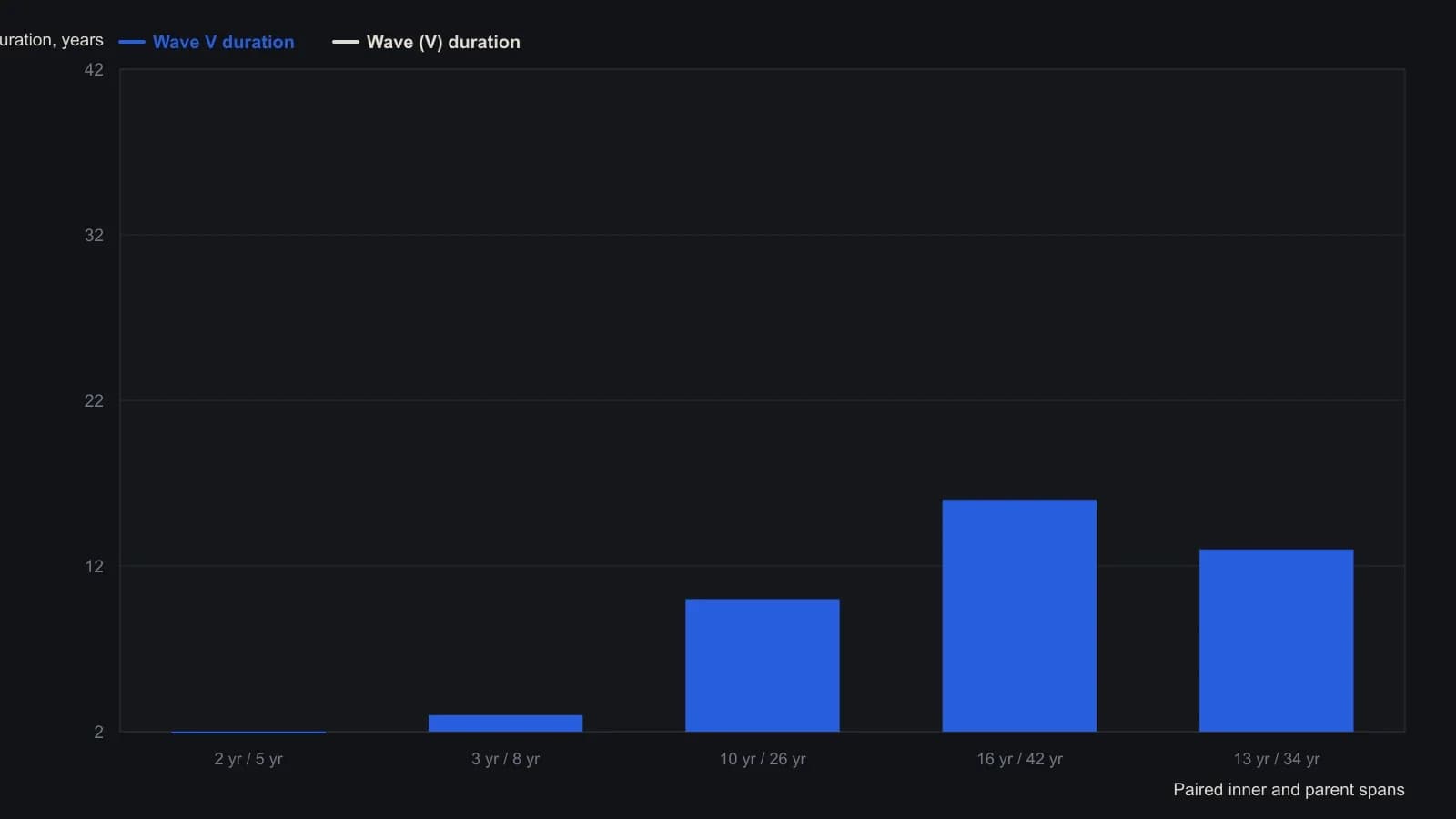
The article presents these pairs as the alternate-Fibonacci (0.382) duration set beginning at 2, and notes that 10/26 and 16/42 reduce to 5/13 and 8/21. The figure heading mentions nine time relationships; only these five year-counts are given in the prose.
All readings on this track · 14 readings
- 1982A three-category Fibonacci filter for wave setups
- 1985Three-check Fibonacci swings in Treasury bonds
- 1990Elliott labels and Fibonacci day counts on a reversal-volatility plot
- 1991Constructing Fibonacci time-cycle clusters from wave ratios
- 1992Constructing clustered static and dynamic cycle forecasts
- 1992Constructing a five-cycle time-ratio workbook
- 1998Constructing support-resistance oscillators and Fibonacci time zones
- 2003Constructing nested fifth waves with Fibonacci ratios
- 2010Seasons, the Wall cycle, and Fibonacci time on a 1949 long wave
- 2011Building Fibonacci and Lucas time-cycle markers
- 2013Contracting Fibonacci time posts as a dominant-cycle classroom case
- 2013Classify the origin low before counting the next advance
- 2014Calling a cycle end with range bars, median lines, and Fibonacci
- 2015Building reaction zones with swings and median lines