1985issue C021-4
Three-check Fibonacci swings in Treasury bonds
A completed swing waits on a fibonacci-fit: pattern-check, time-check, and ratio-check must each express the same integer series. The early-1980s Treasury-bond sequence is used here as an editorial drill in leaving a count open when a third major-wave or a later cycle date is still missing.
- A Fibonacci-based futures checklist splits into three independent tests. A fibonacci-fit exists only when pattern-check, time-check, and ratio-check all express the same integer series.
- Count both advances and declines as three-wave structures that mirror each other, nesting intermediate-wave and minor-wave labels when a major-wave may still be unfinished.
- Use a continuation-ratio of 1 or 1.618 on successive waves of similar degree, and a corrective-ratio of 0.382 or 0.618 mainly on pullbacks.
- Editorial practice: keep the count open when a third major-wave, a missing minor-wave, or a later Fibonacci cycle date has not yet appeared.
A completed swing waits on three checks
Editorial note: treat a completed swing as a three-lock problem. The wave count, the calendar length, and the measured price proportion must agree before the swing is closed.
A Fibonacci-based futures checklist can be split into three independent tests, pattern, time, and ratio. Each test is expected to express the same integer series before a swing is treated as complete. That provisional agreement is a fibonacci-fit.
Pattern-check
The pattern-check is a count of an advance or a decline as three waves. Those waves may nest minor-wave and intermediate-wave swings inside a major-wave.
In this checklist both advances and declines are counted as three-wave structures that mirror each other, rather than as an asymmetric two-wave decline. A two-wave map is therefore unfinished.
Time-check
The time-check asks whether wave spans, or a first wave plus its correction, land on Fibonacci durations such as 13 weeks or 89 days. The second wave and its correction are also expected to end on such a span.
Ratio-check
The ratio-check compares a wave or pullback length with 0.382, 0.618, 1, or 1.618 of a prior wave. A continuation-ratio of 1 or 1.618 is used mainly for successive waves of similar degree when projecting the next swing. A corrective-ratio of 0.618 or 0.382 is used mainly for corrections.
After a sharply oversold or overbought first swing, later corrections were described as nearer 38.2 percent. A typical advance from a non-oversold area was described as more often correcting about 61.8 percent.
Keep the Treasury-bond count open
An October 1981 Treasury-bond low near 55.00 was placed on an 89-week cycle low. Two completed major-wave swings were read as implying a required third major-wave. Editorial reading: the pattern-check stayed open until that third major-wave could be counted.
The 1983 peak and a completed time-check
Nested 1.618 projections from the minor-wave sequence were used to raise the upside objective to 80.00, later identified as the 1983 peak. After that peak a 55-week cycle landing just before the second intermediate-wave was treated as completing the time-check.
Mapping the decline from 80.00
The decline from 80.00 was mapped with a 1.618 objective from the first major down-wave, a 61.8 percent correction of the second major down-wave, and a third major down-wave to 59.16 as the 1.618 maximum projection of that second wave.
A missing minor-wave and a major turn
A missing minor-wave, the third, then made a slightly lower low on a 144-week cycle from the prior low near 55.00. After that low, pattern-check, time-check, and ratio-check were all treated as aligned for a major turn. Editorial reading: the larger decline stayed open while that minor-wave was missing, even after the 1.618 projection at 59.16 had been named.
The later advance still has a time marker
A later advance to 74.07 was mapped with the first two major-wave swings about equal, a 1.618 projection of the second wave at 73.16 on a 21-week cycle, then a 38.2 percent and a 61.8 percent retracement of the rise from 59.16. The next named time marker sat at 34 weeks. Editorial reading: the 34-week marker is a reason to keep the time-check, and therefore the whole count, under review after 74.07.
Weekly Treasury-bond futures, spring 1982 to March 1985
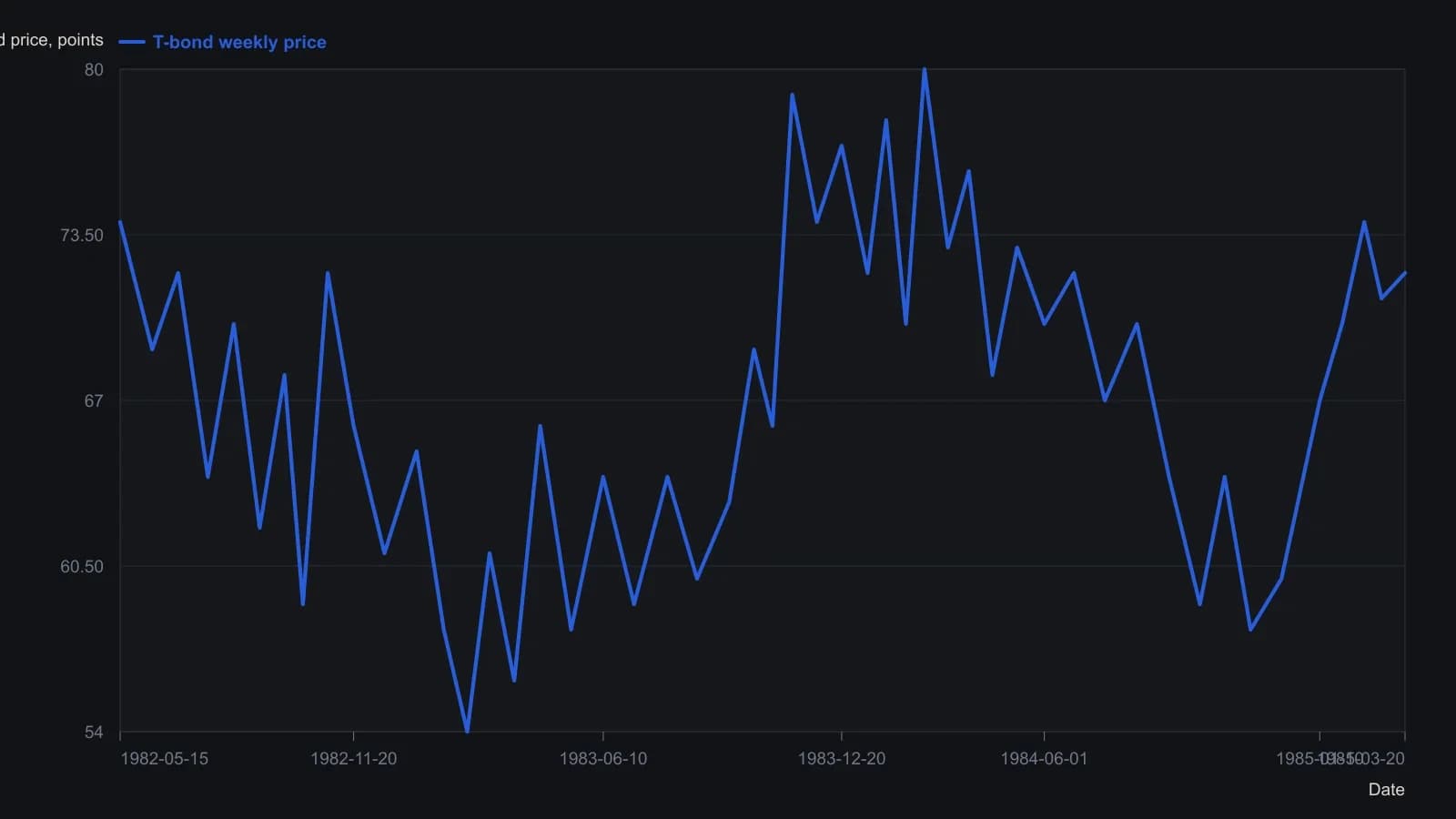
Closes were estimated from weekly OHLC bars on the printed page, to the nearest point. Dates follow the 1983, 1984, 1985 and March axis marks; the unmarked left edge is treated as spring 1982. Wave numerals and 1.618/61.8 arrows are the author’s annotations, not extra plotted series.
All readings on this track · 14 readings
- 1982A three-category Fibonacci filter for wave setups
- 1985Three-check Fibonacci swings in Treasury bonds
- 1990Elliott labels and Fibonacci day counts on a reversal-volatility plot
- 1991Constructing Fibonacci time-cycle clusters from wave ratios
- 1992Constructing clustered static and dynamic cycle forecasts
- 1992Constructing a five-cycle time-ratio workbook
- 1998Constructing support-resistance oscillators and Fibonacci time zones
- 2003Constructing nested fifth waves with Fibonacci ratios
- 2010Seasons, the Wall cycle, and Fibonacci time on a 1949 long wave
- 2011Building Fibonacci and Lucas time-cycle markers
- 2013Contracting Fibonacci time posts as a dominant-cycle classroom case
- 2013Classify the origin low before counting the next advance
- 2014Calling a cycle end with range bars, median lines, and Fibonacci
- 2015Building reaction zones with swings and median lines