1988issue C081-6
Constructing contrarian signals from polled consensus
A contrary entry is taken only after a participant poll shows one-sided agreement and a failed-news-check shows the popular side is already filled. Otherwise the procedure stays in abstention.
- The sole market-state input is a polled-consensus: a count of how many participants are bullish or bearish, not the size of any one account and not a fundamental or technical reason.
- A contrary-situation exists only when about 70 percent or more of participants share one view and that popular side is fully-positioned.
- The entry rule takes the opposite side once the majority is of one mind. Abstention remains the default because one-sided consensus is uncommon.
- The signal does not wait for the underlying facts to change. Price is treated as the result of participant action, and remaining capacity is attributed to minority-capacity on the unpopular side.
What the construction is doing
A contrary-situation is defined as existing when about 70 percent or more of participants share one view and are fully positioned. The entry rule takes the side opposite the prevailing majority once that majority is of one mind.
The poll as the only input
The required market-state input is a poll of how many participants are bullish or bearish. Reasons from fundamental or technical analysis are excluded from the rule.
That polled-consensus counts participants. It does not use the size of any one account's position to define the state.
Confirming that the majority is filled
Full positioning of the popular side is identified when news that supports that side fails to extend price in the expected direction. The failed-news-check is that confirmation.
Fully-positioned means the popular side has no residual same-side demand left to extend price.
Capacity on the unpopular side
In the zero-sum futures illustration, if 80 percent of traders are long, the average long holds about one-fourth as many contracts as the average short, so the minority side is treated as better financed. That reading is minority-capacity: the larger average size and greater staying power attributed to the unpopular side in a one-sided futures book.
After the majority is fully positioned, early exits by that crowd can force a sharp reversal because remaining capacity sits with better-financed holders of the unpopular side who cover only after a large move. The steepness of the contrary move is treated as increasing with the share of participants who share the same view.
Average bull versus bear contract size at each bullish-consensus level
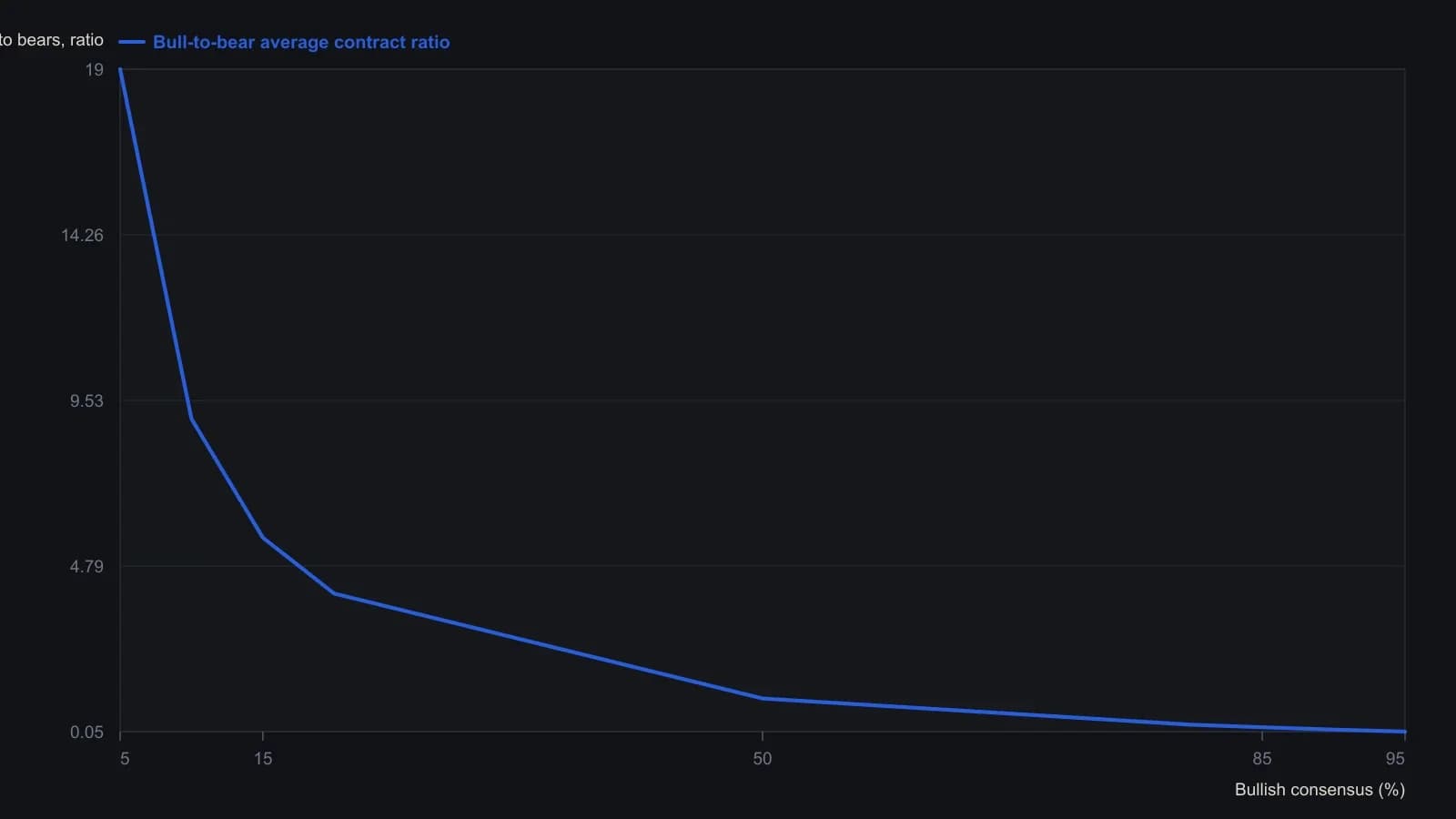
Each ratio is the zero-sum identity (100 minus the bullish share) divided by that share. The source writes the 15% and 85% cases as 5.6 rather than the unrounded 5.67.
Abstention as the usual state
One-sided consensus is described as uncommon, about once every two years in a stock market and about twice a year in a futures market, so the procedure stays inactive most of the time. Abstention is the default idle state when a contrary-situation is not present.
Action first, not a change in facts
Price is treated as the result of participant action rather than of facts, so a contrary signal does not wait for the underlying facts to change.
All readings on this track · 20 readings
- 1986A pre-trade checklist for crowded trading methods
- 1988Contrary decision process versus lagging bullish consensus
- 1988Constructing contrarian signals from polled consensus
- 1989Constructing a ten-input breadth diffusion score
- 1989Even-number first penetration as a construction problem
- 1991Joint strength and sentiment rules for entries and exits
- 1995Evaluating contrarian sentiment thresholds for bond futures
- 1998A weekly composite-score that classifies despair, euphoria, or neither
- 1998Lagged phase clocks for market cycles
- 2003Process rules when a correct view fails
- 2003Closing stops and equity-curve filters as one decision process
- 2003One procedure for entry, exit, and standing aside
- 2004Cross-index volatility gauges as a premium regime map
- 2005When trend rules need a losing filter
- 2006Evaluating sector breadth as a contrarian regime filter
- 2011Sideline patience versus crowd noise
- 2012Assembling a sentiment zone oscillator as one contrarian filter
- 2012Currency regime context for fading rallies
- 2014When late trend confirmation is a sideline signal
- 2017Write a daily contrarian rule from the closed-end-fund discount