2003issue C031
Synthetic long construction with delta and margin checks
Decode the listed option symbol, pair a same-strike call and put as a synthetic long, then compare posted margin with the unhedged loss. The archive case shows why posted cash and maximum loss are not the same quantity.
- A listed option symbol encodes the option symbol root, a month-and-type letter, and a strike letter, and the root can differ from a longer equity ticker.
- A synthetic long buys a call and sells a put at the same strike and expiry so the payoff curve is meant to match long stock.
- Posted margin is not maximum loss; the worked case posts 16 against a 50-point loss if the underlying falls to zero.
- A deep in-the-money call one or two strikes inside the money, with delta above 80, is framed as stock-like exposure with smaller defined risk.
One construction workflow
Editorial reading: treat stock replacement as one workflow. Decode the listed contract, assemble a matching-delta book, then reject any package whose posted margin is smaller than its open-ended loss. The archive supplies the symbol rules, the synthetic-long construction, and the worked margin comparison. The three-step sequence is editorial.
Decode the listed contract
A listed option symbol encodes the underlying root, call or put type, expiration month, and strike through a letter system.
The option symbol root is one to three letters. It names the listed underlying and can differ from a four-letter or longer equity ticker. Longer-dated January series can use a distinct root until they leave that class.
Call and put expirations use separate month-letter series. The month-and-type letter is the second-to-last character and jointly identifies expiration month and whether the contract is a call or a put. The strike letter is the final character. It maps the contract onto a strike ladder, generally in five-point steps that recycle after 100, with a separate map for half-point strikes.
Assemble a matching-delta synthetic long
A synthetic position is a package of one or more options assembled so its payoff curve is meant to match another instrument. A synthetic long is built by buying a call and selling a put at the same strike and expiry. The package is intended to match long-stock risk and reward on a payoff curve.
In the worked case the underlying is at 50 and the same-strike call and put are each at 6. The package is described as reaching a stock-equivalent position delta of 100 once the call has no remaining time value.
Posted margin is not the loss
Cash stock is illustrated at 50 percent margin, or 25 posted on a 50 underlying. Short-put margin is illustrated as about 20 percent of the stock price plus the put premium minus the amount the stock sits above the strike, totaling 16 in that case.
Posted margin is the cash required to open the position. It is not the same quantity as maximum loss. The same case notes that a drop of the underlying to zero produces a 50-point loss, larger than the 16 posted, because the short put is unhedged.
XYZ synthetic long: posted margin versus unhedged loss
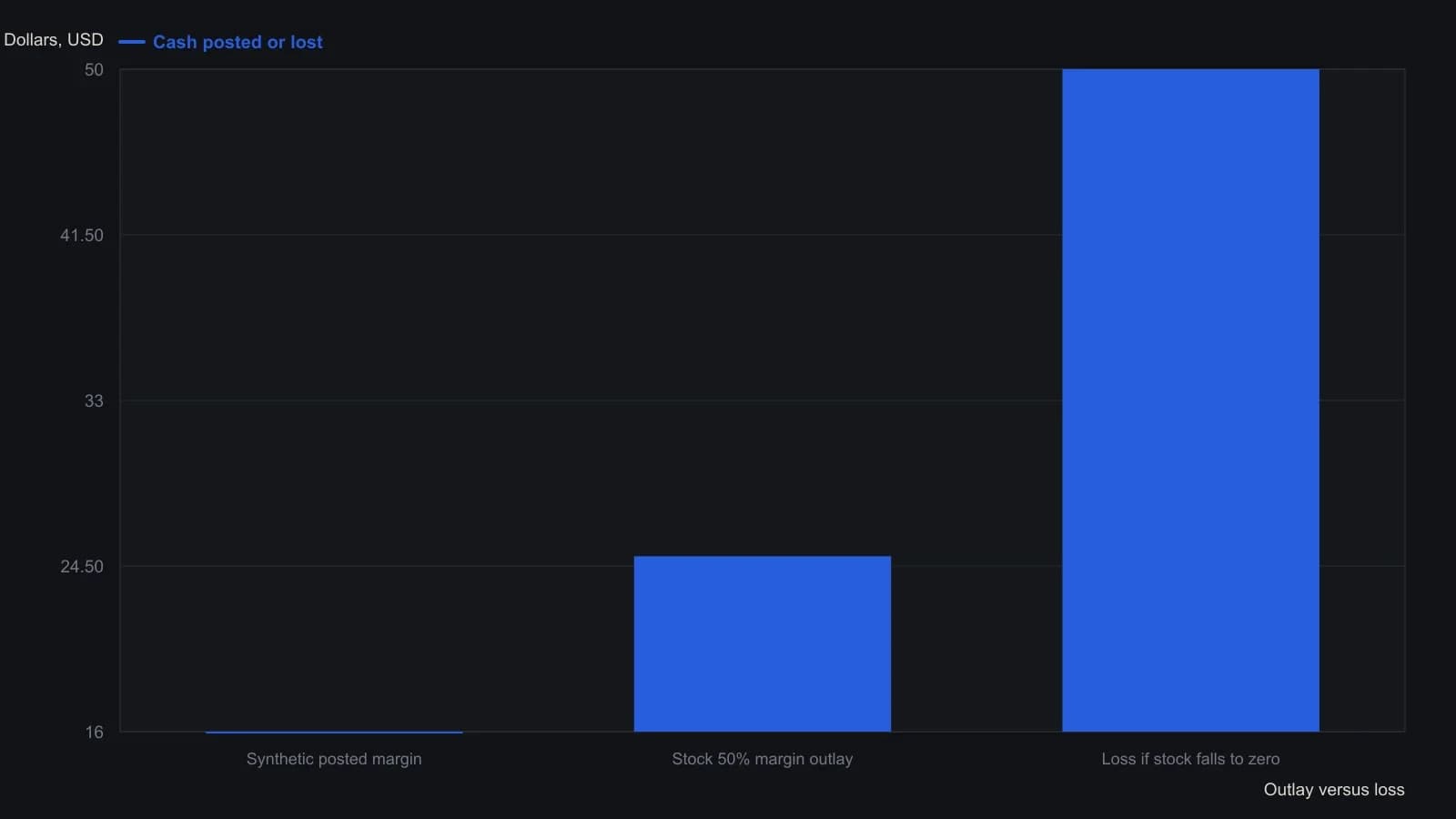
Gentile prices both the March 50 call and the March 50 put at $6 with XYZ at 50, and treats short-put margin as roughly 20 percent of the stock price plus the put premium, minus the strike-to-spot difference.
A deep in-the-money call as a substitute
An alternative construction is a deep in-the-money call, one or two strikes inside the money, with delta above 80. It is framed as stock-like exposure with smaller defined risk than the unhedged synthetic long.
All readings on this track · 16 readings
- 1990Synthetic option parity in limit-locked futures
- 1991Constructing synthetic option positions with puts and spreads
- 1991Synthetic stock and protective put payoff construction
- 1993Equivalent option strategies as a capital and execution checklist
- 1993Keep a futures loss bounded when stops fail
- 2001Financed call ratio repair for a gapped long
- 2003Synthetic long construction with delta and margin checks
- 2003Cash-covered split-synthetic after a decline
- 2004Constructing synthetic calls and puts with stock
- 2006In-the-money calls as bounded synthetic leverage
- 2006Credit construction of a synthetic long call via futures and a long put
- 2006Convert a support-and-resistance range into one synthetic option procedure
- 2007Long-call adjustment via a synthetic straddle
- 2008Constructing protective puts and synthetic option packages
- 2018An uneven vertical debit spread as a stock proxy
- 2020Out-of-the-money strikes as a delta budget for synthetic futures