2006issue C051-4
Credit construction of a synthetic long call via futures and a long put
A long-call payoff can be assembled as a synthetic-option-position by pairing a long underlying with a long-put. Whether that package is a credit-construction or a debit-construction depends on when the put is attached and on whether the worst-case-exit sits above the original entry.
- A long-call payoff can be assembled as a synthetic-option-position by pairing a long underlying with a long-put.
- The construction is sequenced: the underlying is opened first during an advance, and the long-put is added only after open profit exists.
- If the worst-case-exit, put strike minus put premium, remains above the original entry, the package is a credit-construction rather than a debit-construction.
- The futures version is presented as more practical than the stock version because the initial margin outlay is lower, and the inverse sequence assembles a synthetic long put.
The assembled payoff
A long-call payoff can be assembled as a synthetic-option-position by pairing a long underlying with a long-put. A synthetic-option-position is a two-or-more-leg package of an underlying contract and options assembled so its payoff matches a different option.
In this package the long-put is a purchased put used as the second leg to define a floor under an already open long underlying position.
Construction order
The construction is sequenced. The underlying is opened first during an advance, and the long-put is added only after open profit exists.
That order is legging: opening the underlying first and adding the option only after that position has already moved enough to pass the credit test.
The credit test
The credit test is arithmetic. If put strike minus put premium remains above the original entry, the package is a credit-construction rather than a debit-construction.
The worst-case-exit is the put strike minus the premium paid for that put. It is the locked floor used to test credit versus debit. A credit-construction is an assembly in which put strike minus put premium still sits above the original underlying entry. A debit-construction is an assembly in which put strike minus put premium still sits below the original underlying entry.
A stock illustration
A stock illustration uses a 15 purchase, a later print at 20, and a 17.5 long-put bought for 2 or less to show the same credit conversion.
The futures walkthrough
The futures version is presented as more practical than the stock version because the initial margin outlay is lower.
In the July 2005 soybean walkthrough, a long futures entry at 5.900 plus a 6.200 put at 0.370 implied a worst-case-exit of 5.830, still below entry, so the package remained a debit-construction.
In the same walkthrough, a 6.400 put costing as much as 0.350 implied a worst-case-exit of 6.050, which is 0.150 above the 5.900 entry and meets the credit test.
Daily May 2005 soybean futures through 25 April 2005
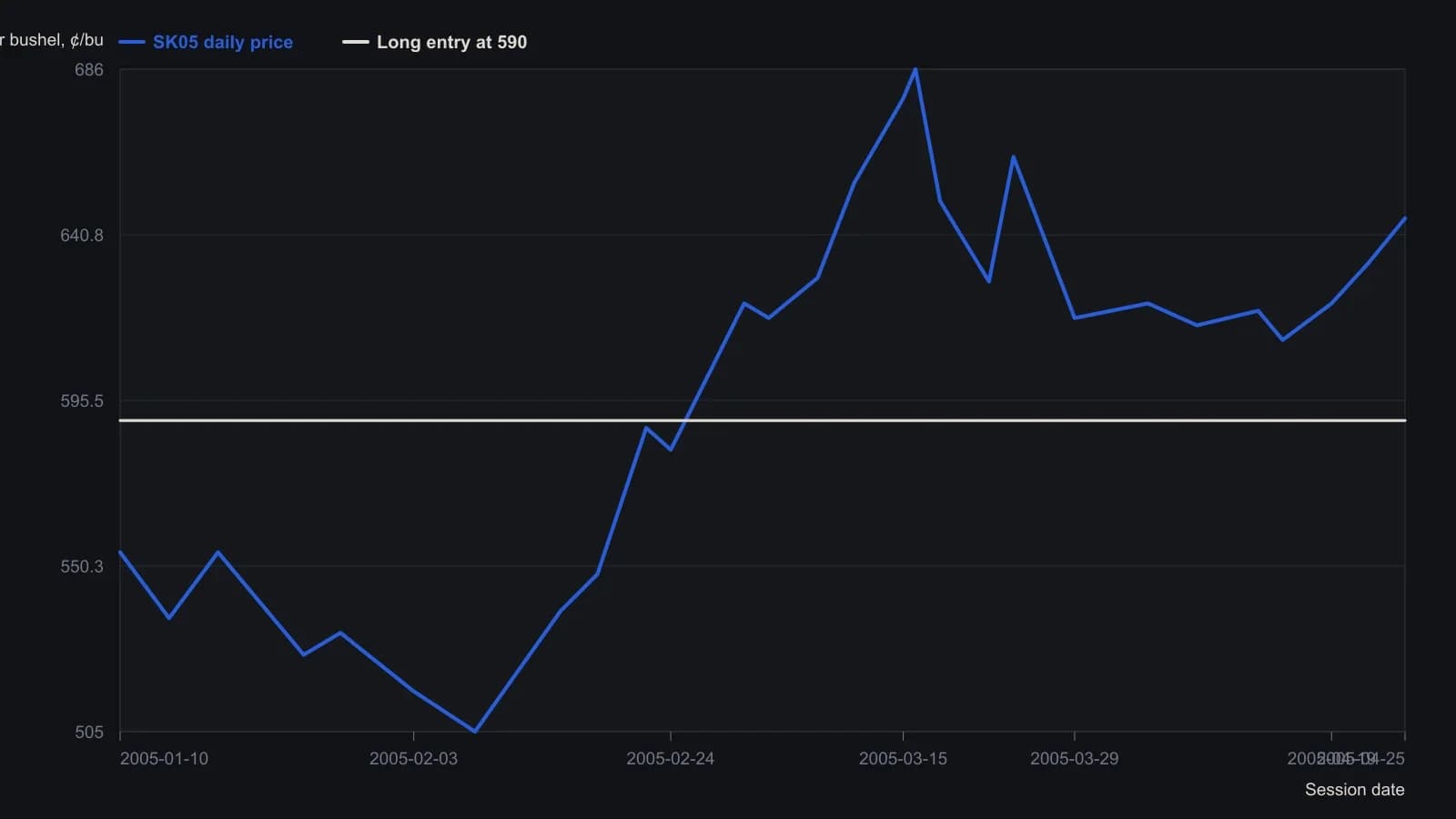
Except for the 25 April session stamp, y-values are digitized from daily bars to the nearest cent (about ±2–3 cents). Dates before 25 April 2005 are inferred from bar spacing on an unlabeled x-axis. The raster is May 2005 (SK05); the article’s walkthrough quotes the nearby July 2005 contract.
The inverse sequence
The inverse sequence, short the futures first, then buy a call after sufficient movement, assembles a synthetic long put as another synthetic-option-position.
The same construction logic is described as extensible to other option packages and to three-leg rather than two-leg assemblies.
All readings on this track · 16 readings
- 1990Synthetic option parity in limit-locked futures
- 1991Constructing synthetic option positions with puts and spreads
- 1991Synthetic stock and protective put payoff construction
- 1993Equivalent option strategies as a capital and execution checklist
- 1993Keep a futures loss bounded when stops fail
- 2001Financed call ratio repair for a gapped long
- 2003Synthetic long construction with delta and margin checks
- 2003Cash-covered split-synthetic after a decline
- 2004Constructing synthetic calls and puts with stock
- 2006In-the-money calls as bounded synthetic leverage
- 2006Credit construction of a synthetic long call via futures and a long put
- 2006Convert a support-and-resistance range into one synthetic option procedure
- 2007Long-call adjustment via a synthetic straddle
- 2008Constructing protective puts and synthetic option packages
- 2018An uneven vertical debit spread as a stock proxy
- 2020Out-of-the-money strikes as a delta budget for synthetic futures