2018issue C0846-47
An uneven vertical debit spread as a stock proxy
A 2018 case compared 100 shares with equal-leg and uneven-leg August 185-190 bull-call spreads. The figures show how debit, delta, leftover upside, and expiration-zone risk change when the aim is share-like participation without posting the full share outlay.
- A bull-call vertical debit spread buys a lower-strike call and sells a higher-strike call with the same expiration, paying a net debit and capping both gain and loss.
- The equal-leg 9-by-9 August 185-190 spread used a 2367 debit instead of an 18687 share outlay, carried a net delta near 94, and still showed as much or more downside than 100 shares if the stock finished between about 163 and 188.
- The uneven 5-by-4 version paid a 1920 debit, carried a delta near 98, left leftover upside after the short strike, and was described as tracking almost point-for-point once past a 188.84 breakeven.
- Below 185 the uneven spread's loss stopped at the 1920 debit, but between about 169 and 189 at August expiration it was shown able to lose more dollars than the shares.
A debit spread used as a stock proxy
A vertical debit bull-call spread is formed by buying a lower-strike call and selling a higher-strike call with the same expiration. That call-only vertical debit is the base building block in this case: a same-expiration structure that pays a net debit and caps both gain and loss.
Treated as one option spread, the legs are a single procedure. Entry, exit, and standing aside can be judged against capital limits, market state, and a stated holding window. The design question is whether the combination can be sized and struck as a synthetic option position, so that after a stated breakeven its price change is meant to track a long share holding without buying the shares.
The equal-leg August 185-190 spread
In the 2018 case, 100 shares at 186.87 implied an 18687 outlay. An August 185-190 bull-call spread with 78 days to expiration was shown at a 2367 debit.
The equal-leg 9-by-9 version of that spread was assigned a net delta near 94, a capped gain of 2133, and a maximum loss equal to the 2367 debit. Delta here is the illustrated sensitivity of the spread's value to a one-point move in the underlying.
Versus 100 shares, that equal-leg spread was shown to have as much or more downside if the stock finished between about 163 and 188 at expiration, because upside was capped while the loss remained large.
The uneven 5-by-4 variant
An uneven-leg ratio buys more long calls than short calls so some upside remains after the short strike, at the cost of a different debit and a different expiration risk zone. The archive case used five long 185 calls against four short 190 calls on the same August 185-190 strikes.
That 5-by-4 spread was shown at a 1920 debit with a delta near 98. Once it passed a stated breakeven of 188.84, it was described as moving nearly point-for-point with the stock, like holding about 98 shares. A reading near 100 is treated as share-like tracking.
Below 185, the uneven spread's loss was limited to the 1920 debit, while a 100-share long would keep losing if the stock continued to fall. Above about 189.50 the uneven spread was shown making slightly more than 100 shares.
AAPL 5-by-4 August 185-190 call spread versus 100 shares at expiration
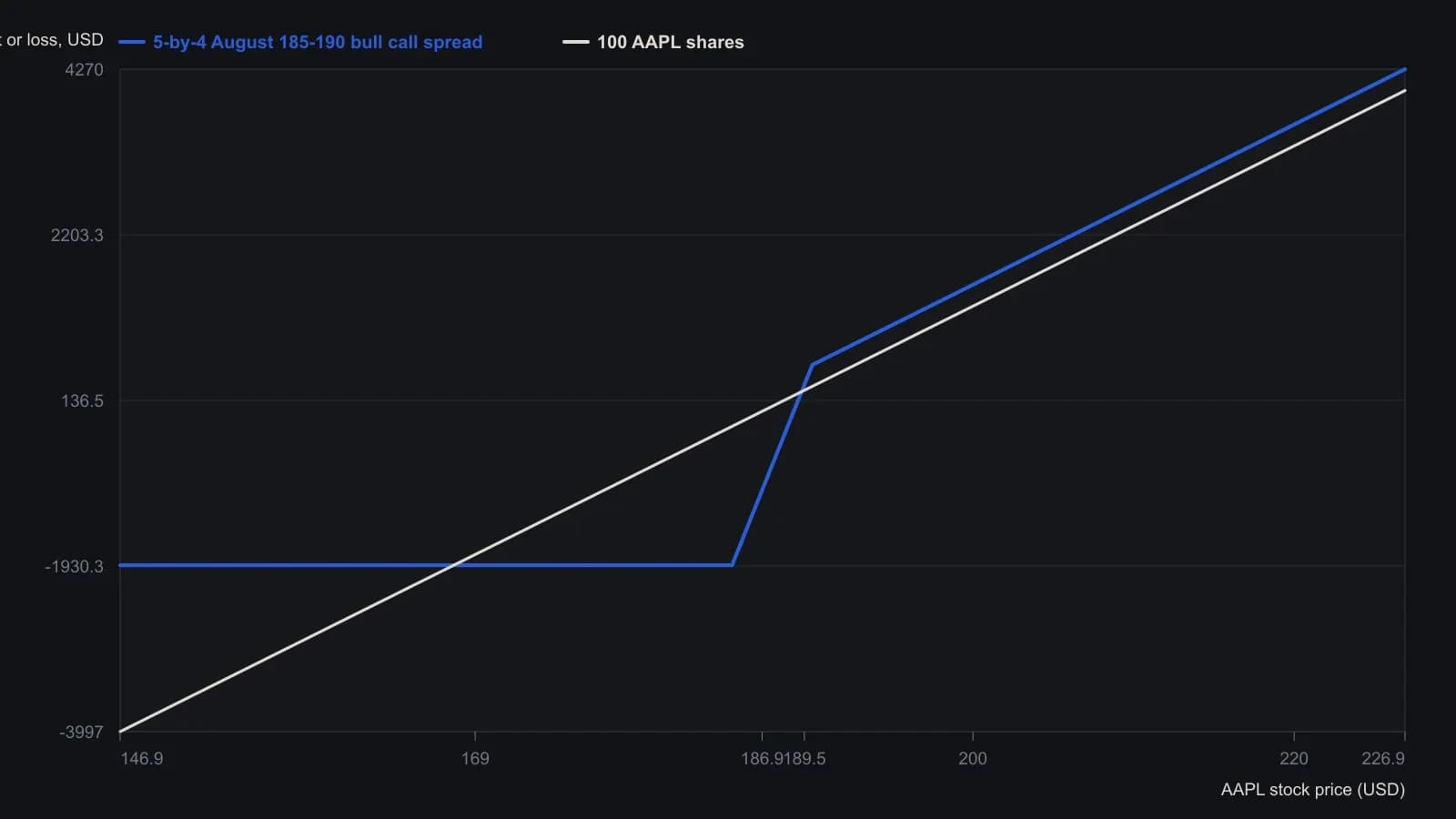
Source figure is the expiration snapshot (days to expiry = 0, all legs closed). Share P/L assumes a 186.87 purchase. The later $18,678 share outlay in the column is treated as a typo for 186.87 times 100.
Expiration-zone risk versus shares
Between about 169 and 189 at August expiration, the uneven spread was shown able to lose more dollars than the shares. The lower debit and the leftover upside after the short strike did not remove that zone.
The equal-leg construction had the same kind of mid-range problem on a different window: as much or more downside than 100 shares if the stock finished between about 163 and 188, with a larger debit and no leftover upside past 190.
All readings on this track · 16 readings
- 1990Synthetic option parity in limit-locked futures
- 1991Constructing synthetic option positions with puts and spreads
- 1991Synthetic stock and protective put payoff construction
- 1993Equivalent option strategies as a capital and execution checklist
- 1993Keep a futures loss bounded when stops fail
- 2001Financed call ratio repair for a gapped long
- 2003Synthetic long construction with delta and margin checks
- 2003Cash-covered split-synthetic after a decline
- 2004Constructing synthetic calls and puts with stock
- 2006In-the-money calls as bounded synthetic leverage
- 2006Credit construction of a synthetic long call via futures and a long put
- 2006Convert a support-and-resistance range into one synthetic option procedure
- 2007Long-call adjustment via a synthetic straddle
- 2008Constructing protective puts and synthetic option packages
- 2018An uneven vertical debit spread as a stock proxy
- 2020Out-of-the-money strikes as a delta budget for synthetic futures