2006issue C101-5
Convert a support-and-resistance range into one synthetic option procedure
A January 2006 March Dow case turns a digestion-range hypothesis into one synthetic-option-position. The legs are chosen so the profit-playground matches the predicted band, then the same vehicle is rewritten when the market revises that range.
- Map a support-resistance digestion band onto one synthetic-option-position so the profit-playground matches the predicted range.
- Reject an outright option when its intrinsic breakeven sits too close to support relative to the futures risk you would otherwise take.
- Use an option-spread, and sometimes a naked-leg, to shift breakeven or turn a debit into a credit while keeping a defined playground.
- When price revises the range, rewrite the same vehicle. Do not treat the next fill as a new trade idea.
A digestion range, not an outright long option
A January 2006 March Dow case used a prior November to December 2005 rally, expected digestion of a large move, and resistance just below 11100 as the setup for a range-aware option structure rather than an outright long option.
The same case treated 50 percent and 61.8 percent Fibonacci retracements near 10692 to 10698 and 10598, plus prior support near 10720, as the lower band of the expected selloff. Support-resistance here meant floors and ceilings used as bands to locate the expected range, the targets, and the option strikes.
Why the at-the-money put was too tight
An at-the-money 10900 put priced near 100 points, or 1000 dollars at 10 dollars per Dow point, produced an intrinsic breakeven at 10800. That left little room above support at 10720 and was rejected as too tight versus a futures risk of 1000 dollars.
One vehicle whose profit band matches the range
The constructed vehicle was a synthetic-option-position: a multi-leg option construction used as a single swing vehicle whose profit-and-loss band is designed to match a predicted price range instead of a directional futures bet. It was built as an option-spread, a paired long and short option structure with an extra short leg, used to shift breakeven, reduce debit, or convert a debit into a credit while keeping a defined playground.
The case used a bear put spread with a short 10700 put and a short 11200 call. The 10700 sale collected 395 dollars and lifted intrinsic breakeven from 10800 to 10839. The 11200 call sale collected 885 dollars to reduce debit and add margin risk. That extra short call was a naked-leg, an unhedged short option added to a defined spread to collect extra premium, raise breakeven, and introduce margin and tail risk.
A credit fill rewrites the same idea
A next-day fill for a 260-dollar credit changed the structure into a credit spread. Reverse-breakevens were calculated from 2395 dollars collected, or 239 points at 10 dollars per point, giving 11439 above the short call and 10461 below the short put. Reverse-breakeven means those upside and downside expiration prices, obtained by adding or subtracting collected premium, in points, from the short strikes.
The case argued that a range-bound market about 80 percent of the time, plus worthless expiration of many short options, raised the chance of a profitable expiration anywhere between 10461 and 11439, with full premium retained only between 10700 and 11200. That inner interval is the profit-playground: the expiration price interval in which the constructed position is designed to keep some or all collected premium.
When the market revises the range
After the market later traded through prior resistance, buying back two short 10700 puts left a bull call spread, removed margin, locked about 4700 dollars of open profit, and shifted the preferred zone toward the remaining short 11200 call. The rewrite stayed inside the original synthetic-option-position.
The teaching close treated support, resistance, and ranges as price bands the market can overshoot to shake out weak holders. The synthetic structure and later rewrite had to tolerate those tests rather than assume razor-sharp lines.
March 2006 Dow futures test the 10720–11093 digestion range
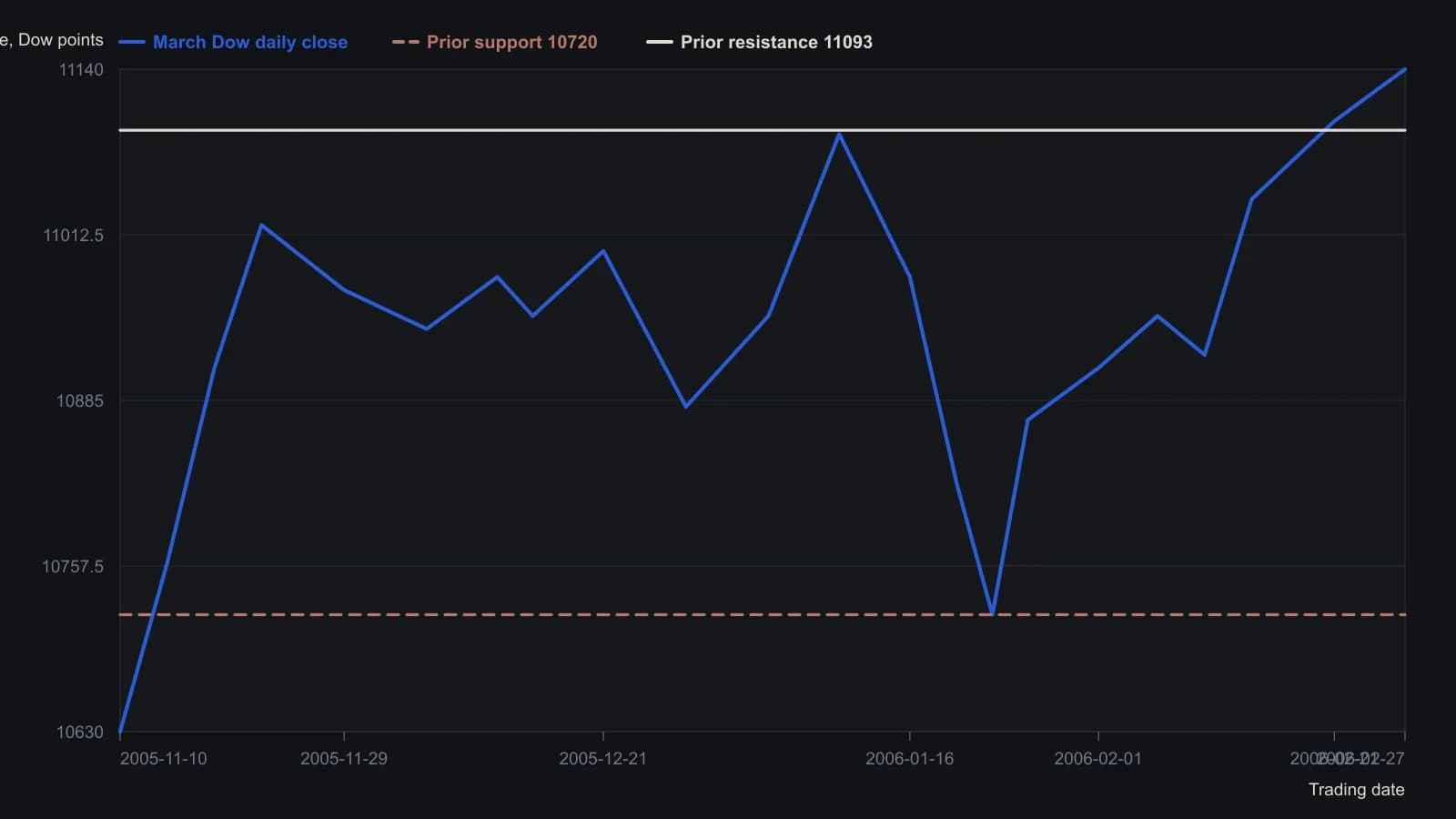
Closes are digitized from the daily bars to the nearest 10–20 Dow points; the raster cannot support tick precision. Month names follow the article’s November 2005–March 2006 March Dow window and the day-of-month axis stamps. Support 10720 and resistance 11093 come from the text, not from the chart’s printed axis ticks.
All readings on this track · 16 readings
- 1990Synthetic option parity in limit-locked futures
- 1991Constructing synthetic option positions with puts and spreads
- 1991Synthetic stock and protective put payoff construction
- 1993Equivalent option strategies as a capital and execution checklist
- 1993Keep a futures loss bounded when stops fail
- 2001Financed call ratio repair for a gapped long
- 2003Synthetic long construction with delta and margin checks
- 2003Cash-covered split-synthetic after a decline
- 2004Constructing synthetic calls and puts with stock
- 2006In-the-money calls as bounded synthetic leverage
- 2006Credit construction of a synthetic long call via futures and a long put
- 2006Convert a support-and-resistance range into one synthetic option procedure
- 2007Long-call adjustment via a synthetic straddle
- 2008Constructing protective puts and synthetic option packages
- 2018An uneven vertical debit spread as a stock proxy
- 2020Out-of-the-money strikes as a delta budget for synthetic futures