2001issue C121-4
Financed call ratio repair for a gapped long
A sudden gap lower can turn a previously sound long into a damaged book. This case compares doubling down in the shares with a financed one-by-two call overlay. TradersWeek editorial reading: a breakeven reset that needs no new cash is paid for by selling the recovery tail.
- After a gap lower on adverse news, the stock-only choices are to realize the loss, buy an equal extra lot, or hold and wait.
- Puts bought on the collapse day are a poor after-the-fact hedge because an implied volatility jump inflates their price and a rebound can erase that premium.
- The illustrated one-by-two overlay buys a January 45 call at 9.50 and sells two January 55 calls at 5.40, taking in a 1.30 credit and stating a package breakeven of 51.85.
- Expiration upside is limited to 3.15 a share, or 315 on the 100-share lot, because the short 55 calls obligate delivery at that strike.
A gap that damages the book
A sudden gap lower on adverse news is a common way a previously sound long becomes a damaged book. After that break, the stock-only choices are to realize the loss, buy an equal extra lot, or hold and wait.
The worked long is 100 shares bought at 60 that later traded at 45, a 25 percent decline from entry.
Qualcomm from the early-2001 highs through the September gap
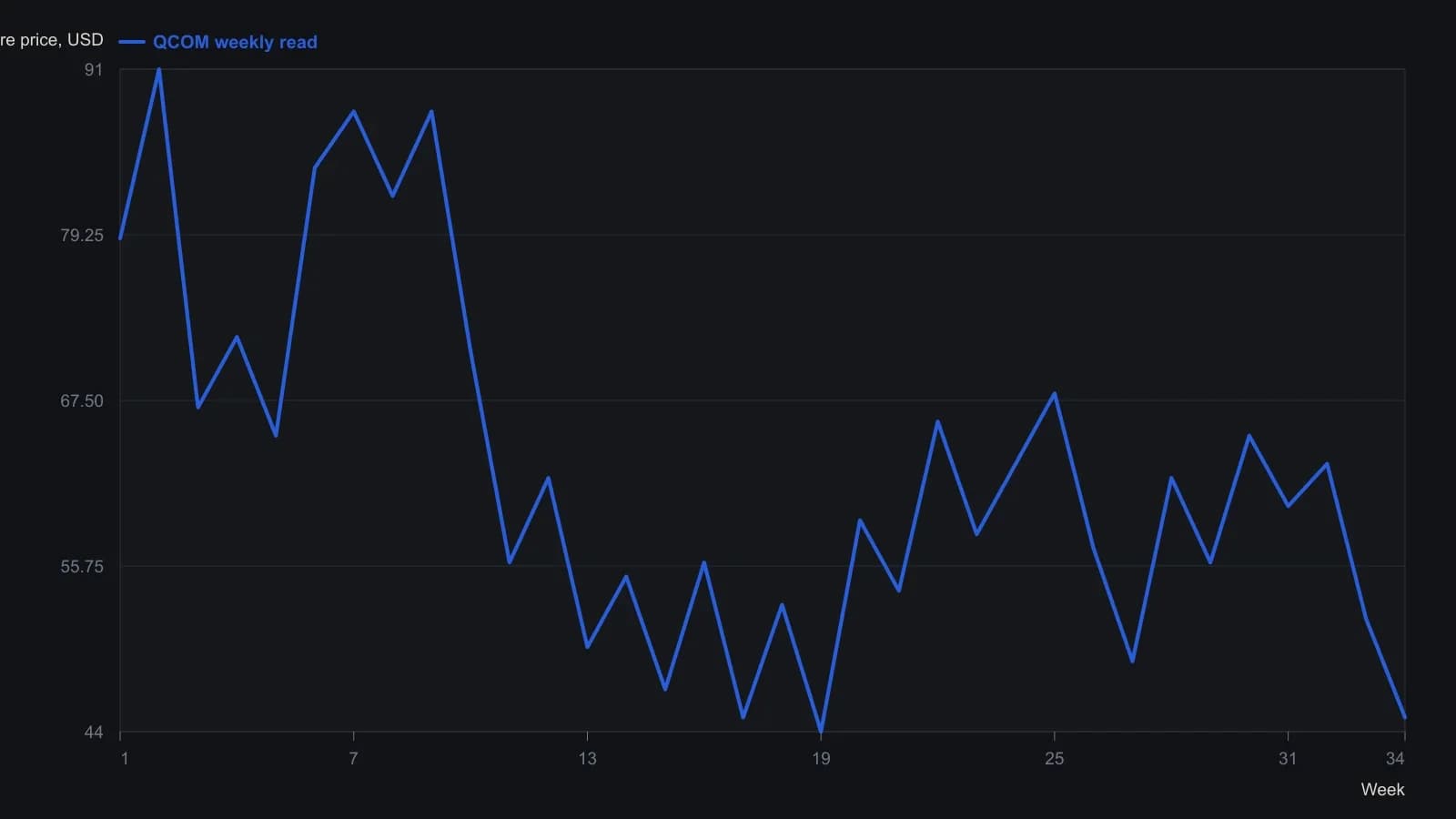
No OHLC table was printed. Values are whole-dollar weekly reads off the magazine candlesticks, not official session closes. Horizontal placement is interpolated from the February–September 2001 month axis.
Doubling down versus a collapse-day put
Buying another 100 shares at 45 is doubling down. That extra lot cuts the stock-only breakeven to 52.50, lifts committed capital from 6000 to 10500, and speeds further losses if the decline continues.
Puts bought on the collapse day are treated as a poor after-the-fact hedge. An implied volatility jump inflates their price, and a rebound can erase that premium.
Once the shares have already lost more than half their purchase price, later options repair overlays are treated as much less useful.
A financed one-by-two call overlay
The illustrated repair is a hedging strategy added after a loss is already open. It is meant to change leftover downside and breakeven while the original shares stay in place.
The overlay is a one-by-two call ratio. For each hundred-share lot it buys one near-the-money call and sells two higher-strike calls, sized so the short premium is meant to cover the long debit. That financed call is meant to open at a credit, so no extra cash is required.
The long-and-short options package is applied as one option spread, so entry, exit, and standing aside can be read from a single payoff.
Using January 45 calls offered at 9.50 and two January 55 calls bid at 5.40, the overlay took in a 1.30 net credit and a stated package breakeven of 51.85. That price is the breakeven reset for the combined book.
The stock-plus-options combination is a synthetic option position. Its remaining payoff no longer matches an unhedged long. It behaves like a rebuilt, usually capped, claim on a rebound.
Because the two short 55 calls obligate delivery at that strike, expiration upside in the example is limited to 3.15 a share, or 315 on the 100-share lot. That limit is the capped recovery that appears when the shorts obligate delivery of the shares at the higher strike.
Closing after the breakeven reset
After price reaches the new breakeven, the overlay can be closed by buying back the shorts and selling the long call, accepting possible commission and bid-ask slippage.
The repair idea is not limited to one one-by-two package. Other option spreads can be combined around the remaining stock and compared on risk graphs before a structure is chosen.
All readings on this track · 16 readings
- 1990Synthetic option parity in limit-locked futures
- 1991Constructing synthetic option positions with puts and spreads
- 1991Synthetic stock and protective put payoff construction
- 1993Equivalent option strategies as a capital and execution checklist
- 1993Keep a futures loss bounded when stops fail
- 2001Financed call ratio repair for a gapped long
- 2003Synthetic long construction with delta and margin checks
- 2003Cash-covered split-synthetic after a decline
- 2004Constructing synthetic calls and puts with stock
- 2006In-the-money calls as bounded synthetic leverage
- 2006Credit construction of a synthetic long call via futures and a long put
- 2006Convert a support-and-resistance range into one synthetic option procedure
- 2007Long-call adjustment via a synthetic straddle
- 2008Constructing protective puts and synthetic option packages
- 2018An uneven vertical debit spread as a stock proxy
- 2020Out-of-the-money strikes as a delta budget for synthetic futures