2013issue C0652-58
Constructing a 1-2-3 wave count from high-low zigzag swings
A 1-2-3 wave count begins by drawing a High-low zigzag through successive highs and lows. Wave numbering is applied only after those Swing point candidates are in place, and the swing engine changes state only when a Reversal threshold is crossed.
- The 1-2-3 wave count starts as a High-low zigzag, so only those turning points are candidates for numbered waves.
- Wave numbering is applied after the zigzag is in place, then used to form expectations for the next move rather than to decorate the chart.
- The swing engine keeps an Uptrend state, Downtrend state, or Undefined state and updates a running maximum high and minimum low only when a new extreme is printed.
- Until a Reversal threshold is crossed, intervening bars are unfinished swing development, not new wave labels.
Draw the zigzag before you number waves
The 1-2-3 wave count construction begins by drawing a High-low zigzag through successive highs and lows so that only those turning points become candidates for numbered waves. That High-low zigzag is the Swing chart layer: its turning points are the only Swing point candidates later used in Wave counting and Elliott wave analysis.
Wave numbering is applied after the zigzag is in place, and the resulting pattern is then used to form expectations for the next move rather than to decorate the chart.
Daily Apple high-low zigzag swings into April 2013
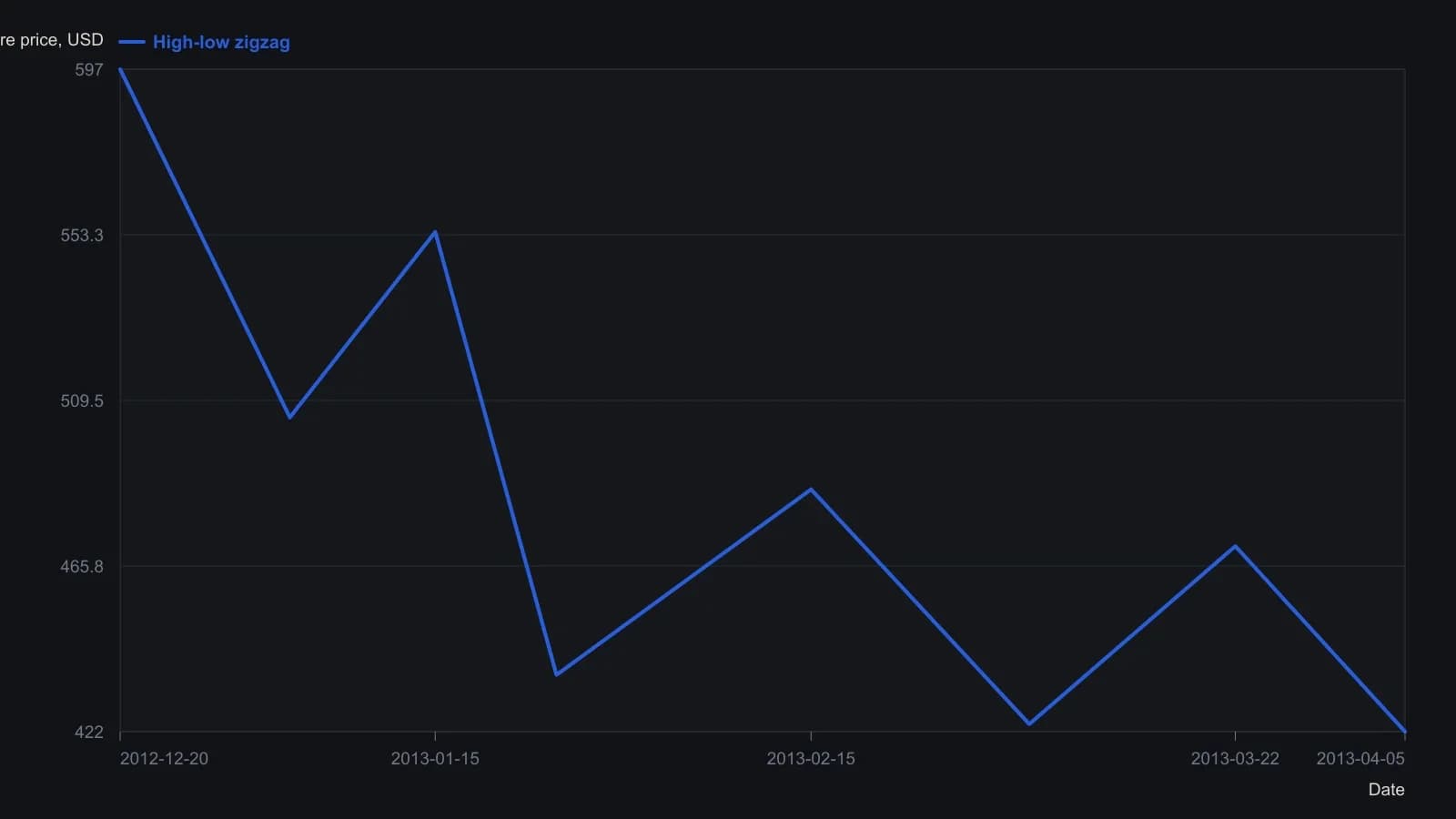
The eSignal study line lists zigzag percent 5, 5-bar ATR lookback and ATR factor 1.5. Vertex dates are estimated from month labels; prices are read against a 20-dollar grid and are approximate to a few dollars.
Hold the trend state until the reversal threshold
The swing engine keeps an explicit Uptrend state, Downtrend state, or Undefined state, updating a running maximum high and minimum low only when a new extreme is printed.
A confirmed reversal requires price to travel a Reversal threshold from the opposite extreme, using a high-pivot fraction of the prior maximum high or a corresponding add-on to the prior minimum low. Until that Reversal threshold is crossed, the construction stays in the current trend state and treats intervening bars as unfinished swing development rather than new wave labels.
Rebuild the zigzag from OHLC bars
The same High-low zigzag can be rebuilt from OHLC bars by exposing adjustable inputs for zigzag percent, ATR lookback, ATR factor, and the color and thickness of the plotted trendlines. Default construction knobs shown in one implementation include a 5 percent zigzag filter, an ATR length of 5, and an ATR factor of 1.5, all meant to be tuned in the study editor.
The same turning-point algorithm can be computed outside a charting platform, with sensitivity controls used to include smaller swings or to treat them as noise.
All readings on this track · 16 readings
- 1991Wave counting as a sampling frame for head and shoulders
- 1995Constructing a percent-reversal wave filter
- 1995Filtered waves, overdue duration, candles, and trend
- 1995Filtered swing ledger for MW pattern construction
- 2003Three ratio tests from a completed supercycle
- 2004Wave labels as a checklist for expansion versus contraction
- 2010Constructing wave-ratio signals from a quadratic trend filter
- 2011A temporary placeholder while source evidence is loaded
- 2011Construct a harmonic impulse from measured three-wave limbs
- 2012Three Fibonacci rules to label trend versus countertrend
- 2013Sentiment wave counts before news headlines
- 2013Constructing a 1-2-3 wave count from high-low zigzag swings
- 2013Step candle confirmations with wave count and chandelier exit
- 2016Nested wave rhythms and double-bottom support
- 2016Nested correction-size bands and a derived support price
- 2020Counting a Nasdaq correction before stacking Fibonacci targets