1995issue C071-6
Filtered waves, overdue duration, candles, and trend
A percentage filter discards opposite swings below a chosen threshold so the remaining path can be classed by size, length, and direction. A live wave becomes a turn candidate only after that class history marks it overdue, and only then are named candlestick conditions used as confirmation, while a coarser filter labels trend.
- Opposite swings smaller than the chosen percentage are ignored so each remaining filtered-wave can be classed by wave-magnitude, wave-duration, and direction.
- A one-percent threshold feeds whole-percent size bins through seven percent, plus one open-ended class, and each class stores duration, retrace, and dispersion history.
- An overdue-reaction is called when live wave-duration reaches the class average length plus duration dispersion, less one session, and a pattern-pair is then required except after a doji or juke.
- A three-percent filter labels trend from the latest qualifying wave, and that label flips after two or more reactions fail to reach the historical average retrace for the prior wave size.
What the filter keeps
A percentage filter discards opposite swings smaller than a chosen threshold so the remaining directional moves can be classified as the informative path of price. Each remaining swing is a filtered-wave.
A filtered-wave is described by three attributes. Wave-magnitude is the percentage change from the start of a qualifying swing to its extreme before an opposite qualifying swing appears. Wave-duration is the number of trading sessions from that start to that extreme. The third attribute is whether the path is up or down.
Wave-counting classifies the swings that survive the percentage filter by size, direction, and length so a live wave can be compared with its historical size class.
Size classes and stored history
A one-percent threshold was used to keep only swings large enough to enter a historical size-and-direction table. Each qualifying percentage swing was floored to a whole-percent bin through seven percent, while larger swings were collected in one open-ended class. The same bins were used for down moves.
For each size class the table stored occurrence count, average length in trading days, a correction-due day count, average size and length of the next opposite wave, dispersion of that retrace length, and the largest and smallest retrace observed.
When duration is overdue
A live wave was treated as due for a reaction when its wave-duration reached the historical average length for its size class plus that class duration dispersion, minus one trading day. That state is an overdue-reaction.
The duration test comes first. The archive treats the live wave as a turn candidate only after this overdue-reaction condition is met.
When each 1% filtered T-bond wave is overdue
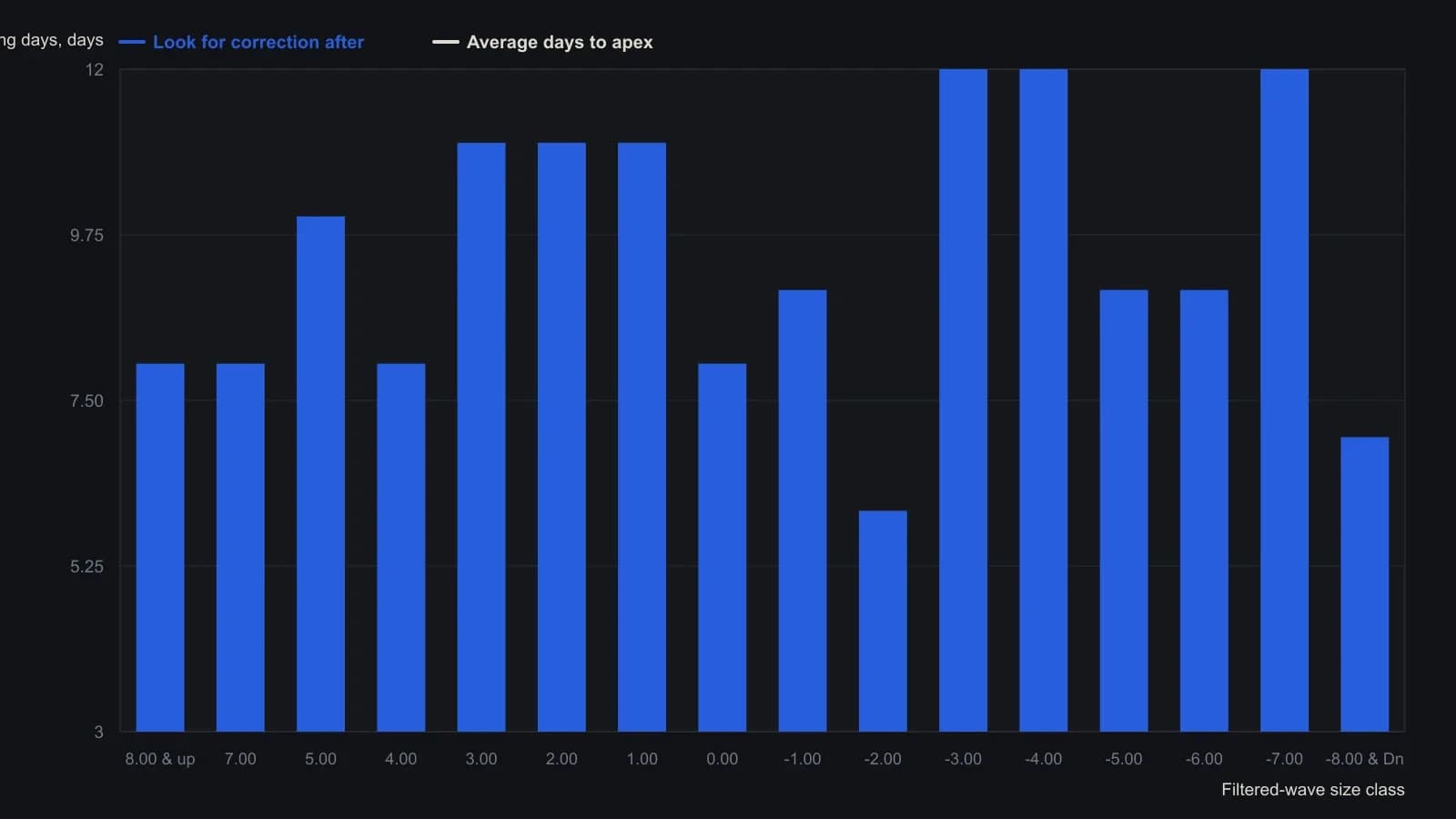
Duration is measured in trading days from wave inception to apex, not calendar days. Waves were floored to the nearest 1%, moves of 8% or more were lumped, and the last wave of each contract year was dropped. The published table has no 6% up-wave row.
Candles after the wave is overdue
Overdue waves were treated as turn candidates only when two or more listed candlestick or reversal patterns appeared. That pattern-pair rule requires two or more named reversal or candlestick conditions together before an overdue wave is treated as a turn hypothesis.
If the prior session was a doji or juke, a gap or key reversal was enough. Candlestick-patterns in this workflow are named single-session and multi-session open-high-low-close conditions used as turn confirmation after a filtered wave is already overdue.
Trend at a coarser setting
A three-percent filter labeled trend from the latest qualifying wave. A second rule flipped that label after two or more reactions failed to reach the historical average retrace for the prior wave size.
Trend-filter is that coarser percentage wave, or that count of failed average retraces, used to label the prevailing direction. The average retrace checked by the second rule is the average size of the next opposite wave stored for the prior wave size class.
All readings on this track · 16 readings
- 1991Wave counting as a sampling frame for head and shoulders
- 1995Constructing a percent-reversal wave filter
- 1995Filtered waves, overdue duration, candles, and trend
- 1995Filtered swing ledger for MW pattern construction
- 2003Three ratio tests from a completed supercycle
- 2004Wave labels as a checklist for expansion versus contraction
- 2010Constructing wave-ratio signals from a quadratic trend filter
- 2011A temporary placeholder while source evidence is loaded
- 2011Construct a harmonic impulse from measured three-wave limbs
- 2012Three Fibonacci rules to label trend versus countertrend
- 2013Sentiment wave counts before news headlines
- 2013Constructing a 1-2-3 wave count from high-low zigzag swings
- 2013Step candle confirmations with wave count and chandelier exit
- 2016Nested wave rhythms and double-bottom support
- 2016Nested correction-size bands and a derived support price
- 2020Counting a Nasdaq correction before stacking Fibonacci targets