2004issue C021-3
Splitting entry and exit speed by regime
A rising-price regime can keep overbought readings in place, so the entry clock and the exit clock should not share one lookback or even the same series. Williams %R can fire a two-step reversal for entry while a slower oscillator or a moving-average close-through times the exit, and that pairing flips once the tape is classified as falling-price.
- Classify the tape as rising-price or falling-price before you choose entry and exit lookbacks, thresholds, or which series may fire.
- In a rising-price regime, overbought readings can persist while oversold readings tend to last only briefly, so a long can pair a faster-reacting entry with a slower-reacting exit.
- Williams %R can run a two-step reversal with independent entry and exit clocks; a simple moving average of closes is an alternative slower exit for a long.
- A 52-week new-highs versus new-highs-plus-new-lows ratio is only one regime check, and it can rise while prices keep falling.
Name the regime before you set the clocks
Regime-dependence is the design rule that entry and exit lookbacks, thresholds, and even which series is used should change once the tape is classified as rising-price or falling-price. In a rising-price regime, overbought readings can persist while oversold readings tend to last only briefly. For long trades in a rising-price regime, a faster-reacting entry indicator can be paired with a slower-reacting exit indicator. That pairing is reversed for short trades in a falling-price regime.
A two-step Williams %R entry
Williams %R locates the current close inside the highest-high to lowest-low range of a chosen lookback and is sometimes scaled so readings run from 0 to -100. In this workflow it is a lookback oscillator used as a two-step reversal trigger. Dual-threshold-reversal means the rule first records a breach of one level and then requires a later reverse crossing of a second level before acting.
Entry used a two-step Williams %R sequence: a prior move below a threshold, held in a short memory window, then a later move back above a threshold. One worked example started with a pass below -80 followed by a pass back above -80.
A slower clock on the same oscillator
The first exit used the same two-step Williams %R structure with independently chosen lookbacks and thresholds. After stepwise search over ten parameters, one entry-side lookback was 12 periods and a comparable exit-side lookback was 20 periods.
A moving-average close as the slower exit
A second long-only design kept those Williams %R entry rules and exited when the daily close fell below a simple moving average of closes, with the average length searched alongside the entry settings. The moving average is a smoothed close series used as a slower exit: the long is closed when the daily close falls back through the average.
The moving-average exit produced 28 closed trades versus 10 when Williams %R handled both entry and exit, with more turnover during a late-2002 sideways stretch that was not a clean rising-price run.
Breadth as one check of the regime
A Nasdaq 52-week new-highs divided by new-highs-plus-new-lows ratio, often smoothed with a 10-day average, was used as one breadth check of whether a rising-price or falling-price regime was in force. That ratio produced a false start in early 2002 when it rose while prices continued to fall. Yield-curve shape, the level of interest rates, employment figures, and policy actions were listed as additional checks of the same regime question.
Williams %R pair equity vs Nasdaq Composite, late 2002–2003
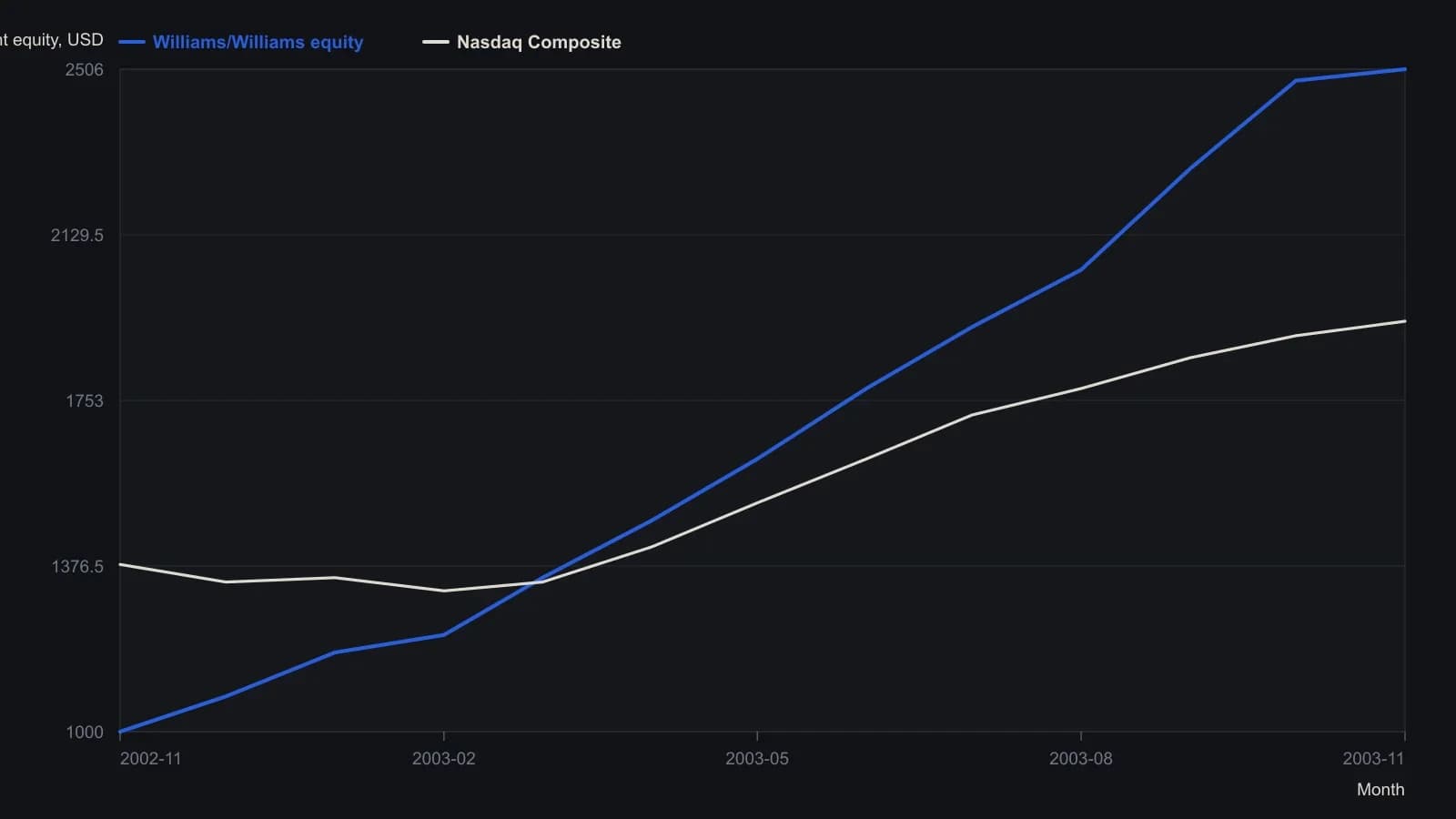
Optimizer settled on 12-period then 4-period %R for the two-step entry and 20-period then 8-period %R for the exit; $1,000 start, 50% margin, one-day delay, no commissions. Digitized from the MetaStock panes, so prices and equity are approximate.
All readings on this track · 13 readings
- 1987Constructing a volume-confirmed Williams %R
- 1991Audit inverse-range oscillators before stacking stochastic %K and Williams %R
- 1991Signed midpoint range oscillator from stochastic and Williams
- 1993Confirm an intradate candlestick only after a longer cycle reprints it
- 1994Building average directional index, the stochastic pair, and Williams percent R from highs, lows, and closes
- 1994Label the tape before you read stochastic or Williams %R
- 1996Calibrating Williams %R entries in rising channels
- 1997Dynamic zones for oscillator buy and sell levels
- 1998Regression channels anchored to Williams %R turning windows
- 1999Constructing isolated synthetic waveforms to watch indicator settling
- 2000Choosing a scale for moving-average oscillators
- 2004Splitting entry and exit speed by regime
- 2008Count the run, then confirm the pivot at a channel edge