2017issue C0530-33
Small-cap swing entries that wait for accumulation and Chaikin to clear
The archive treats selected wider-spread small-cap names as swing candidates only when chart structure, not news flow, shows a quiet bottom. The trade stays closed while the accumulation-distribution line and the Chaikin oscillator still warn that large incremental buying has paused.
- A late-2016 shift from penny increments to five-cent increments, plus thinner floats, was treated as the market-structure reason selected small-cap swing setups became more usable.
- Those candidates were to be taken from chart relationships, not from news, social posts, or retail recommendations, and the screen favored a small share count, high institutional ownership, and quieter bottoming or platforming.
- When price held near a range high while the accumulation-distribution line declined, and the Chaikin oscillator diverged negatively from price, both readings were treated as stand-aside warnings.
- After the range compressed, a steady accumulation-distribution line and Chaikin holding above its center line were read as professional positioning, and the swing rule was to enter at the onset of the run rather than after it had already started.
A closed trade inside a bottoming range
The archive presents swing trading as a multi-session procedure that states when to enter, stand aside, or exit a range-to-run move instead of reacting to the first burst of price. In the small-cap case, a bottoming range can persist while those rules still say stand aside.
TradersWeek editorial reading: treat the setup as a two-indicator veto, not a breakout chase. The accumulation-distribution line and the Chaikin oscillator must both stop warning that large incremental buying has paused before the swing is allowed to open.
Wider increments and thinner floats
A late-2016 small-cap spread-widening test moved selected names from penny increments to five-cent increments. The archive treats that wider increment, together with thinner floats, as the market-structure reason swing setups in those names became more usable.
Chart relationships, not coverage
Wider-spread small-cap swing candidates are to be chosen from chart relationships rather than news, social posts, or retail recommendations, because those names rarely appear in that coverage.
The listed swing screen requires a small share count, high institutional ownership, active professional and high-frequency participation, liquidity tied to buy-side interest, and quieter bottoming or platforming conditions. Those quieter conditions are where quiet accumulation is easier to see: off-display institutional buying inferred from a bounded price range and volume-structure clues rather than from public headlines.
The bottoming case
The case chart is a small-cap bottoming attempt with 55 million shares outstanding and just under 80 percent institutional ownership. The archive says extra volume tools are required to see quiet accumulation and professional or high-frequency footprints before a sudden run.
When the accumulation-distribution line vetoes the high
The accumulation-distribution line is a running volume-and-price series used to test whether large incremental buying is still filling a defined range or has already shut off near the highs. In the case it is used to map a time-weighted incremental-buy range. Incremental time-weighted buying is a professional instruction that adds size from a defined low toward a defined high over time and then stops once that high is reached. Volume-weighted incremental buying, which times those adds to volume spikes, is described in the case as more typical of smaller funds.
When price holds near the range high while that line declines, the reading is that large incremental buying has paused and an entry is premature because price is expected to cycle lower first.
Chaikin as a second stand-aside
The Chaikin oscillator is a volume oscillator built from the accumulation-distribution line and used here to confirm or reject a bottom when it diverges from price or holds above its center line. At the same juncture as the declining accumulation-distribution line, a negative divergence between the Chaikin oscillator and price is treated as a stand-aside signal during the bottoming phase.
SLGN daily closes inside the 2016 bottoming range
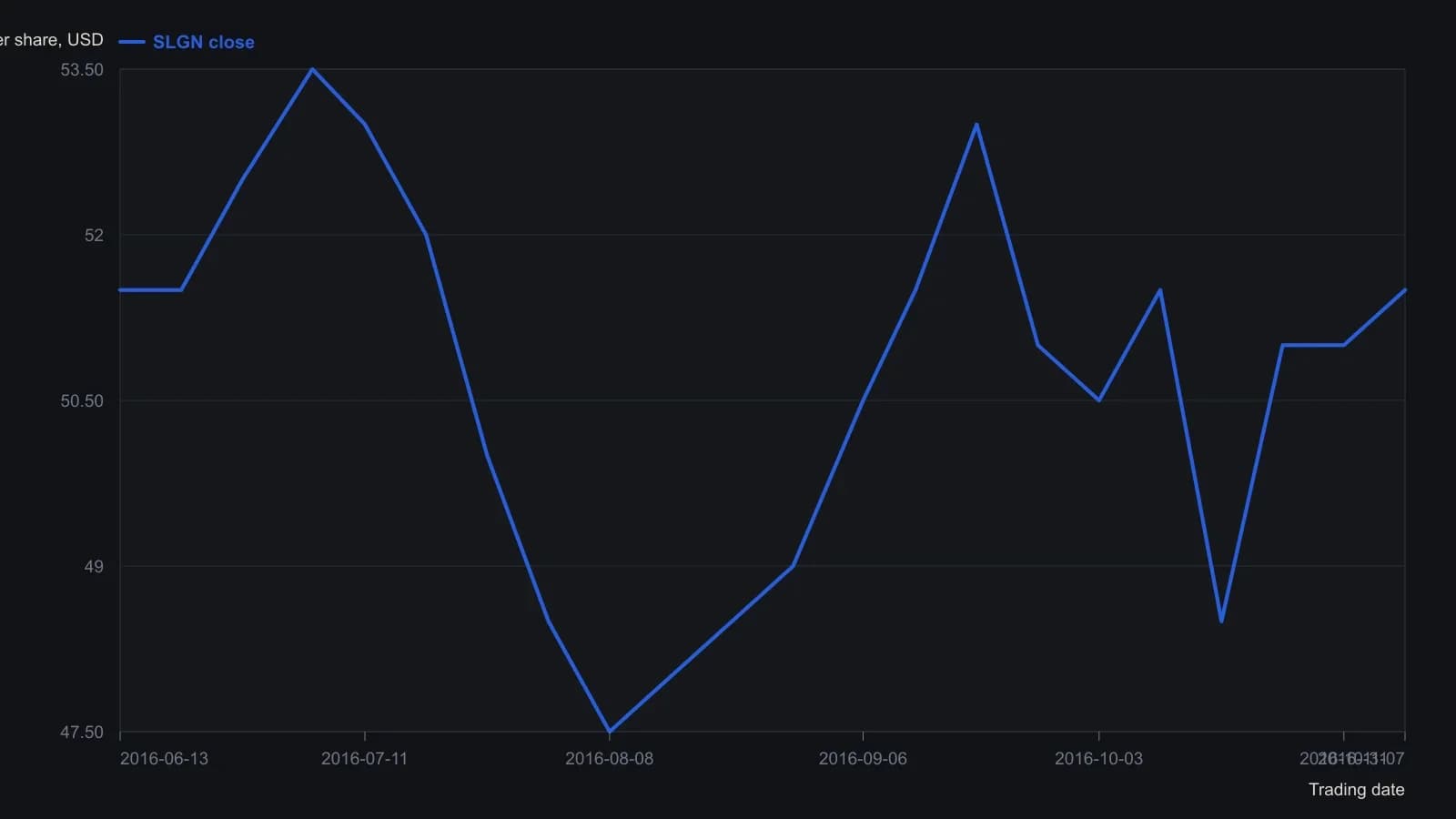
Closes were digitized at the labeled session ticks and rounded to the nearest half-dollar. Header prints (close 60.32, volume 735.6K, 2 February 2017) sit after the visible June–November 2016 window and were not used as the last point. Accumulation-distribution and Chaikin oscillator panes are on the source chart but cannot share this dollar axis.
A later tape that was still too wide
A later tape shift is read as continued range-bound accumulation after a failed high-frequency sell attempt. A large down-volume bar from premarket sell flow is absorbed, the incremental-buy trigger is raised, the bottom base steps up, and volume weight moves to buyers. The range is still judged too wide for entry.
Entry at the onset of the run
After the range compresses, Chaikin holding above its center line and a steady accumulation-distribution line are read as professional positioning ahead of a possible momentum run. The swing rule is to enter from that price-versus-volume structure at the onset of the run rather than after it has already started.
All readings on this track · 9 readings
- 1992Fitting oscillator parameters to stock personality
- 1994Constructing the Chaikin oscillator from close-in-range volume
- 1994Constructing Chaikin money flow and a double-exponential smoother
- 1994A three-lock reversal drill: line, oscillator, and volume
- 2000Constructing a Chaikin oscillator from the accumulation-distribution line
- 2005Volume-spike alerts versus direction from follow-through
- 2014A 2014 research stack as a classroom for volume-flow hypotheses
- 2015Money flow oscillator construction from volume pressure
- 2017Small-cap swing entries that wait for accumulation and Chaikin to clear