2005issue C061-6
Volume-spike alerts versus direction from follow-through
A volume-spike marks a contested price of unusually high participation and stays direction-neutral until later follow-through. Direction for on-balance volume, volume-price analysis, and the Chaikin oscillator is assigned only after nearby support or resistance breaks.
- A volume-spike records unusually high participation at a price and remains direction-neutral until later movement shows whether buyers or sellers were right.
- On-balance volume and the Chaikin oscillator can give opposite readings on the same high-volume bar, so those jumps work as alerts rather than as buy or sell signals at the spike.
- Direction is often assigned only after a later break of nearby short- or medium-term support or resistance that formed around the spike.
- If later price fails to break a threshold defined by the spike bar's range, the apparent breakout can be treated as false and the old level can act as a springboard instead.
A volume-spike marks a contested level
A volume-spike is a bar whose traded volume is extremely high relative to recent average volume. It marks a price level of unusually high participation. Direction-neutrality means volume records that participation without itself being bullish or bearish. Later price movement is what shows whether buyers or sellers were right.
Read the spike as an alert first
Alert-versus-direction is the construction rule. Read the spike first as a notice that a level matters, and only later as a directional cue after follow-through.
On-balance volume is a cumulative volume line that adds or subtracts each bar's volume according to that bar's close-to-close direction. The Chaikin oscillator is derived from the accumulation/distribution line and can jump or reverse on a high-volume bar independently of on-balance volume. The two can give opposite readings on the same high-volume bar because their formulas weight that bar differently.
Treating those indicator jumps as buy or sell signals at the spike itself can produce conflicting hypotheses. Treating them as alerts that something important is happening keeps both readings consistent. Volume-price analysis reads raw volume together with the price structure around the spike instead of treating the spike as a buy or sell by itself.
Assign direction after follow-through
Follow-through is the price movement after a high-volume bar that tests nearby support or resistance and can confirm who was right. Direction is often assigned only after a later break of nearby short- or medium-term support or resistance that formed around the spike.
The same spike-plus-follow-through construction can be applied across markets, including a non-U.S. listing, when tall volume bars appear near a previously important resistance.
Failed breaks can restore the old level
If later price fails to break a threshold defined by the spike bar's range, the apparent breakout can be treated as false and the old level can act as a springboard instead.
Alerts lead, directional signals lag
Volume spikes are leading when read as alerts and lagging when read as directional signals. Later price action must be combined with prior price and volume structure.
Avery Dennison daily price versus 52.50 support
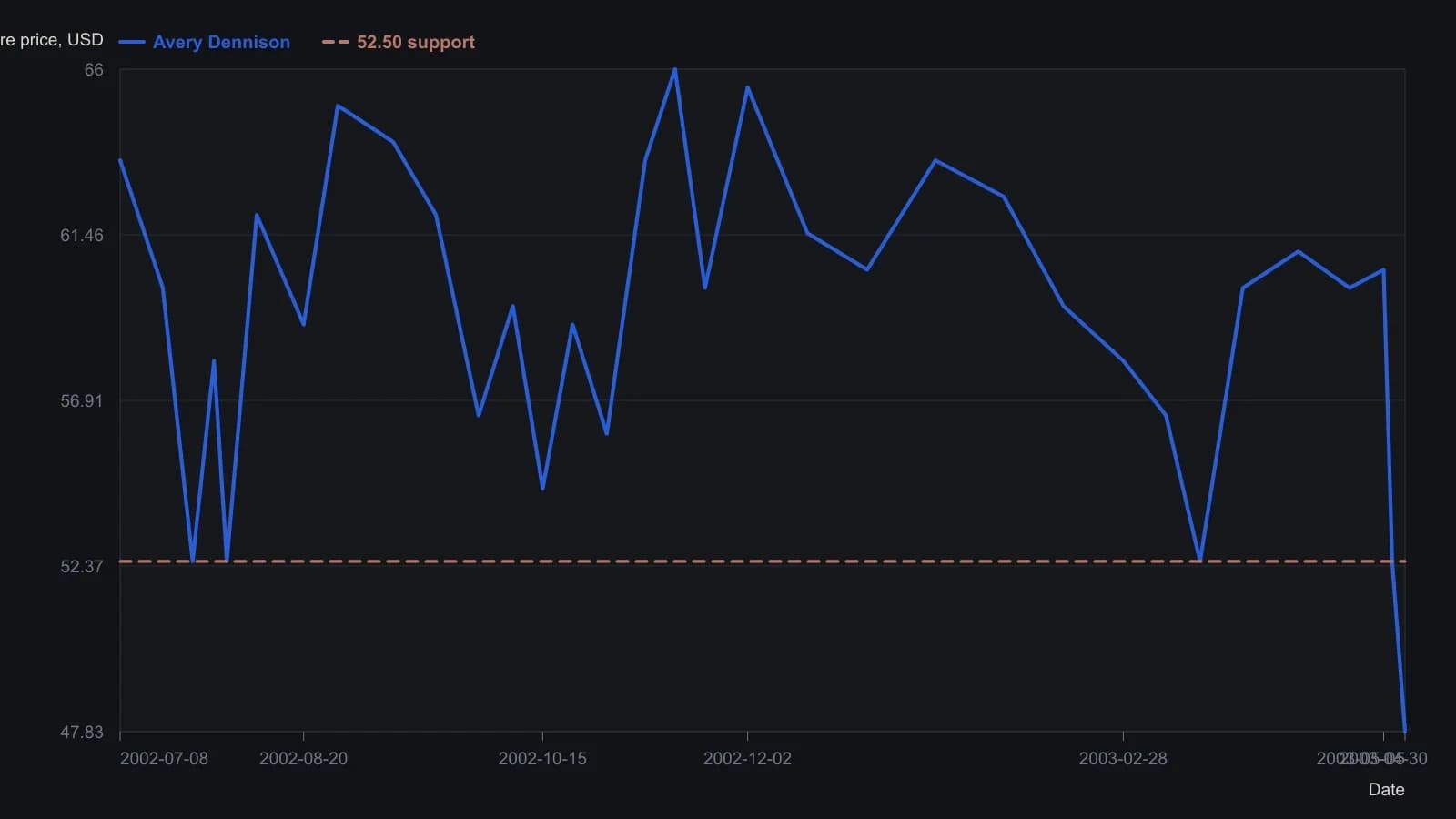
Digitized from the daily MetaStock candlesticks to about a half-dollar. The blue line is the support drawn on the source chart, pinned at 52.50 by the last bar’s open and the header change of −4.67. Intermediate dates are approximate week-scale samples, not official session stamps.
Editorial reading
TradersWeek editorial: the sentiment-factor is the tendency of participants to treat their own entry price as the most important level on the chart. Read in that light, a volume-spike is a construction step that marks a contested price, not a buy or sell by itself. The editorial construction waits for the next break of nearby support or resistance before assigning direction to on-balance volume, volume-price analysis, or the Chaikin oscillator.
All readings on this track · 9 readings
- 1992Fitting oscillator parameters to stock personality
- 1994Constructing the Chaikin oscillator from close-in-range volume
- 1994Constructing Chaikin money flow and a double-exponential smoother
- 1994A three-lock reversal drill: line, oscillator, and volume
- 2000Constructing a Chaikin oscillator from the accumulation-distribution line
- 2005Volume-spike alerts versus direction from follow-through
- 2014A 2014 research stack as a classroom for volume-flow hypotheses
- 2015Money flow oscillator construction from volume pressure
- 2017Small-cap swing entries that wait for accumulation and Chaikin to clear