1995issue C111-7
Sizing a trend futures sleeve in a 1995 policy shift
A February 1995 policy signal left the asset mix as the open problem. Editorial reading: use the case as a three-step drill that names a monetary shock, caps a satellite sleeve, and fills that sleeve with several systematic trend books.
- A February 1995 policy signal was read as a turn back toward money creation while a more subjective consumer-price gauge reduced trust in official inflation, leaving the asset mix as the open problem.
- The case assigned managed futures a 10% to 15% satellite sleeve and reserved the 15% cap for a more adverse inflation reading.
- Live implementation was specified as several systematic, diversified advisors screened on capital, tenure, and process rather than on being the recent return leader.
- A 28.7% drawdown in January 1995 for the then-leading advisor was used to show that an oversized bet on a hot manager turns ordinary style volatility into a panic exit.
The mix was the open problem
A February 1995 policy signal was read as a turn back toward money creation. A more subjective consumer-price gauge reduced trust in official inflation at the same time. The remaining problem was the asset mix.
Editorial reading: treat that mix problem as a policy regime question. A lasting monetary stance can reprice stocks and bonds together, so a single-ticker forecast does not settle the book.
Cap a satellite beside the core
The case assigned managed futures a 10% to 15% satellite sleeve and reserved the 15% cap for a more adverse inflation reading. The sleeve sat beside a core stock-and-bond book rather than replacing it.
Any new sleeve had to meet four tests at once: diversification, an inflation hedge, noncorrelation with the core book, and the ability to stand alone as a profitable class. Noncorrelation means a return pattern that does not move in lockstep with stocks or bonds. It does not require a reliably negative link.
Editorial reading: the cap is the second construction step. A bounded sleeve keeps the experiment from dominating the book if the inflation reading turns more adverse.
Why futures were treated as the wider tool
The futures sleeve was treated as more versatile than a narrow gold-share hedge. Advisors could short equity-index and bond contracts and could span hundreds of commodity and financial markets.
Futures were described as tools that inherit value from an underlying market. The case assigned the real hazards to excess leverage and undiversified books, not to derivative status itself.
Fill the sleeve with several trend books
A simple trend-following illustration took a long or short stance in each of 25 equally weighted markets from a 12-month lookback and reviewed that stance once a month. The rule stayed with a market while the lookback signal remained on one side.
Live implementation was specified as a multi-advisor book: several systematic, diversified advisors screened on capital, tenure, and process rather than on being the recent return leader.
A 28.7% drawdown in January 1995 for the then-leading advisor was used to show that an oversized bet on a hot manager turns ordinary style volatility into a panic exit.
Editorial reading: the third step is to fill the capped sleeve with several systematic trend books so one manager's drawdown is not the whole test.
Late money was framed as a crowding lag
Late institutional entry was framed as a prudence-perception lag. The case warned that such a lag could crowd a then-about $25 billion futures pool from a $15 trillion bond stock and a $9 trillion equity stock.
Annual returns of selected CTAs versus the S&P 500 and Barra/MLM
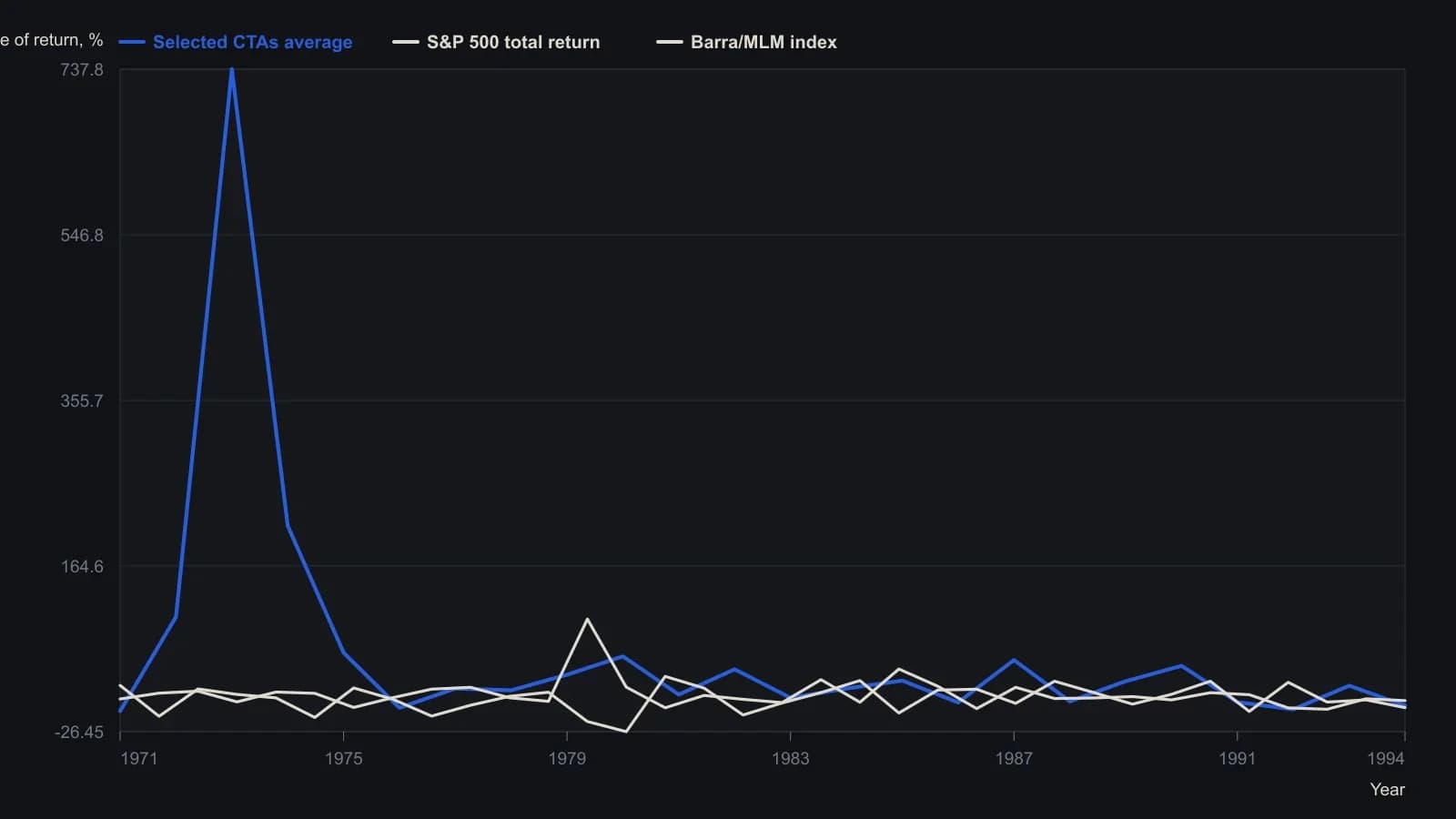
The CTA average is omitted for 1961–1970 because the table lists zero advisors, not a live 0% return. 1972–1974 rest on only two or three names, including 737.82% in 1973. Barra/MLM is a single 12-month long/short rule on 25 equally weighted markets and is not a fee-paying book.
All readings on this track · 26 readings
- 1990Stress-testing a futures sleeve across equity regimes
- 1990Staged sleeves from one equity forecast
- 1990Score a trade after allocation, diversification, and a drawdown limit
- 1993A three-sleeve regime map for equities, rates, and futures
- 1994Late-cycle breadth as an allocation exam
- 1994Ratio MACD crossover as a portfolio weight filter
- 1995Sizing a trend futures sleeve in a 1995 policy shift
- 1996A 1990s case on liquidity cycles, rank rotation, and cross-market sleeves
- 1997Regime-aware allocation versus binary timing
- 1998Hedge-fund sleeves under a hard drawdown limit
- 2010True diversification as portfolio construction
- 2012Regime-gated trend baskets and layered sizing
- 2013Score fund cost drag before the equity-versus-defensive mix
- 2013Cost-first fund mix in portfolio construction
- 2015Cost-first fund construction and the stock-bond mix
- 2016Audit the fund cost-stack, then set the sleeve-mix
- 2016Read fund listings through costs, then allocation, then diversification
- 2017A four-channel own-account book with signal-replacement
- 2017Listed REITs as a standalone portfolio sleeve
- 2017Cost-first stock and bond fund construction
- 2017Cost-first fund mix in a diversified portfolio
- 2018Mutual-fund costs come before returns in portfolio mixes
- 2018Cost gates before a stock-bond fund mix
- 2019Cost-stack and bond-equity mix around a trade
- 2019Evaluate diversification by correlation, not by the mix label
- 2020Cost-first fund sleeves and a stock-bond mix