2015issue C1324-37
Reading engulfing candles in context
A white engulfing candle is a familiar candlestick pattern, but its usefulness depends on where it forms, how large it is next to nearby bars, and whether volume agrees. This Coca-Cola daily case study walks through those checks before a continuation reading can be used.
- A white engulfing candle is useful only after its location and size are compared with nearby bars.
- A white engulfing bar with a small upper wick and a tiny lower tail is treated as stronger than one with long wicks and tails.
- On the Coca-Cola daily chart, 0.59 of upside remained to the first range high against about two points of risk, and the 1.13-point engulfing rise had already used most of the 1.42-point typical run inside the range.
- Volume-price analysis showed a slowly declining exponential moving average, red volume above that average only on down days, and a quieter engulfing bar than the prior two days, which the case study reads as seller dominance.
Name the candle, then test it
A white engulfing candle is a familiar candlestick pattern. The archive case study does not stop at the name. Usefulness depends on where the candle forms relative to nearby bars and how its size compares with those bars.
A white engulfing bar with a small upper wick and a tiny lower tail is treated as a stronger pattern than one with long wicks and tails.
Where the Coca-Cola bar sat
On the Coca-Cola daily chart used as the case study, the stock was moving sideways and often gapped. Those gaps tended to fill or attempt to fill.
In that sideways stretch, black candles were longer most of the time while upside runs used smaller candles. Those upside runs were shrinking in points gained.
Coca-Cola daily closes into the May 2013 resistance shelf
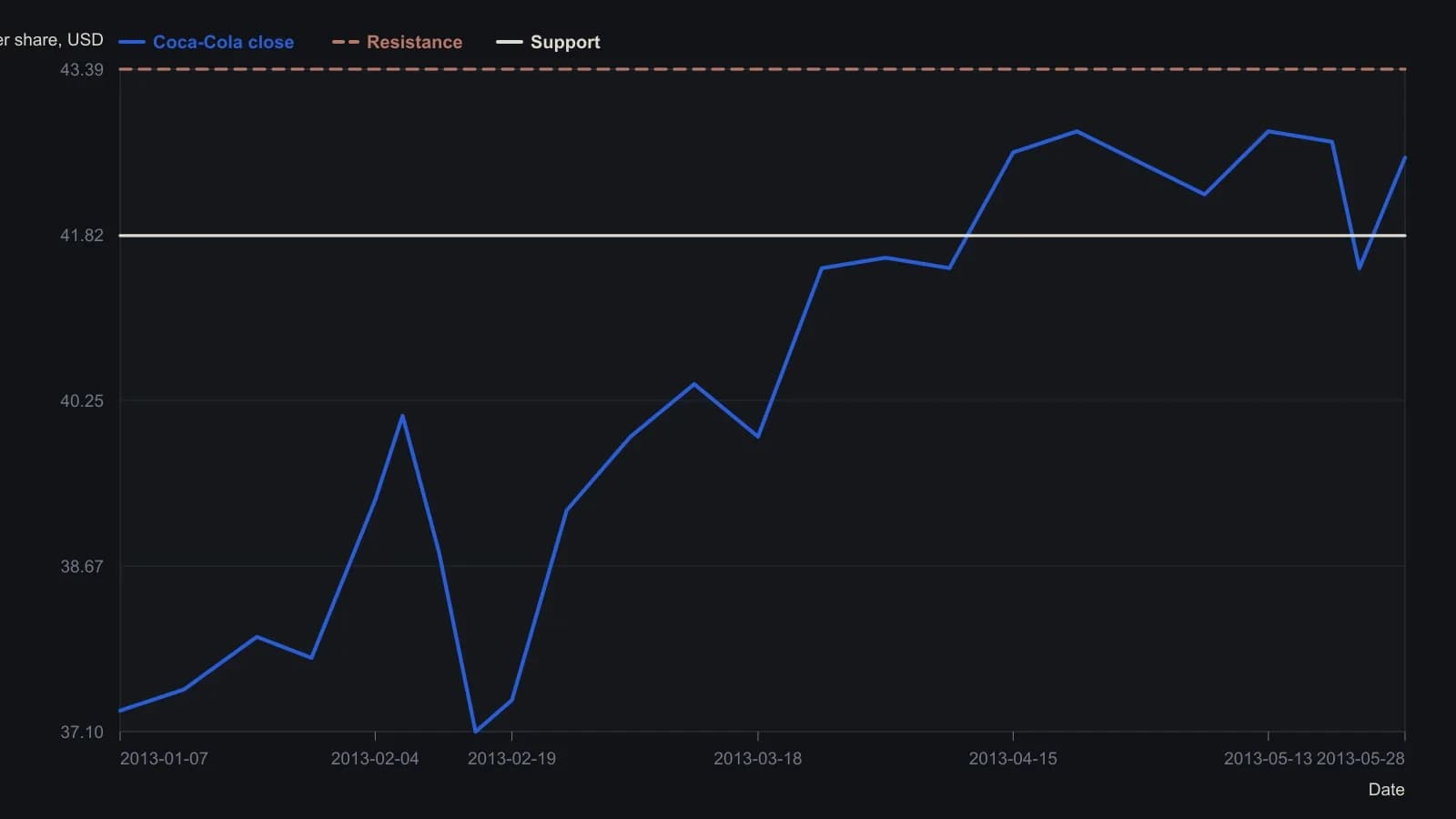
Closes were read against the printed dollar scale on the TC2000 pane and are only good to about 0.1, except the 28 May quote printed on the chart as 42.55. The red line on that pane sits at 43.39; the article also names 42.96 as the first high of the same range and 42.37 as the engulfing-white high.
Measure what the bar has already used
The first high of the sideways range sat at 42.96. The engulfing white high was 42.37. That left 0.59 of upside to that resistance versus about two points of risk down to support beneath the gap white candle.
The longest white engulfing rise in the example was 1.13 points in one day, while the longest run inside the sideways pattern was 1.42 points. The engulfing white had already used most of the typical run potential in that range.
Volume-price analysis of the same bar
Volume-price analysis is the third check in this workflow. Volume during the sideways move was slowly declining on an exponential moving average. The only volume above that average inside the range was red volume on down days.
The engulfing white printed lower volume than the previous two days. The case study reads that as seller dominance even though the candle itself is bullish in shape.
What the three checks leave standing
Candlestick patterns supply the engulfing label. Candlestick engulfing describes the bar. Volume-price analysis tests whether volume supports that shape.
Editorial: in this archive example, the white engulfing candle does not survive as a continuation signal. Nearby bars, remaining range, and quieter volume all work against treating the familiar shape as enough.
All readings on this track · 16 readings
- 1991Candlestick stops from confirmation and engulfing
- 1994Stacked candlestick confirmation on Malaysian indexes, 1994
- 2001Two-bar candlestick reversal as a timed construction
- 2002Engulfing reversal needs trend and a trailing stop
- 2003Engulfing geometry needs a swing slope referee
- 2004Constructing stops from candle control levels
- 2007Abstention completes the engulfing system
- 2007Constructing the belthold candlestick signal
- 2008Evaluating engulfing reversals with opposite-exit tests
- 2010Candle names as a filter, not a catalog
- 2012Critiquing engulfing and volume patterns as crowd psychology
- 2012Candlestick construction of bullish engulfing and a paper-trading rehearsal
- 2015Reading engulfing candles in context
- 2018Treat a bullish engulfing as unfinished work
- 2019Evaluating bullish engulfing with context filters
- 2020Eight-bar pause reclaim entry and a stop-target grid