2002issue C011-5
Engulfing reversal needs trend and a trailing stop
An engulfing-pair is two opposite-color candle bodies in which the later body fully covers the earlier body, with shadows ignored. Editorial reading: the wrap becomes a checkable reversal idea only after trend-context is named and a stop is written before the next open.
- An engulfing-pair is two consecutive opposite-color candle bodies in which the later body fully covers the earlier body; shadows are ignored.
- A reversal reading requires trend-context: a dark body then a light body after a decline, or a light body then a dark body after an advance.
- A pattern-only pass without a trend filter produced trades inside sideways ranges, which motivated a stop-loss, a five-dollar trailing-stop, and a five-day minimum gap between trades.
- Editorial reading: the wrap is a checkable trade idea only after the prior higher-high or lower-low sequence is named and a stop is written before the next open.
How an engulfing pair is identified
An engulfing-pair is two consecutive candle bodies of opposite color in which the later body fully covers the earlier body. Shadows are not part of the identification rule.
Candle bodies encode open-close direction by appearing dark when the close is below the open and light when the close is above the open. Volume, moving averages, and oscillators may confirm a wrap but are not required to identify it.
Trend context and confirmation
A reversal reading requires a prior trend. After a decline the pair is a dark body then a light body. After an advance the pair is a light body then a dark body.
Trend-context is a run of higher highs or lower lows that locates the pair as a reversal attempt rather than a continuation print. An uptrend is a succession of higher highs and a downtrend is a succession of lower lows, often read from closes.
A body-size-filter treats a second body more than 30 percent larger than the first as a stronger engulfing condition. Third-day-confirmation is a close on the session after the pair that continues in the reversal direction.
After three failed reversal attempts the structure is treated as a consolidation-range that may resume the prior direction.
The equity case and written stops
In the 15-month equity case from May 2000 into mid-2001, planned entries were the next session near the open with rounded prices.
A late-June 2000 buy-side pair was skipped because it appeared in an advance or continuation rather than a decline, and nine-day and 18-day exponential averages did not support that pair.
A pattern-only pass without a trend filter produced trades inside sideways ranges, which motivated an explicit stop-loss, a five-dollar trailing-stop, and a five-day minimum gap between trades.
Editorial reading: that workflow treats the wrap as incomplete until the prior higher-high or lower-low sequence is named and a stop is written before the next open. A stop-loss is a precommitted exit that bounds the loss if the wrap fails as a reversal. A trailing-stop follows price by a fixed distance so an open position stays bounded after entry.
Microsoft daily price, May 2000 to July 2001
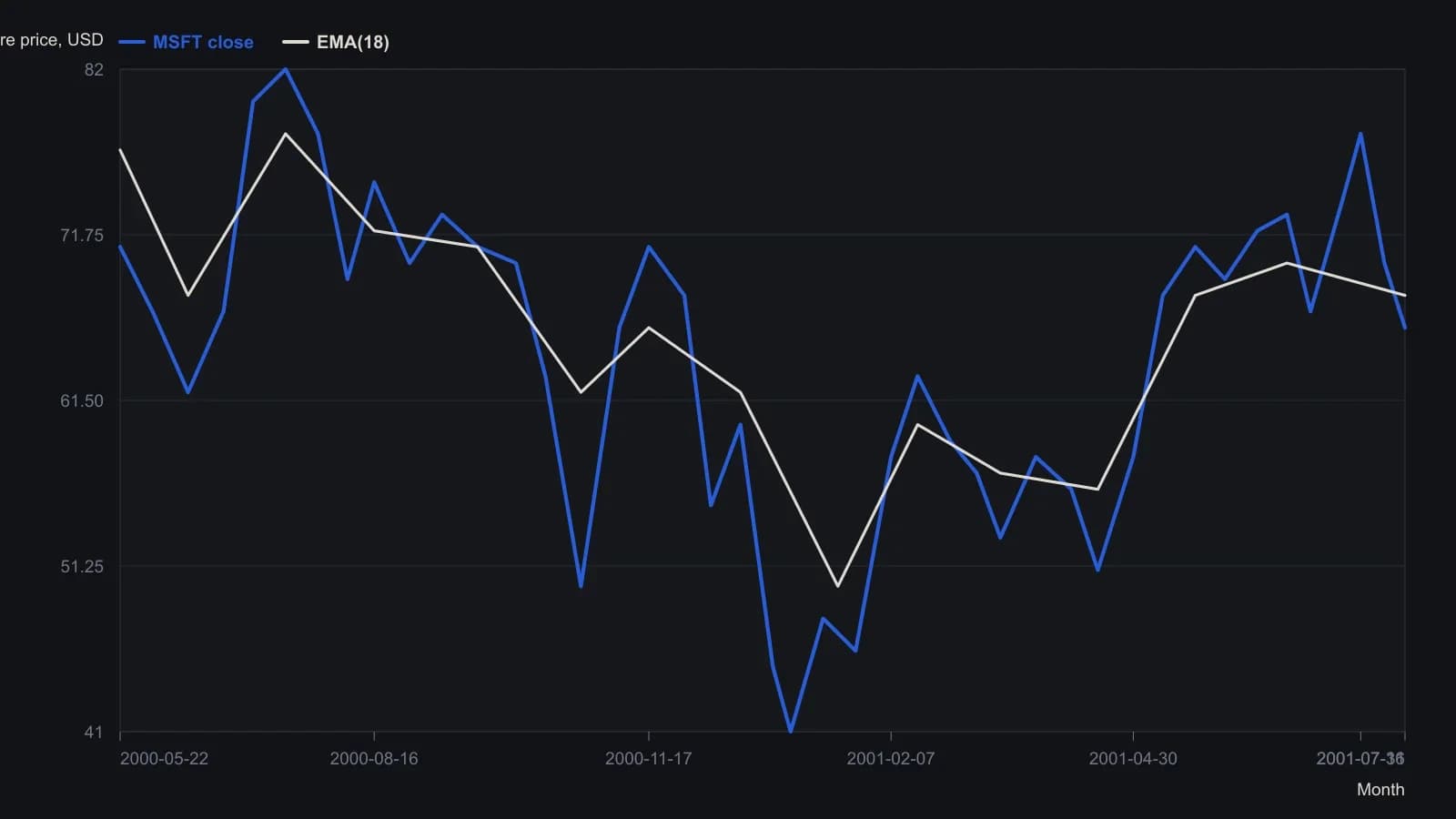
Closes were read from the printed daily pane to the nearest dollar. The source also plots EMA(9) and EMA(18); only the slower average is carried as a reference. Individual engulfing arrows were not digitized.
All readings on this track · 16 readings
- 1991Candlestick stops from confirmation and engulfing
- 1994Stacked candlestick confirmation on Malaysian indexes, 1994
- 2001Two-bar candlestick reversal as a timed construction
- 2002Engulfing reversal needs trend and a trailing stop
- 2003Engulfing geometry needs a swing slope referee
- 2004Constructing stops from candle control levels
- 2007Abstention completes the engulfing system
- 2007Constructing the belthold candlestick signal
- 2008Evaluating engulfing reversals with opposite-exit tests
- 2010Candle names as a filter, not a catalog
- 2012Critiquing engulfing and volume patterns as crowd psychology
- 2012Candlestick construction of bullish engulfing and a paper-trading rehearsal
- 2015Reading engulfing candles in context
- 2018Treat a bullish engulfing as unfinished work
- 2019Evaluating bullish engulfing with context filters
- 2020Eight-bar pause reclaim entry and a stop-target grid