2003issue C061-4
Engulfing geometry needs a swing slope referee
A candlestick is a color-coded open-high-low-close bar. Many named patterns last two sessions, and an engulfing remains only a candidate until swing direction is measured. The archive admits that geometry only after a short close-slope filter and a first-body size floor.
- A candlestick is the same open-high-low-close information as a standard bar, drawn so the up or down session is easier to read by eye.
- Many named patterns last two sessions, and a continuation or reversal reading is only meaningful if the swing or trend state is already known.
- The patterns seen most often are not the same set as those called most reliable, and a candle event's influence is described as fading from one session after the event toward seven sessions after.
- The archive keeps the engulfing geometry and admits it only when a short linear-regression slope of closes and a first-body size floor agree with the intended swing.
A candle is a readable open-high-low-close bar
A candlestick uses a color-coded body for open versus close and wicks for high and low. This is the same information as a standard open-high-low-close bar, arranged so the up or down session is easier to read by eye.
Candlestick study is framed as sequences of day types already used in bar analysis: up and down, inside and outside, narrow and wide range, with extra attention to wick length. Many of the named patterns last two sessions.
Engulfing geometry is only a candidate
A bullish engulfing is a filled down body followed by an up body that contains it. A bullish harami is a filled longer body followed by a shorter unfilled body.
Automatic marks included engulfing cases with a short first body, and some bullish engulfing marks printed while the illustrated series was already in an upswing, after which no reversal followed.
In the archive account, that two-session structure remains only a candidate until swing direction is measured.
QQQ daily price through the late-2001 advance
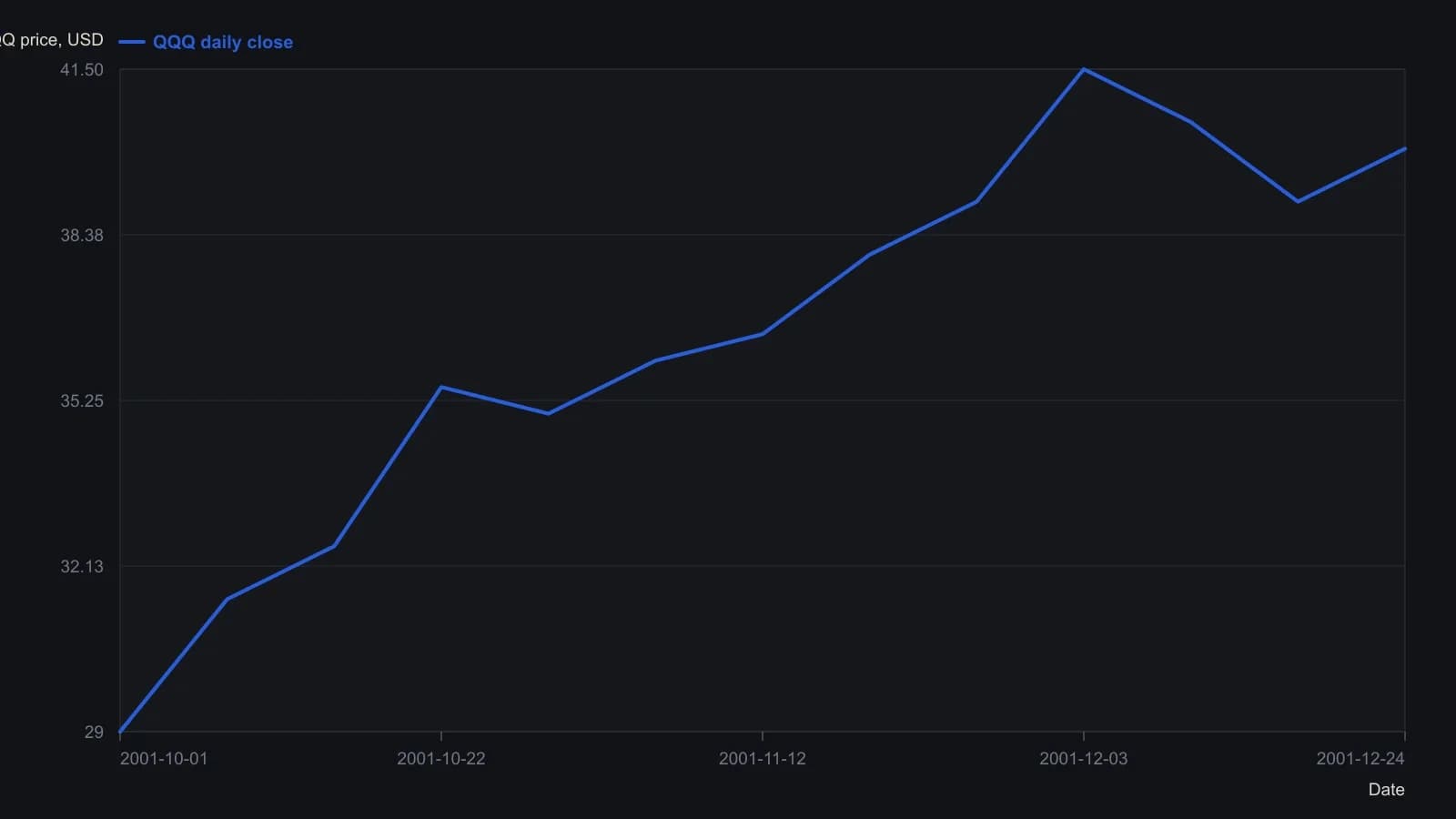
The pane does not print the calendar year. October–December 2001 follows from the neighboring QQQ screenshot marked 2002 and from this 30–42 dollar range. The red zigzag overlay is not the seven-day linear-regression slope used later as the swing referee.
Three evaluation caveats travel together
The patterns seen most often are not the same set as those called most reliable.
A candle event's influence is described as fading sharply from one session after the event toward seven sessions after, so the horizon is a swing rather than a trend.
A continuation or reversal reading is only meaningful if the swing or trend state is already known. Two-bar candle events are treated as swing-scale, not trend-scale, conditions.
A slope referee and a body-to-range floor
A refined long-side rule admitted a bullish engulfing only when a seven-session linear-regression slope of closes was negative and the first body was at least 30 percent of that session's high-low range. That body-to-range floor requires the first engulfing body to cover a minimum fraction of that session high-low range before the pattern is admitted.
Outcomes were scored by comparing the close four sessions after the event with the open of the session after the event.
The same engulfing geometry, non-positive slope filter, and first-body-to-range floor were reused on the short side. In the worked system the slope lookback was searched from 4 to 24 sessions in steps of 4, the slope threshold from -0.5 to 0, the body-to-range floor from 0.2 to 0.7, entry was delayed one session to the next open, and the hold was fixed at two sessions.
Editorial reading: the fitted slope on an ordered close series over a chosen lookback is used here as a binary swing filter rather than as a price forecast by itself.
Rarer three-session reversals
Three consecutive down sessions after an upswing and three consecutive up sessions after a downswing are presented as more reliable reversal forms that appear infrequently, because a single session is treated as having roughly even odds of rising or falling.
Wick length as a range measure
Wick length is treated as a high-low range measure. The wick from the body to the session high or low is a candle shadow, and its length is a direct high-low range measure.
During a strong advance, lower wicks were generally longer than upper wicks. Because the raw daily lower-minus-upper difference was noisy, each side was first smoothed with a 22-session average and that difference was then passed through a 12-26-9 moving-average convergence construction. Discrete wick-as-pattern use is described as riskier than wick length as a momentum reading.
All readings on this track · 16 readings
- 1991Candlestick stops from confirmation and engulfing
- 1994Stacked candlestick confirmation on Malaysian indexes, 1994
- 2001Two-bar candlestick reversal as a timed construction
- 2002Engulfing reversal needs trend and a trailing stop
- 2003Engulfing geometry needs a swing slope referee
- 2004Constructing stops from candle control levels
- 2007Abstention completes the engulfing system
- 2007Constructing the belthold candlestick signal
- 2008Evaluating engulfing reversals with opposite-exit tests
- 2010Candle names as a filter, not a catalog
- 2012Critiquing engulfing and volume patterns as crowd psychology
- 2012Candlestick construction of bullish engulfing and a paper-trading rehearsal
- 2015Reading engulfing candles in context
- 2018Treat a bullish engulfing as unfinished work
- 2019Evaluating bullish engulfing with context filters
- 2020Eight-bar pause reclaim entry and a stop-target grid