2008issue C061-2
Evaluating engulfing reversals with opposite-exit tests
A reversal count is used only when price arrives from one direction and leaves with an opposite-side exit. A median frequency filter then keeps common types in view, so two-bar bearish engulfing can be judged as a retestable chart condition.
- A reversal count requires an arrival from one direction and an opposite-side exit: a close above the pattern highest high or below its lowest low.
- A median frequency filter keeps only candlestick types that appear more often than the midpoint of the 103 compared types, which removes rare formations from the ranking.
- After that screen, two-bar bearish engulfing had the strongest bull-market reversal standing among the remaining common candles, ahead of three outside up and the bullish belt hold.
- Pattern-height projection from highest high to lowest low is a separate short-horizon check toward the next swing high or swing low.
Count the leaving close first
The archive used a reversal count only when price entered a candlestick pattern from one direction and left it in the opposite direction. The leaving trend was an opposite-side exit: a close beyond the pattern highest high or lowest low.
A delayed turn, or a one-tick turn that failed immediately, did not qualify. The close had to leave the whole pattern, not merely tick through one edge and fail.
Keep types above the median
The evaluation compared 103 candlestick types. A search of more than 4.7 million candles across hundreds of stocks in both bull and bear markets found only nine examples of one highly ranked but extremely rare reversal type.
A median frequency filter kept only patterns that appeared more often than the median of those 103 types, which removed rare formations from the ranking. Among the 103 types, bearish engulfing received a frequency rank of 11, where 1 marked the most frequent rank on that scale.
What the common set still ranked
After that screen, the two-bar bearish engulfing pattern had the strongest bull-market reversal standing among the remaining common candles, ahead of three outside up and the bullish belt hold.
Bearish engulfing was read after an advance as a white body fully spanned by a following black body that opened above the prior close and closed below the prior open. Shadows were ignored and tied body edges were allowed.
Three outside up was a bullish engulfing pair in a decline plus a third candle with a higher close, used as confirmation of the engulfing turn. The bullish belt hold is a white opening-marubozu bar in a decline: an upper shadow is present and a lower shadow is absent.
Common reversal candles after the median frequency cut
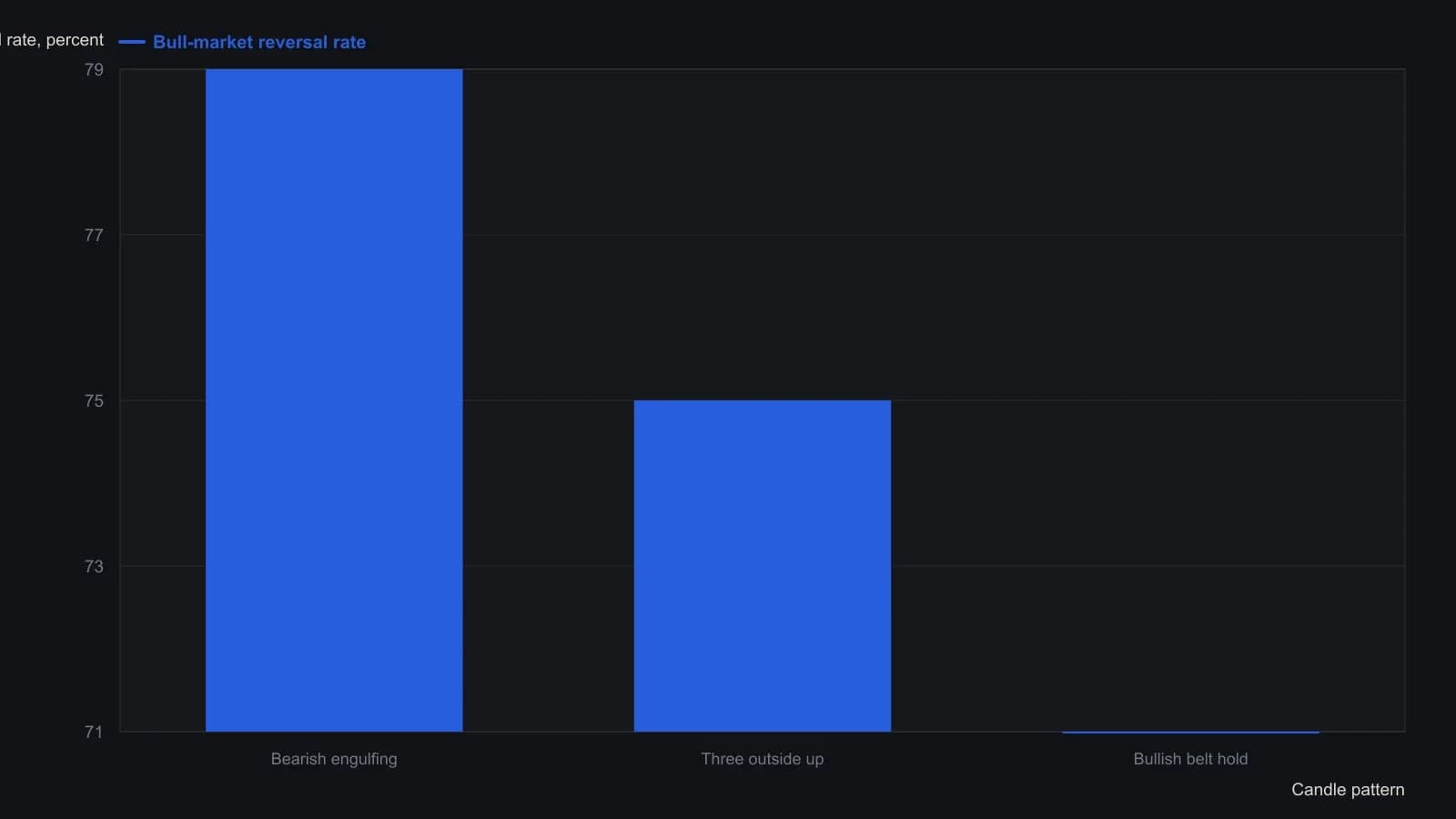
A reversal is counted only on an immediate close beyond the pattern high or low. The search covered 103 candle types on more than 4.7 million candles; only types more frequent than the median remain. Results are for a bull market.
Use height as a separate check
Pattern-height projection measured the distance from a pattern highest high to lowest low. That height was a separate short-horizon check toward the next swing high or swing low, not a substitute for the reversal count or the frequency filter.
All readings on this track · 16 readings
- 1991Candlestick stops from confirmation and engulfing
- 1994Stacked candlestick confirmation on Malaysian indexes, 1994
- 2001Two-bar candlestick reversal as a timed construction
- 2002Engulfing reversal needs trend and a trailing stop
- 2003Engulfing geometry needs a swing slope referee
- 2004Constructing stops from candle control levels
- 2007Abstention completes the engulfing system
- 2007Constructing the belthold candlestick signal
- 2008Evaluating engulfing reversals with opposite-exit tests
- 2010Candle names as a filter, not a catalog
- 2012Critiquing engulfing and volume patterns as crowd psychology
- 2012Candlestick construction of bullish engulfing and a paper-trading rehearsal
- 2015Reading engulfing candles in context
- 2018Treat a bullish engulfing as unfinished work
- 2019Evaluating bullish engulfing with context filters
- 2020Eight-bar pause reclaim entry and a stop-target grid