2018issue C1216-19
Treat a bullish engulfing as unfinished work
A bullish engulfing marked at the Day 0 close is only a trigger after a decline. The historical workflow still required falling short-horizon averages, a higher-horizon average stack, a mapped swing high, and a confirmation clock.
- A bullish engulfing marked at the Day 0 close is a trigger after a decline, not a complete trade plan.
- Both the five-day and ten-day simple moving averages had to be falling on Day 0 and the next two sessions, while the 100-day average stayed above the 400-day average on the name and on the S&P 500.
- The mapped objective was a nearby local peak within 30 sessions, and three entries were specified, including a delayed open two sessions later after a close above Day 0's high.
- Protective exits, an acceptance gate of at least 1.0, a 200-day average overlay, and a companion trendline sat beside the candle rather than replacing it.
Mark the bar at the Day 0 close
The historical workflow marked the bullish engulfing condition on Day 0 at the close. That two-session candlestick condition was used as the Day 0 trigger after a decline, not as a complete trade plan.
Later timing, stops, and targets were measured from that same Day 0 session.
Write the moving-average state
Both the five-day and ten-day simple moving averages had to be falling on Day 0 and on the next two sessions. That short-horizon filter placed the engulfing bar inside a pullback.
A higher-horizon filter required the 100-day simple moving average to remain above the 400-day simple moving average on the individual name and on the S&P 500.
Day 0 volume had to exceed the prior 14-day average and 100,000 shares. Last price had to sit between 20 and 90 dollars, and the universe was the Russell 3000.
Map a nearby swing high
The mapped objective was the high of a prior local peak that exceeded the surrounding three sessions. That peak had to fall no more than 30 sessions before the engulfing bar.
One acceptance gate required the distance from a prospective entry to the mapped peak, divided by the two-dollar risk, to be at least 1.0. An early-exit rule placed the objective at Day 0's high plus the full Day 0 range from high to low.
Cash committed to each name was capped at 10,000 dollars.
Specify a confirmation clock
Three entries were specified: buy the next open; buy the open two sessions later only after a close above Day 0's high; and that same delayed entry only if the intervening high did not exceed Day 0's high.
The first protective exit sat two dollars under Day 0's high. A later variant also flattened if a session closed ten cents under Day 0's low while leaving that two-dollar stop in place.
Win rate of three bullish-engulfing entry rules
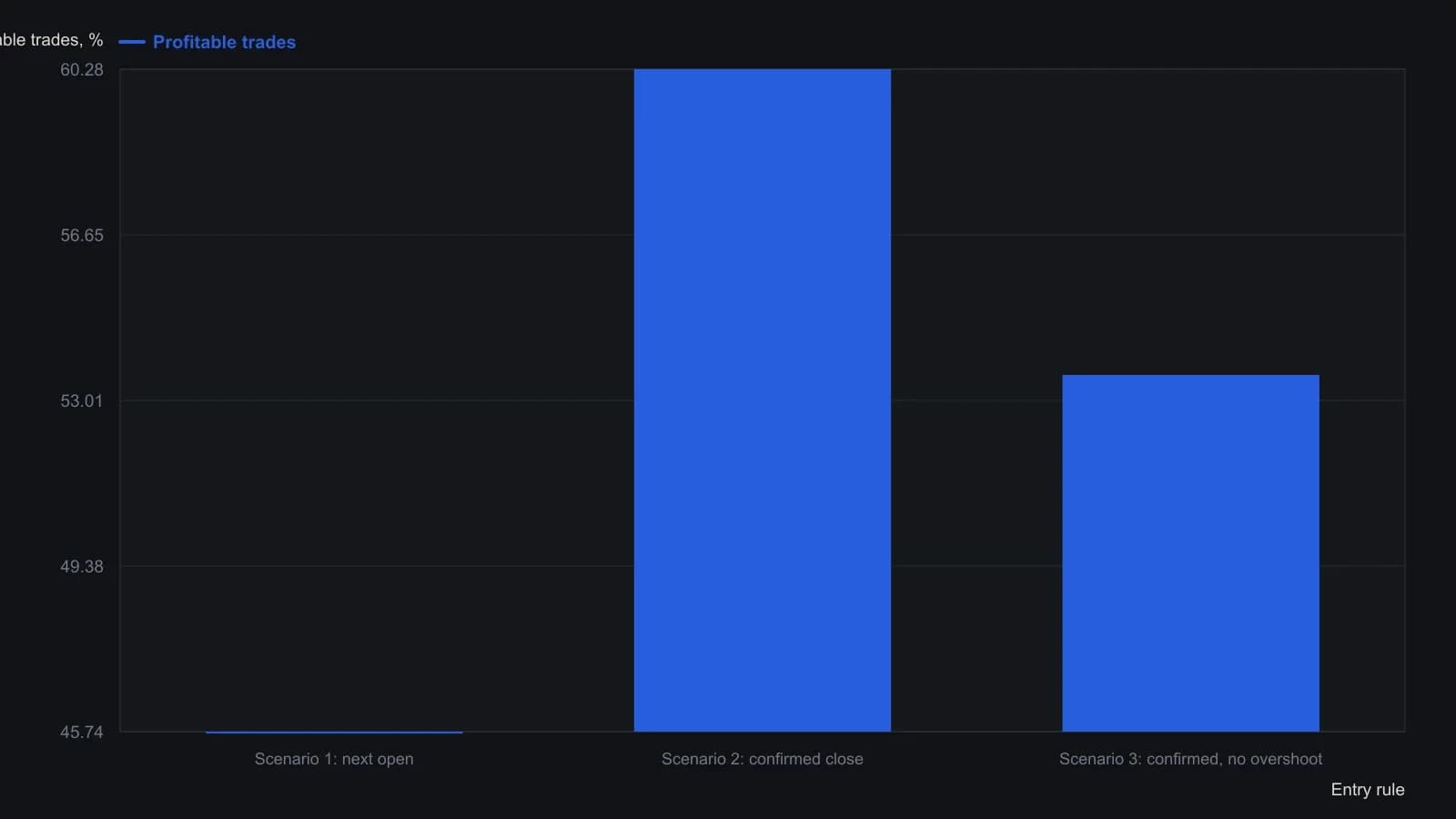
Each position was sized at no more than $10,000 with a $2 stop under the Day 0 high. The pattern also had to print against a falling 5-day and 10-day average, a 100-day average above the 400-day average on both the stock and the S&P 500, Day 0 volume above the 14-day average and above 100,000 shares, and a price between $20 and $90. The author notes a live book would be thinner once extra support and resistance filters are applied.
Keep companions beside the bar
A 200-day simple-moving-average overlay required a Day 0 or Day 1 low beneath that average and a close back above it, with a few cents of slack.
The same write-up treated trendlines and later price action as companion conditions rather than as a replacement for the engulfing bar.
All readings on this track · 16 readings
- 1991Candlestick stops from confirmation and engulfing
- 1994Stacked candlestick confirmation on Malaysian indexes, 1994
- 2001Two-bar candlestick reversal as a timed construction
- 2002Engulfing reversal needs trend and a trailing stop
- 2003Engulfing geometry needs a swing slope referee
- 2004Constructing stops from candle control levels
- 2007Abstention completes the engulfing system
- 2007Constructing the belthold candlestick signal
- 2008Evaluating engulfing reversals with opposite-exit tests
- 2010Candle names as a filter, not a catalog
- 2012Critiquing engulfing and volume patterns as crowd psychology
- 2012Candlestick construction of bullish engulfing and a paper-trading rehearsal
- 2015Reading engulfing candles in context
- 2018Treat a bullish engulfing as unfinished work
- 2019Evaluating bullish engulfing with context filters
- 2020Eight-bar pause reclaim entry and a stop-target grid