2007issue C051-4
Session filters for moving-average entry rules
A lagging moving average forecasts whether the regular-session open sits above a lookback baseline. In the archive workflow, that forecast became a mechanical long only after overnight and volume filters decided when the 09:30 ET entry was allowed to fire.
- A moving average is a lagging forecast of whether the open sits above or below a lookback baseline, not an order by itself.
- Session analysis then filters that forecast with the overnight gap, prior-session volume, and regular-session hours.
- The mechanical system is one procedure: enter at the 09:30 ET open, exit at the 16:00 ET close, or stand aside.
- Among the listed lookbacks, only the unadjusted 34-day long had a positive regular-session result, and the three-condition filter changed that historical comparison.
The forecast is not yet a trade
A moving average is a lagging average of ordered session prices that forecasts whether the open sits above or below a lookback baseline. That comparison names a condition. It does not yet say when a regular-session long may be sent, when it must be offset, or when the desk should stand aside.
How the unadjusted long was stated
The archive workflow used a mechanical long that entered at the 09:30 ET open when that open was above the 34-day average and was offset at the 16:00 ET close. No trade occurred when the open was below the average.
The 34-day signal could not be formed until 34 trading days after the October 31, 2002 start, so that series began on December 18, 2002.
Session filters that gate the open
Session analysis is a filter that uses overnight gap, prior-session volume, and regular-session hours to decide whether an opening long is executable.
The adjusted rule required three conditions together: open above the 34-day average, prior-day volume above 100,000,000 shares, and an overnight session below 0.00.
A 100 million-share session sat at the 60th percentile of cue volume given a mean of 92 million and a standard deviation of 29 million.
One procedure for entry, exit, and abstention
A mechanical trading system is a single procedure that states when to enter at the open, exit at the close, or stand aside. After the session filters, the overnight-decline branch posted a 0.708 win rate and a 124 average on a 1,000-share regular-session long.
The same filtered procedure produced a 12.38 regular-session profit, versus 0.685 for the unadjusted 34-day long over 615 days.
Filtered 34-day SMA running P/L on QQQQ
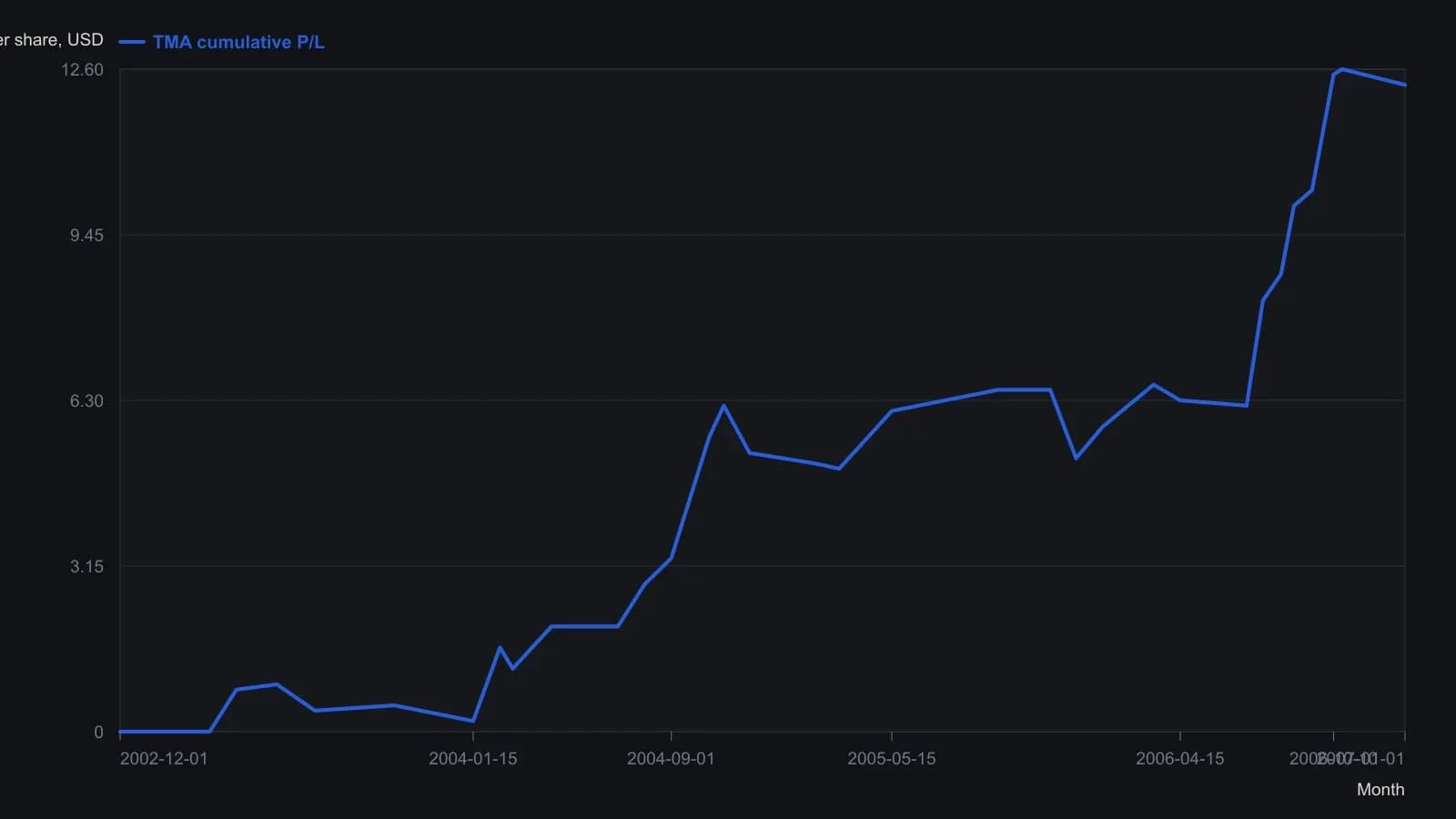
TMA entered a 1,000-share long only when the 09:30 ET open was above the 34-day simple moving average, prior-day volume exceeded 100 million shares, and the overnight session declined; the position was always closed at 16:00 ET. Digitized turning points are approximate to about two-tenths of a dollar.
All readings on this track · 18 readings
- 1990Constructing a second-hour session residual exponential index
- 2000Treat an open limit book as an execution filter
- 2002Constructing a long, short, or flat pre-trade checklist
- 2003Session-window trims for mechanical day-system evaluation
- 2004Overnight session entry rules after regular hours
- 2005Overnight and regular session execution in Nasdaq 100 names
- 2006The intraday workspace as a combined decision procedure
- 2006Same-session trading needs presence and next-signal rules
- 2007Session filters for moving-average entry rules
- 2008Related-market checklist, session filter, and ATR-scaled stop
- 2008After-hours session regimes and the next-day close
- 2008Evaluating a next-open entry after one-day corrections
- 2010Session range share: currency futures versus the mini index
- 2011Dollar travel, afternoon sessions, and a 1:2 first-loss bound in equity-index futures
- 2012Last-hour volume breaks with a first-hour exit
- 2013Same-session and multi-session trades as one rule-based procedure
- 2015Session clock bars from public quote feeds
- 2016Session-gated moving-average entry construction