1988issue C021-5
Folding night auctions into daily OHLC bars
When a Treasury futures venue added an evening window in 1987, the official close stayed the afternoon print while highs and lows spanned both auctions. The first question was which prints belonged in the daily bar.
- The venue treated the prior-evening window as the start of the next daily session, but the official close remained the 14:00 Central afternoon print.
- Published highs and lows used combined-session extremes, so a night-window-extreme could set the daily range even though close construction used a different part of the same session.
- About one-third of combined-session extremes in a May 8 to July 15 1987 sample printed at night, yet volume confirmation stayed unresolved because the window was described as thinly participated.
- Editorial view: keep a split-chart-book until a session-volume-test shows the extra auction is broad enough to treat those extremes as session-wide rather than local.
Define the session before the bar
A 1987 Treasury futures and options night auction ran from 18:00 to 21:00 Central time, and the venue defined the daily session as beginning with that prior-evening window.
The last night-window trade was labeled a suspension and the next morning restart a resumption. In this archive article those marks are the suspension-print and the resumption-open. Range construction and close construction used different parts of the same defined session.
What entered the daily bar
The official daily close remained the afternoon print at 14:00 Central time. The published daily high and low used the combined extremes of the night window and the following daytime pit.
That produced a combined-session-bar: the high and low could include a night-window-extreme, while the close stayed the designated end-of-day print.
The venue published only combined-session highs and lows and did not archive a night-window last trade, which blocked independent OHLC construction for the evening auction alone.
Which weekday bars included the overnight extreme
Sunday-night auctions were initially absent from Monday ranges. They were later authorized to begin on 13 September 1987, which changed which weekday bars included an overnight extreme.
How often the night window set the range
In a May 8 to July 15 1987 sample of disaggregated session highs and lows, about one-third of the combined-session extremes printed during the night window.
How often the night auction set the T-bond daily extreme
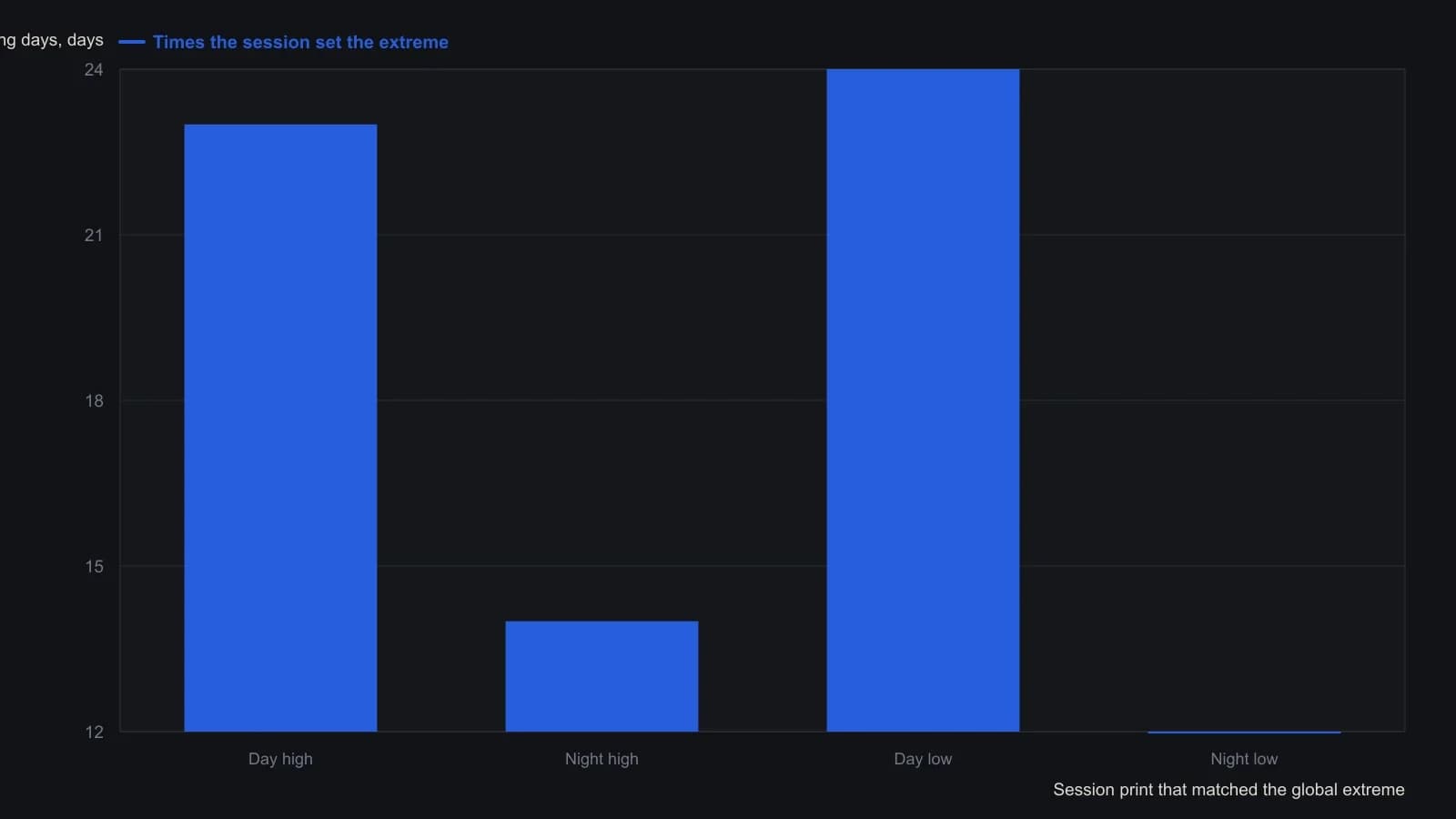
Sample is front-month June 1987 contracts through 29 May and September thereafter. Sunday night sessions had not yet been approved. A day can be counted on both sides when night and day print the same extreme.
Why many daily signals barely moved
Over the first two months of night trading, moving averages, momentum, a relative-strength oscillator, and stochastics showed no material change in average signal count versus earlier two-month segments. That pattern is consistent with most of those tools depending on a close that was not unique to either window.
The volume question stayed open
As of July 1987 the night window was described as thinly participated, with local traders more active than institutions, so volume confirmation of night extremes remained unresolved.
A venue estimate attributed about 25 percent of night-window volume to Japanese participation after a May 1987 rule change allowed Japanese financial institutions to trade U.S. financial futures for their own accounts.
Editorial reading: a session-volume-test checks whether activity in the new auction window is broad enough to treat its extremes as representative rather than local. Until that extra volume can be judged, a split-chart-book keeps two parallel series of the same contract, one that includes the extra auction and one that excludes it.
All readings on this track · 12 readings
- 1988Folding night auctions into daily OHLC bars
- 1989Constructing currency-translated commodity OHLC bars
- 1990Volume-width candlestick bar construction
- 1991Session-fitted bars and average-true-range risk bounds
- 1991Overnight versus session decomposition of futures bars
- 1994Constructing range overlap and bar-pattern filters from neighboring OHLC bars
- 1995Open-range stops after a fifty percent retracement
- 1997Lock the ohlc-bar before a flag or candle becomes a setup
- 2003Equal session OHLC bars for multiframe stochastic decisions
- 2003Continuous FX auctions, session-cuts, and gap proxies
- 2008Near-end-of-bar confirmation for discretionary entries
- 2018Constructing roller-and-strip charts from high-low-close pressure