2003issue C081-5
Session-window trims for mechanical day-system evaluation
Evaluation is taught here as a three-layer procedure: specify one mechanical day-trading system, treat opening and closing auction minutes as a session-analysis filter on the price series itself, then robustness-test the identical rules on a moderate trim and an over-trim.
- Around-the-clock equity-index mini futures concentrate most activity in the regular cash session, while the first and last 15 minutes can be erratic from opening-order flow, missing cash-index updates, and piled-up closing orders.
- Dropping those session-edge bars from the series is data-reduction: oscillators and moving averages recalculate on the trimmed path, which is not the same as skipping signals printed in those minutes.
- One mechanical day procedure used a 10-period average of a trend-confirmation stochastic with 45- and 5-period SlowD smoothing, a 100-period average of the close, 50-level crosses with the close on the same side, and a flatten at the session close with no stops.
- The identical rules produced weaker evaluation metrics on a 10:00 to 15:45 window than after a first-and-last 15-minute trim, which the archive treated as a sign that useful information had been removed.
A three-layer evaluation
Editorial framing: treat evaluation as three layers that stay separate. First specify one mechanical trading system so entry, exit, and the end-of-day flatten are tested as a single procedure on rule inputs, market state, and execution assumptions. Next use session analysis to choose which minutes of the order-life cycle enter the series, after weighing auction imbalance, missing cash references, spread, volume, and trading-cost conditions. Then robustness-test the identical rules after changing only the session window.
Editorial note: a moderate trim and an over-trim are shown side by side so students can see when data-reduction stops cleaning session-edge noise and starts deleting the path the signals need. The archive does not report that the first trim improved results. It reports that the tighter window produced weaker evaluation metrics.
Session-edge noise as a series filter
Around-the-clock equity-index mini futures concentrate most activity in the regular cash session. The final 15 minutes after the cash close lack updated cash-index and major-stock prices while absorbing piled-up closing orders. The first 15 minutes can be similarly erratic because the contract must adjust to newly opened index stocks and accommodate opening-order flow.
Those session-edge swings distort momentum oscillators and smoothing tools such as moving averages. Session analysis here chooses which minutes remain in the series before the mechanical rules are computed.
How a trimmed window changes a moving average
A 10-period simple moving average computed on a 9:45 to 16:00 window can diverge from the full 9:30 to 16:15 average after the open. The two averages can match again once both lookbacks share the same bars.
Editorial note: the mechanical rules below inherit that same effect, because a changed window means the oscillators and smoothers are no longer the same inputs.
One mechanical day procedure
The archive specified one mechanical trading system: a fully specified entry, exit, and end-of-day flatten tested as one procedure. It combined a 10-period average of a stochastic, 45- and 5-period SlowD smoothing, and a 100-period average of the close. It entered long when that stochastic average crossed above 50 with the close above the long average, entered short on the opposite cross, and flattened at the session close with no stops.
The 50-level cross was specified as trend confirmation rather than 20/80 extreme picking because the design was trend-following. That mid-scale stochastic cross, used with the long moving average of the close, is a trend-confirmation stochastic rather than a fade of oscillator extremes.
What stayed fixed in the evaluation
The evaluation used unadjusted five-minute bars of the current contract. Roll dates were aligned to first-notice dates of the larger related contract. The execution assumptions were a five-dollar round-turn commission and no slippage allowance. Robustness testing then re-ran the same mechanical rules after changing only the session window.
A moderate trim and a tighter window
The same rules were retested after dropping the first and last 15 minutes, then again on a narrower 10:00 to 15:45 window. The tighter window produced weaker evaluation metrics, which the archive treated as evidence that useful information had been removed.
Closed profit by side after trimming the auction minutes
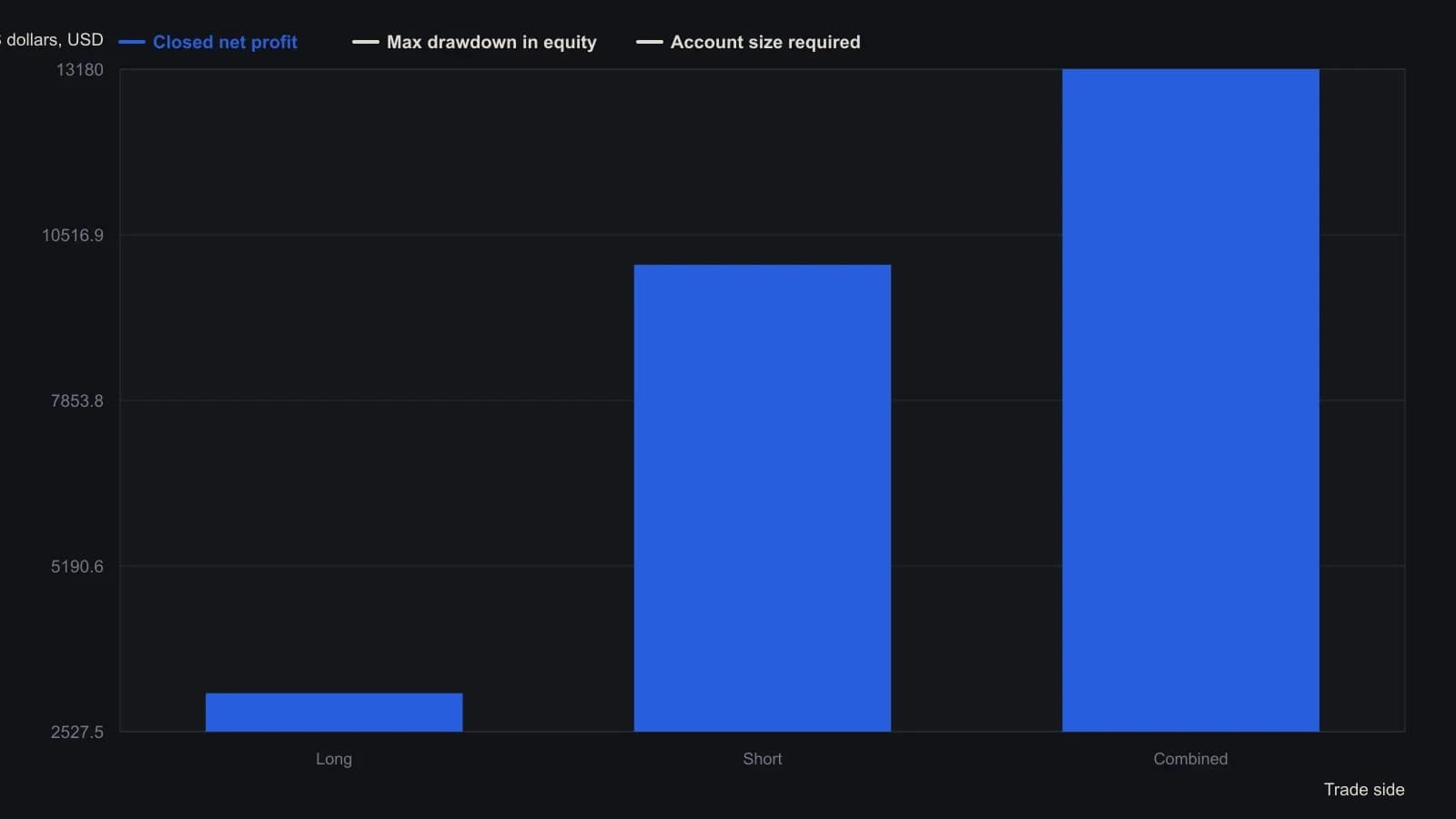
Same rules in all columns: 10-period SMA of stochastic crossing 50 with a 100-period close SMA filter, end-of-day exit, one contract, $5 round-turn, no stops and no slippage. The test year is calendar 2002 on unadjusted five-minute S&P e-mini data, session cut to 9:45–16:00 ET.
When to trim early
Further reduction that worsens results is presented as a stop signal that the core behavior of the series has changed. Session-window trimming is recommended early in system design only when the noise is consistent.
All readings on this track · 18 readings
- 1990Constructing a second-hour session residual exponential index
- 2000Treat an open limit book as an execution filter
- 2002Constructing a long, short, or flat pre-trade checklist
- 2003Session-window trims for mechanical day-system evaluation
- 2004Overnight session entry rules after regular hours
- 2005Overnight and regular session execution in Nasdaq 100 names
- 2006The intraday workspace as a combined decision procedure
- 2006Same-session trading needs presence and next-signal rules
- 2007Session filters for moving-average entry rules
- 2008Related-market checklist, session filter, and ATR-scaled stop
- 2008After-hours session regimes and the next-day close
- 2008Evaluating a next-open entry after one-day corrections
- 2010Session range share: currency futures versus the mini index
- 2011Dollar travel, afternoon sessions, and a 1:2 first-loss bound in equity-index futures
- 2012Last-hour volume breaks with a first-hour exit
- 2013Same-session and multi-session trades as one rule-based procedure
- 2015Session clock bars from public quote feeds
- 2016Session-gated moving-average entry construction