2008issue C071-5
After-hours session regimes and the next-day close
After the regular cash session ends, a large after-hours print can be treated as an input to the next day's close rather than as a same-session trade. In the collected sample, price, volume, move size, and weekday split that overnight direction into continuation, fade, or sit-out buckets.
- After the regular cash session ends, a large after-hours print can be treated as an input to the next day's close rather than as a same-session trade.
- After-hours up names above 25, with volume of at least 100000 and a move of at least 10 percent, showed a positive average next-day close, while cheaper names under the same filters did not.
- Among after-hours down names held long into the next close, only the 5-to-10 price band printed a positive average result.
- After-hours volume was not a universal confirmation, and the after-hours up bucket above 50 had only 14 qualifying trades.
From the after-hours print to the next close
After the regular cash session ends, a large after-hours print can be treated as an input to the next day's close rather than as a same-session trade. Session analysis in this workflow holds the print overnight and scores it at the next regular close.
A winning trade was defined as a next-day return of at least 0.5 percent. That hurdle was chosen as a buffer for after-hours slippage and trading costs rather than as a market-derived threshold.
When after-hours strength continued
In the collected sample, after-hours up names above 25 with volume of at least 100000 and a move of at least 10 percent showed a positive average next-day close, while cheaper after-hours up names under the same filters did not.
The after-hours up bucket above 50 in that filter set had only 14 qualifying trades, so the strongest-looking continuation result is also the least supported by sample size.
After-hours volume did not act as a universal confirmation: larger volume reduced next-day losses for after-hours up names under 5, increased losses in the 5-to-25 band, and improved the after-hours up result only above 25.
When after-hours weakness was held or shorted
Among after-hours down names held long into the next close, only the 5-to-10 price band printed a positive average result; other down-side price bands did not. That long-into-weakness slice is the Contrarian strategy leg of the rule set, and only in the band that printed a positive average.
For after-hours down names, smaller overnight percentage declines were associated with better next-day long results than larger declines, across the price bands reported.
A weekday slice of after-hours down names taken as shorts showed Friday with the highest win rate and only 15 qualifying trades, consistent with thin Friday after-hours news flow. Seasonal trading in this workflow is that weekday cut.
The study window sat inside a rising broad-market stretch, so any short-after-hours observation measured there is a same-regime result, not a test across bull and bear market states.
Next-day close after a 10% after-hours move, by share price
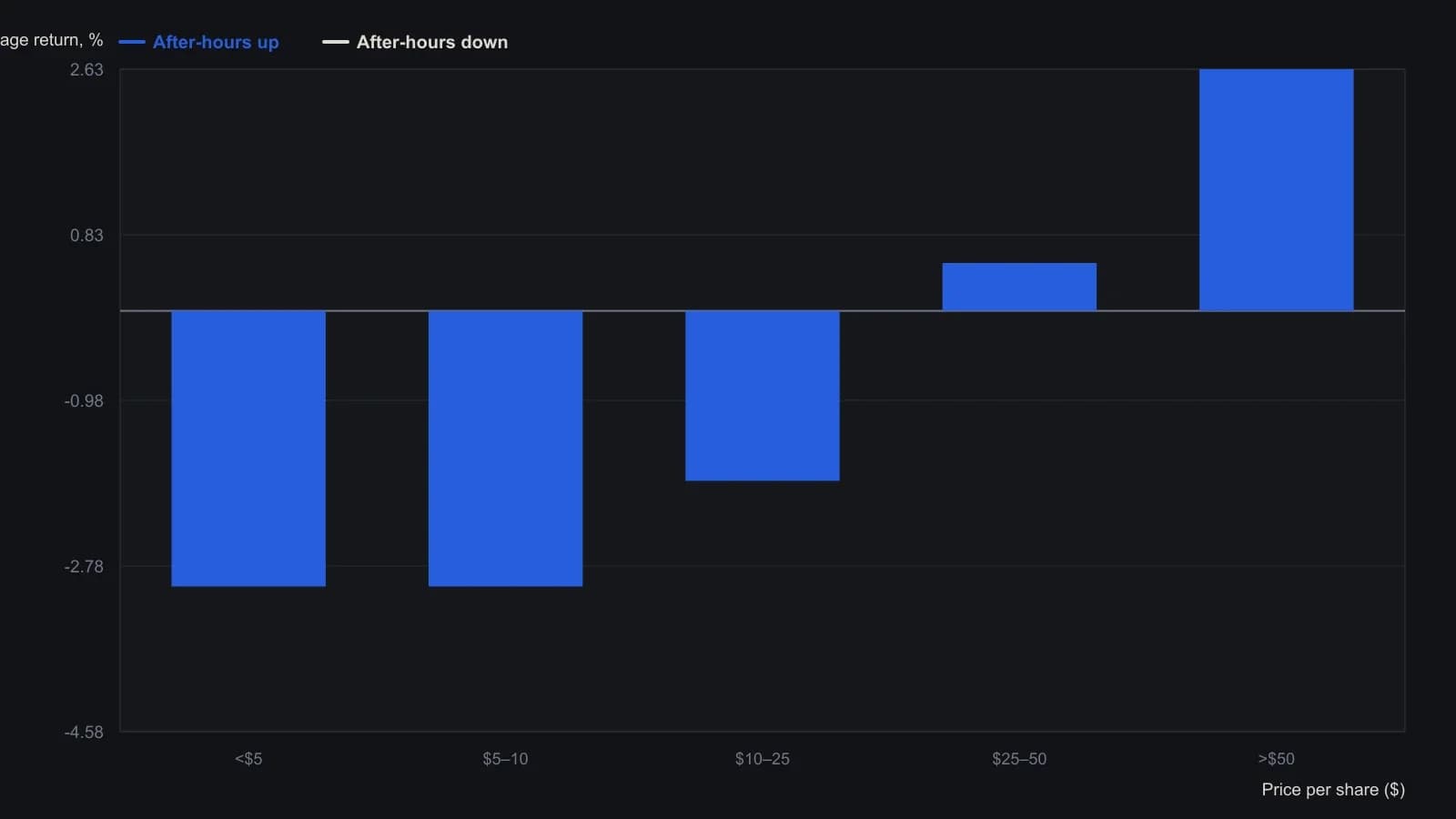
Every bar is a long from the after-hours close to the next regular close. Volume is held at 100,000 shares or more and the overnight move at 10% or more. The above-$50 after-hours-up bucket has only 14 trades. A win is defined as a 0.5% or larger gain to cover slippage and fees. Sample is 8 February 2006 to 21 June 2007.
All readings on this track · 18 readings
- 1990Constructing a second-hour session residual exponential index
- 2000Treat an open limit book as an execution filter
- 2002Constructing a long, short, or flat pre-trade checklist
- 2003Session-window trims for mechanical day-system evaluation
- 2004Overnight session entry rules after regular hours
- 2005Overnight and regular session execution in Nasdaq 100 names
- 2006The intraday workspace as a combined decision procedure
- 2006Same-session trading needs presence and next-signal rules
- 2007Session filters for moving-average entry rules
- 2008Related-market checklist, session filter, and ATR-scaled stop
- 2008After-hours session regimes and the next-day close
- 2008Evaluating a next-open entry after one-day corrections
- 2010Session range share: currency futures versus the mini index
- 2011Dollar travel, afternoon sessions, and a 1:2 first-loss bound in equity-index futures
- 2012Last-hour volume breaks with a first-hour exit
- 2013Same-session and multi-session trades as one rule-based procedure
- 2015Session clock bars from public quote feeds
- 2016Session-gated moving-average entry construction