1992issue C061-7
Evaluating maximum-adverse-excursion stop reversals with short time stops
An archive evaluation reversed the position automatically at the maximum-adverse-excursion stop instead of only flattening. It then inspected the reverse’s own adverse-excursion profile, price stops, and a short time stop rather than the first trade horizon.
- The evaluation reversed the position automatically when price reached the maximum-adverse-excursion stop, instead of using that stop only to flatten.
- A reversing trade can still produce a large adverse move if price recrosses the original breakeven line and then turns back against the new side inside the same trade horizon.
- On reversing trades in Treasury bond futures, the write-up supported considering price stops at 32, 48, or 64 points, and reversing trades were observed to become profitable quickly, usually within two days.
- Editorial reading: the reverse inherits a new maximum-adverse-excursion profile and must not keep the first trade horizon.
What the evaluation changed
The evaluation tested reversing the position automatically when price reached the maximum-adverse-excursion stop, instead of using that stop only to flatten. Maximum adverse excursion is the largest unfavorable move recorded against a live position. It was used both to site the original stop and to inspect how far a reversed trade then ran against the new side.
The recorded maximum-adverse-excursion values were described as likely overstated because intraday prices were not available.
Adverse movement after the reverse
A reversing trade is a new position taken the opposite way when the original trade hits its maximum-adverse-excursion stop. Reversing at that stop can still produce a large adverse move when price recrosses the original breakeven line and then turns back against the new position inside the same trade horizon.
The breakeven line is the original trade's zero result. Recrossing it after a reverse can create a large adverse excursion on the new side. The trade horizon is the planned holding window of the first setup. The evaluation asked whether the reverse should inherit that window or be closed much sooner.
MAE of reversing December T-bond trades, 1986–91
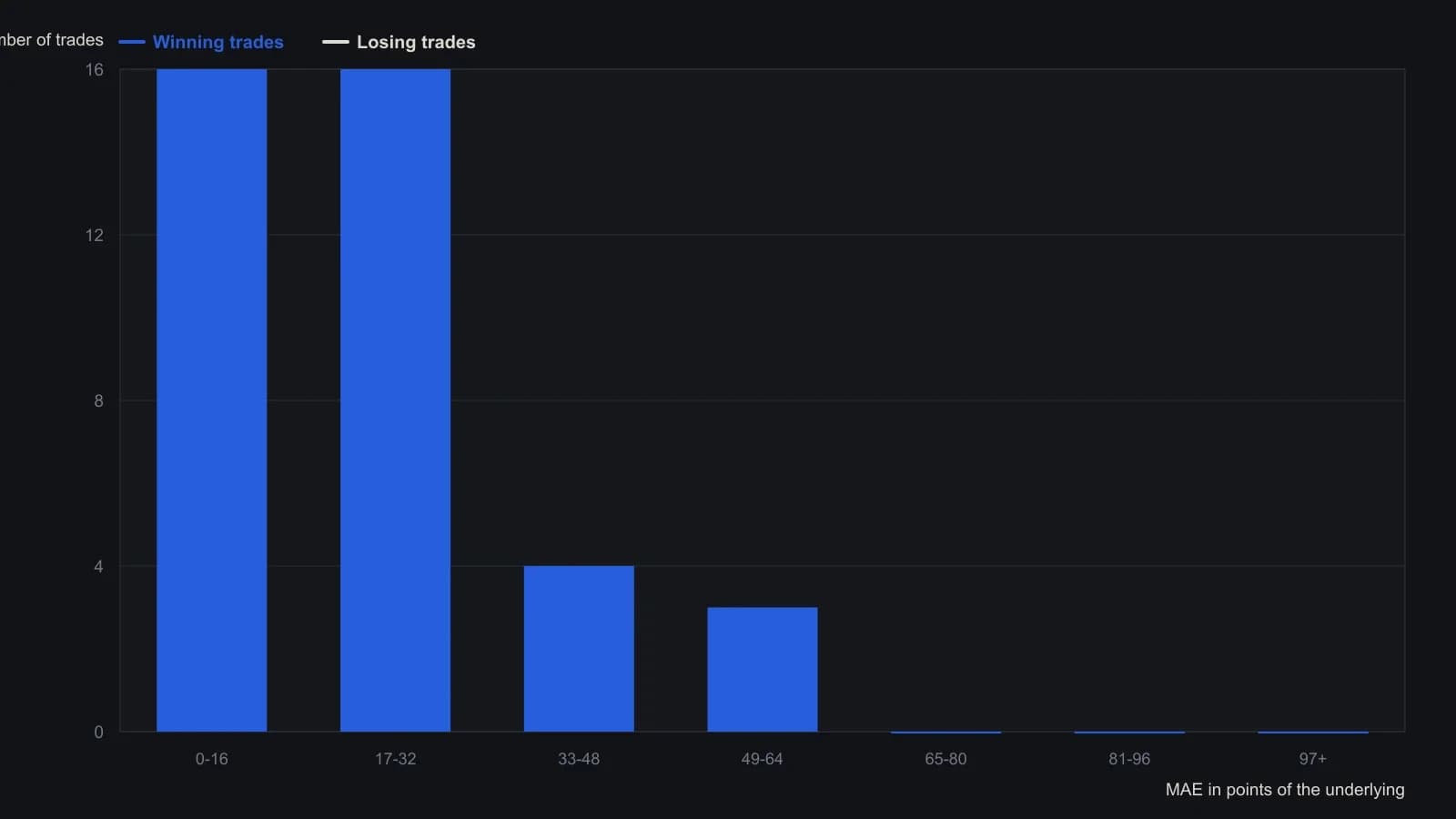
The author warns MAE is likely overstated because the study had daily data only, not intraday. Printed bar heights are approximate integer counts and may be off by one trade in a bin; digitized winning bars sum to 39 versus the stated 37 wins.
Price stops on the reversing trade
A stop-loss is a pre-set price limit that ends or flips a position once adverse movement reaches a chosen distance. Here it was examined on the reverse at 32, 48, or 64 points.
On reversing trades in Treasury bond futures, the maximum-adverse-excursion profile of winners and losers supported considering price stops at 32, 48, or 64 points. The write-up stated that reversing-trade losses could be cut anywhere above 32 points while still keeping most eventual winners.
A short time stop for the reverse
A time stop is a rule that closes the reversed exposure after a fixed number of sessions instead of waiting for the original trade horizon to expire. Reversing trades were observed to become profitable quickly, usually within two days.
In the time-stop test, an entry-day exit was only marginally profitable. Waiting one extra day built a clearer result. Waiting two days improved overall profitability by another 50 percent, and further days added little.
Reversals still open after 20 to 25 days were not observed to become large winners, and beyond about 10 days a later winner could not be distinguished from a later loser in advance.
All readings on this track · 15 readings
- 1987Evaluating a black-box pyramiding routine with adverse excursion
- 1991Set the first stop from a capital-scaled MAE histogram
- 1991Opening gap fades bounded by excursion and time stops
- 1991Stop bounds versus added system parameters
- 1991Bound losses with MAE, stops, and drawdown limits
- 1992Multi-year evaluation of MAE-bounded mechanical rules
- 1992Moving-average add-ons could not be separated by maximum adverse excursion
- 1992Evaluating maximum-adverse-excursion stop reversals with short time stops
- 1992Failed range trades as breakout-system tests
- 1998Fitted moving averages for trend add-on entries
- 1998Monthly changer rules specified as one mechanical procedure
- 2002An excursion cutoff test for stops and profit exits
- 2006Constructing peak-excursion filters for stops and size
- 2006Cost-aware excursion filters for stops and holding period
- 2017Staged stops, drawdown limits, and mechanical risk survival